Key takeaways
- New FCC rules on opting out of calls and texts take effect on November 25, 2026. The FCC adopted them on September 30 and published them in the Federal Register on October 26.
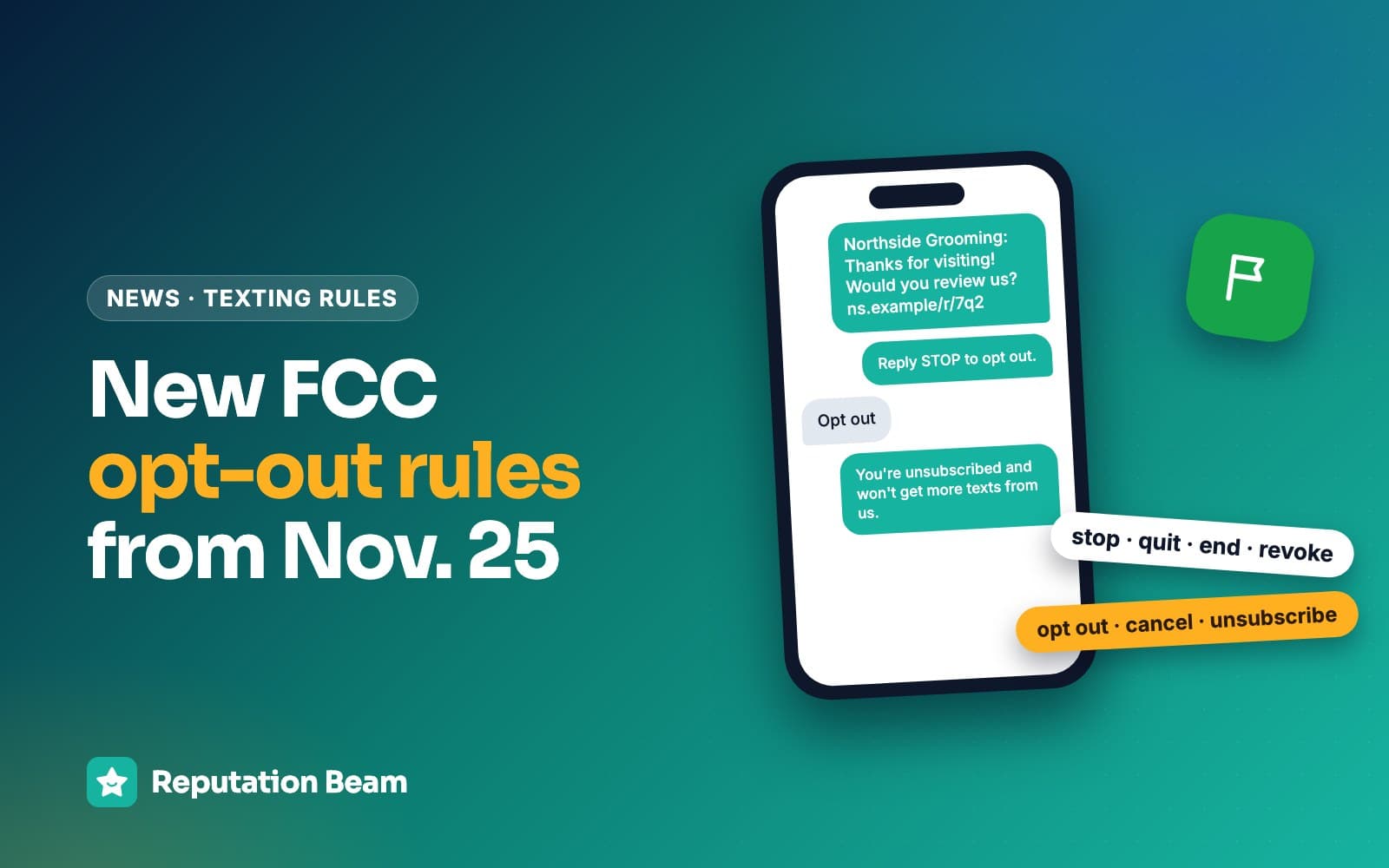
- A business may make a reply with one of seven words (stop, quit, end, revoke, opt out, cancel, unsubscribe) its exclusive opt-out method, as long as every text names one of the words and all seven work.
- An opt-out from an informational text may be limited to that kind of text. An opt-out from a marketing text still ends all marketing texts. The ten-business-day limit stays.
- The FCC is also asking whether to shorten that limit and require two-way texting. Comments are due November 25 and reply comments December 28.
In this post
On October 26, 2026, the FCC published new rules on opting out of calls and texts in the Federal Register. They take effect on November 25, 2026, and they change how a business that texts its customers, for appointment reminders or review requests, can handle STOP replies. The FCC adopted them on September 30 in order FCC 26-67, and in the same order it asked for comments on further changes.
Below: what changed, what it means if you text customers for reviews, a checklist for before November 25, and what the FCC is still deciding. This is general information, not legal advice. For a firm answer about your business, ask a lawyer who knows the TCPA.
What the FCC changed
The opt-out changes rewrite paragraphs (a)(10) to (a)(12) of 47 CFR 64.1200, the FCC's rule on automated calls and texts. The FCC treats a text sent through an automated system as a call under these rules, so they reach texting tools; our guide to texting customers for reviews explains why.
| Through November 24, 2026 | From November 25, 2026 | |
|---|---|---|
| How customers opt out | Any reasonable way | Any reasonable way, unless you designate an exclusive method and disclose it |
| The seven standard words | Count as opt-outs | Still count; if replies are your exclusive method, every one must work |
| What an opt-out covers | The 2024 "revoke all" requirement was not yet in force | From an informational text, possibly just that category; from a marketing text, all your marketing |
| Deadline to honor it | At most ten business days | At most ten business days |
| Confirmation text | One text, no marketing, and the only message after the opt-out | No marketing; the "one-time" and "only message" wording is gone |
The biggest change is the exclusive method. A business may designate one or more of three ways for people to opt out: a key press or voice option on a call; a reply text with one of the standard words "stop," "quit," "end," "revoke," "opt out," "cancel" or "unsubscribe"; or a website or phone number it designates. It must "clearly and conspicuously disclose" the method on the call or in the text. For texts, naming at least one of the seven words in each message is enough, "so long as the text sender recognizes the use of any of the standardized words as a valid revocation request." A business that designates an exclusive method "is not required to process revocation requests made by any other means." One that doesn't must keep honoring requests made "by any reasonable means."
The second change is scope. An opt-out sent in reply to an informational text, meaning one with no advertising or telemarketing in it, may be treated as covering only that category of informational texts. An opt-out sent in reply to a text that advertises or counts as telemarketing ends consent to all future marketing calls and texts from that sender.
The new rule also replaces the "revoke all" requirement from 2024, under which one opt-out would have ended every robocall and robotext from a sender. Its start had been delayed to January 31, 2027, and the FCC says the new rule will "supersede the delayed effective date." A confirmation text sent within five minutes of an opt-out is still presumed to be allowed, as long as it only confirms the opt-out and has no marketing in it.
September 30, 2026
The FCC adopts order FCC 26-67: the new opt-out rules and a proposal for more changes.
October 26, 2026
Both are published in the Federal Register, which starts the clock.
November 25, 2026
The new rules take effect. Comments on the proposal are due the same day.
December 28, 2026
Reply comments on the proposal are due.
January 31, 2027
The date the 2024 "revoke all" requirement was due to start. The new rule replaces it.
What it means if you text customers for reviews
Many review texts already end with "Reply STOP to opt out." That line names one of the seven words, which is the disclosure the rule asks of a business that uses replies as its exclusive method. Two things decide whether you can rely on it:
- Your texting system has to treat all seven words as opt-outs, including the less common "revoke" and "opt out." Carrier guidelines also ask that small differences in capitals and punctuation not matter, so "Stop." and "Opt-out" should work too.
- You should decide that a reply text is how customers opt out, and write it down so your staff give the same answer.
What about a customer who writes "please stop texting me"? With an exclusive method in place, the rule says you don't have to process requests made by other means, but it doesn't say how to treat a sentence that contains one of the words. The Messaging Principles and Best Practices of CTIA, the wireless industry's trade group, ask senders to support opting out by phone call, email or text, and to read and act on plain-language requests like that one. A customer who asked you to stop and then gets another review request is also likely to report your number as spam. The habit stays the same: treat any clear no as an opt-out.
The narrower scope helps only with informational texts, and whether a review request is informational or marketing is still unsettled; the texting guide lays out both sides. If you send appointment reminders and review requests, the new rule may let you keep sending reminders to someone who opted out of review texts, provided both are informational and you treat them as separate categories. That's a judgment to make with a lawyer. Until you have an answer, the simplest policy is that an opt-out stops every text to that number.
What to do before November 25
Opt-outs, ready for November 25
0 of 7 done
Template: a review text that names the opt-out word
Hi [First name], it's [Business name]. Thanks for coming in. Would you leave us a quick review? [review link] Reply STOP to opt out.
What the FCC is still deciding
In the same order, the FCC proposed further changes and asked for comments on whether to:
- shorten the ten-business-day limit for honoring an opt-out (a joint letter it cites suggests seven business days);
- drop the option of texting from a number that can't take replies, which would make two-way texting a requirement, or keep one-way texting for informational texts and require two-way texting only for marketing;
- require a "revoke all" method, a way to opt out of everything from a sender at once;
- set how an opt-out applies to affiliates, separate lines of business and divisions of a company.
Comments are due November 25, 2026, and reply comments December 28, 2026, in CG Docket No. 02-278. Interested parties, small businesses included, can file through the FCC's Electronic Comment Filing System or on paper. None of this is a rule yet; any change would come in a later order.
Where Reputation Beam fits
Reputation Beam's default review text ends with "Reply STOP to opt out." A reply that is one of the FCC's seven words, in capitals or not and with or without punctuation, marks the customer opted out and stops further texts to them, and you're notified if you've turned on opt-out notifications in Settings. Replying START opts them back in. It can't decide for you whether your review texts are informational or marketing, so that question stays with you and your lawyer.
Keep going
Texting customers for reviews covers consent, opt-out replies, sending hours and 10DLC registration in full, with texts to copy for many kinds of business. For the request itself, how to ask customers for reviews has wording for the counter, email and receipts. Registration itself is covered in what is 10DLC.
Questions people ask
When do the FCC's new opt-out rules take effect?
On November 25, 2026. The FCC adopted them on September 30, 2026 in order FCC 26-67 and published them in the Federal Register on October 26, 2026, and they take effect 30 days after publication. Through November 24 the current rule applies: customers can opt out in any reasonable way, and you have at most ten business days to honor it.
Do I still have to honor a text like "please stop texting me"?
The new rule says a business that designates an exclusive opt-out method and discloses it doesn't have to process requests made by other means. It doesn't say how to treat a sentence that contains one of the standard words. Without an exclusive method, any reasonable request still counts, and the carrier guidelines ask senders to act on plain-language requests. The safe habit is to treat any clear request to stop as an opt-out.
Is a review request an informational text or a marketing text?
The new rules don't say, and it's a gray area. A plain request asks for no purchase, which points toward informational, but a review helps sell your business, and an added coupon or "book again" line moves a text toward marketing. It matters because only an opt-out from an informational text can be limited to that kind of text. For a firm answer about your texts, ask a lawyer.
How long do I have to honor a STOP reply?
At most ten business days, under both the current rule and the new one. The FCC is asking whether to shorten that limit, and a joint letter it cites suggests seven business days. Texting systems can act on a STOP reply automatically, and acting the same day is the habit to keep, whatever the limit ends up being.
Was this guide helpful?
Get the free review request checklist and new guides
Twenty checks to run before you ask customers for reviews, as a one-page PDF. After that, a short email when new guides go up, at most once a week.