Key takeaways
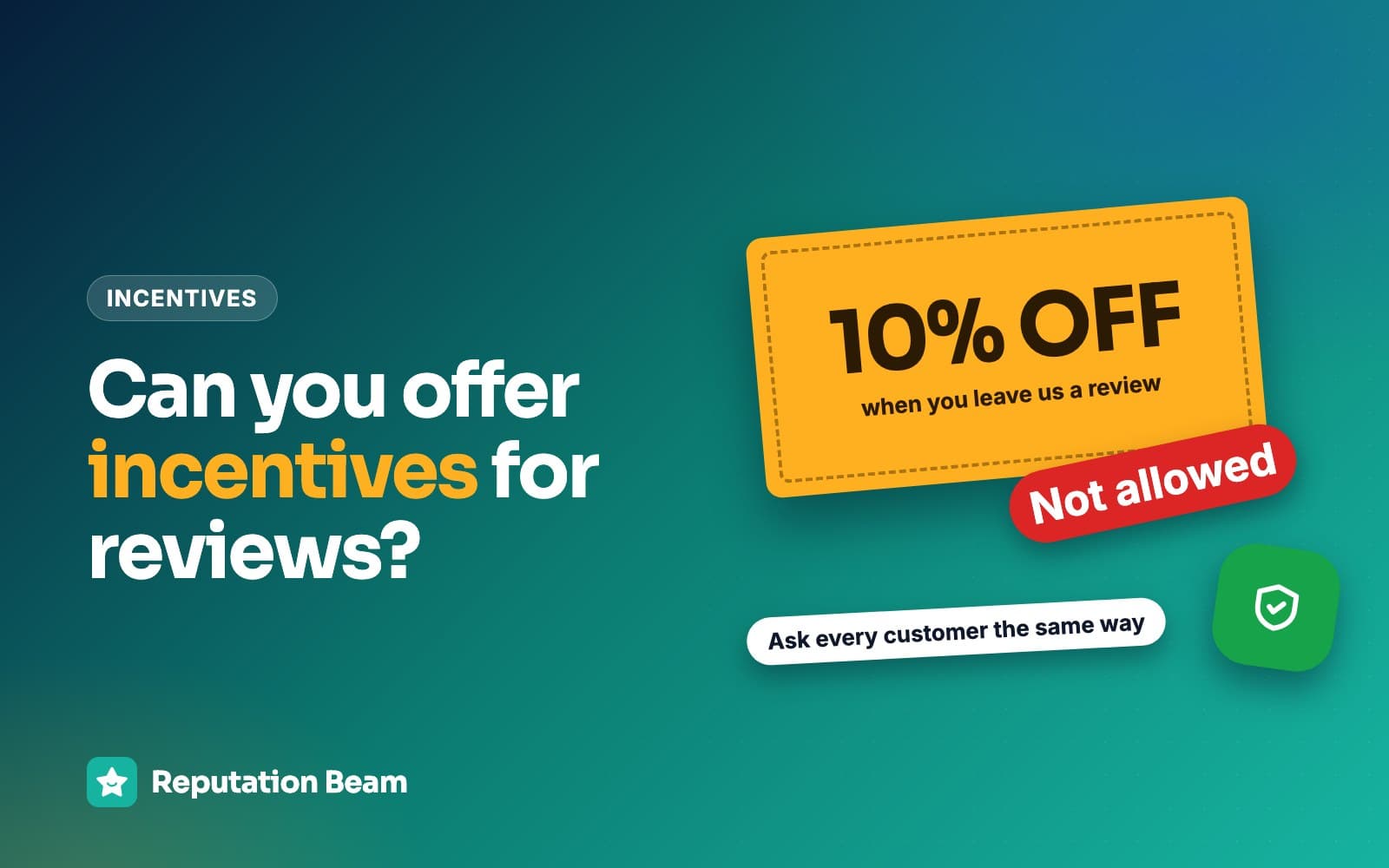
- No. Google prohibits offering payment, discounts, free goods or services in exchange for any review, positive or negative, or for changing a review or removing a negative one.
- Yelp says businesses should never ask customers to write reviews, and its support article tells businesses not to offer freebies, discounts or payment in exchange for them.
- The FTC's rule bans incentives tied to positive or negative reviews and counts contest entries as something of value. It is narrower than Google's policy, so it gives you no permission on Google.
- Ask every customer the same way, make the review link one tap away, and thank customers whether or not they review.
In this guide
- Can you offer incentives for Google reviews?
- What Google, Yelp and the FTC say about review incentives
- Is it illegal to pay customers for reviews?
- Which review incentives are off limits? Everyday cases
- Where popular advice on review incentives goes wrong
- What happens if you offer incentives for reviews
- How to get Google reviews without incentives
- How to thank customers without breaking the rules
- Common mistakes with review incentives
- Checklist: audit your review requests for incentives
- Where Reputation Beam fits
- Keep going
A sign by the register that says "$5 off when you review us" looks like harmless marketing. So does a monthly prize draw for everyone who leaves a review, or a free cookie for showing the barista your post. Owners ask about all of these, and the question is always the same: can you offer incentives for Google reviews?
No. Google bans offering anything of value for a review, whatever the review says, and that includes discounts, free items, prize entries and refunds for taking a review down. This guide quotes the exact wording from Google, Yelp and the FTC, goes through the everyday incentives owners ask about one at a time, and gives you signs, texts and scripts that ask for reviews the honest way. For the full ask in person, by text and by email, see how to ask customers for reviews.
This is general information about the rules as of October 2026, not legal advice. Platform policies change and state laws differ, so check anything that matters with a lawyer.
Can you offer incentives for Google reviews?
No. Google does not allow businesses to offer incentives "such as payment, discounts, free goods and/or services" in exchange for posting any review, or for revising or removing a negative one. It makes no difference whether the review is positive, negative or "honest," or how small the reward is. Reviews posted because of an incentive are removed.
That rule comes from Google's Maps user contributed content policy, which covers reviews on Google Maps. Google's tips for getting more reviews repeat it for business owners: offering incentives, "like free or discounted goods or services," to post, change or remove reviews "is considered fake & misleading content and is strictly prohibited."
What Google does allow is asking. The same policy says merchants may "solicit or encourage the posting of content that does represent a genuine experience," as long as they do it "without offering incentives to do so or attempting to influence the rating or the contents of the review." So the honest version of every incentive in this guide comes out the same way: ask, make it easy, and give nothing in return for the review.
What Google, Yelp and the FTC say about review incentives
Three sets of rules apply, and they don't say the same thing. Google and Yelp are private platforms that decide which reviews they publish. The FTC enforces federal law. Here is each one in its own words.
| Who | What it says about incentives | Where it applies |
|---|---|---|
| Don't offer incentives "in exchange for posting any review or revision or removal of a negative review" | Reviews on Google Maps (also shown in Search) | |
| Yelp | "Don't offer freebies, discounts, or payment in exchange for reviews," and don't ask for reviews at all | Reviews on Yelp |
| FTC (16 CFR 465.4) | Illegal to give incentives for reviews "expressing a particular sentiment, whether positive or negative" | Review sites, and reviews on your own site |
Google: no incentive for any review
Google's policy lists offering incentives among the things merchants may not do, and the same list has two more rules that matter here. Merchants may not "discourage or prohibit negative reviews, or selectively solicit positive reviews from customers." And "when soliciting reviews, merchants should not require or pressure users to leave ratings or write reviews while on the premises, nor should they request that specific content be included."
The examples of incentives in the policy follow the words "such as," so the list is open. The cautious reading is that a prize entry, loyalty points or a gift card is covered just as a discount is. Google also removes content "posted due to an incentive offered by a business," so an incentive costs you the reviews it produced.
Yelp: don't ask, and don't offer anything
Yelp is stricter about asking. Its content guidelines say: "Businesses should never ask customers to write reviews." Its support article Don't Ask for Reviews tells businesses not to ask "customers, mailing list subscribers, friends, family," says "your staff should never compete to collect reviews," and adds: "Don't offer freebies, discounts, or payment in exchange for reviews." The same article says that doing so "may also be illegal" and that "you can't offer incentives for users to remove reviews."
On Yelp, then, there is no compliant way to offer anything, because there is no compliant way to ask. Point your review requests at Google and leave Yelp out of them.
The FTC: no incentive tied to a positive or negative review
The FTC's Rule on the Use of Consumer Reviews and Testimonials, which the FTC says went into effect on October 21, 2024, makes it a violation for a business "to provide compensation or other incentives in exchange for, or conditioned expressly or by implication on, the writing or creation of consumer reviews expressing a particular sentiment, whether positive or negative" (16 CFR 465.4).
The rule's definitions show how wide "something of value" can be. To "purchase a consumer review" means "to provide something of value, such as money, gift certificates, products, services, discounts, coupons, contest entries, or another review, in exchange for a consumer review" (16 CFR 465.1). A raffle or prize-draw entry is a contest entry.
The words "by implication" matter as well. The FTC's questions and answers on the rule say you "can't suggest to consumers that their reviews must be positive (or negative)" to get a promised incentive, "even if you don't say so explicitly." Its example is a prize offer that asks people to tell their friends "about all the fun you had."
Is it illegal to pay customers for reviews?
Under federal law, paying for reviews that must be positive (or negative) is illegal, and so is writing or buying fake reviews. The FTC's rule doesn't ban an incentive for an honest review of any kind, though the FTC warns that failing to disclose it could violate the FTC Act. On Google, any payment for a review breaks the policy.
Here is how the federal pieces fit together.
- Incentives tied to sentiment are illegal. The FTC's Q&A asks "Can my business pay incentives for 5-star reviews on third-party review platforms, so long as we ask the reviewers to add a disclosure about the incentive?" and answers "No. That conduct would violate Section 465.4."
- Fake reviews are illegal. The rule bans writing, creating or selling reviews that misrepresent whether the reviewer exists, whether they used the business, or what their experience was (16 CFR 465.2).
- Other incentives need disclosing. The Q&A points to the FTC's Endorsement Guides, which say a material connection can include "monetary payment or the provision of free or discounted products" and "the possibility of being paid, of winning a prize" (16 CFR 255.5). The Guides' own example of paid reviews says a resulting review "that fails to clearly and conspicuously disclose the incentives provided to that reviewer is likely deceptive."
- Paying to remove a review is risky. The Q&A says the rule doesn't prohibit it, "but paying consumers to change or remove truthful negative reviews may violate the FTC Act."
The FTC says the rule "authorizes courts to impose civil penalties for knowing violations." State consumer protection laws can apply too, and they differ from state to state. The Endorsement Guides add one more catch: even disclosed incentivized reviews "could still be deceptive" if including them "materially increases" an average star rating.
For a local business, the plain way out is to offer nothing for reviews anywhere. The FTC fake review rule covers the rest of the federal rule.
What about reviews on other sites or your own website?
Other platforms set their own rules. The FTC's guide for marketers says some "may allow incentivized reviews with an appropriate disclosure," while others prohibit reviews from people "who got an incentive for the reviews." Wherever an incentive is allowed, the FTC's advice is not to condition it on a positive review, and that "the review should disclose the incentive." One rule for every site is simpler: no incentives.
Which review incentives are off limits? Everyday cases
Most owners don't set out to buy reviews. They print a coupon, run a contest or reward a hard-working tech, and the incentive creeps in. Here are the cases that come up most.
| What you might offer | Yelp | FTC rule | |
|---|---|---|---|
| A discount or coupon for a review | Prohibited | Prohibited | Illegal if tied to a positive review |
| A raffle or prize entry for reviewers | Prohibited | Prohibited | Contest entries count as value |
| Loyalty points for a review | Prohibited | Prohibited | Illegal if tied to a positive review |
| A free dessert, drink or add-on | Prohibited | Prohibited | Illegal if tied to a positive review |
| A refund or credit to change or remove a review | Prohibited | Prohibited | May violate the FTC Act |
| Bonuses or quotas for staff | Quotas not allowed | Staff must not compete | Not addressed directly |
| A charity donation per review | Treat as an incentive | Treat as an incentive | Not named |
In the FTC column, an incentive that isn't tied to praise still needs disclosing, as explained above. On Google and Yelp, disclosure doesn't help, because the incentive itself is what's banned.
Can you give discounts for Google reviews?
No. Made-up example: a pizza shop prints "Review us on Google, get $5 off your next order" on every box. That's a discount in exchange for a review, and discounts are named in Google's policy. Adding "good or bad, we want your honest opinion" changes nothing, because the ban covers "any review."
Here is a sign that breaks several rules at once, taken apart.
- 1
Love us? Leave a 5-star review
Asking for the rating you want
Google allows asking only without 'attempting to influence the rating.' Tied to a reward, a five-star request is also what the FTC rule bans.
- 2
on Google or Yelp
Naming Yelp
Yelp's guidelines say businesses should never ask customers to write reviews.
- 3
right here at the counter
Asking on the spot
Google says merchants should not require or pressure customers to write reviews while on the premises.
- 4
and get $5 off today.
The incentive
A discount in exchange for a review. Google names discounts among the incentives it prohibits.
The fix keeps the ask and drops everything else: "Tell people what you thought on Google. Scan here." That line fits on the same pizza box.
Google review giveaways, raffles and prize draws
Made-up example: a gym posts "Every member who reviews us this month is entered to win a free year." A chance to win is an incentive. The FTC's definition of buying a review lists "contest entries" next to money and coupons, and the Endorsement Guides say a material connection can include "the possibility of being paid, of winning a prize." On Google, a prize draw for reviewers is an incentive for posting a review, however the winner is picked.
You can still run a giveaway. Base entry on something that has nothing to do with reviews, such as every member who checks in during March, and keep reviews out of it completely: not in the rules, not in the announcement, and not in the same message. Contest and sweepstakes laws differ from state to state, so have someone check the rules of any giveaway before you run it.
Loyalty points or punch-card stamps for a review
Made-up example: a car wash app gives 200 bonus points for a Google review. Points have value, so this works the same as a discount. Points for visits, purchases or referrals are fine as long as a review earns nothing.
A free dessert, drink or add-on
Made-up example: a cafe hands a free cookie to anyone who reviews while they wait, or a nail salon offers free nail art to clients who post. "Free goods and/or services" are in Google's own wording, and the policy sets no minimum value. A small freebie is treated like a large one.
A refund or credit for removing or changing a review
Made-up example: a moving company's customer posts a one-star review about a scratched table, and the owner offers to pay for the repair "if you take the review down." Google and Yelp both prohibit incentives for removing reviews, and the FTC warns it may violate the FTC Act, as quoted above.
Pay for the repair anyway, because the table was scratched, and never make the review part of the deal. Google's tips page says that following up on concerns "may even encourage the customer to update their review," and whether they do is up to them. How to respond to negative reviews covers the public reply, and how to remove a Google review covers reviews that break Google's rules.
Staff bonuses and review contests
Made-up example: an HVAC company pays technicians $10 for every review that mentions them by name and posts a monthly leaderboard. Among the things Google's policy says merchants may not do are "merchants requesting that staff solicit a certain number of reviews" and "merchants requesting that staff solicit reviews that include specific content," which it says includes "content that identifies a staff member." Yelp says "your staff should never compete to collect reviews."
Per-review bonuses push staff toward quotas and toward asking only the customers who seem happy. To reward your team, reward the work customers see, such as on-time arrivals, fewer callbacks and clean job sites, and make asking every customer part of the job. Google's review policy goes through the staff rules in full, and can employees leave Google reviews covers your team's own reviews.
Donating to charity for every review
Made-up example: a bakery promises to give $1 to the local food bank for each Google review in December. Neither Google, Yelp nor the FTC rule names donations, but Google's wording is broad: incentives "such as" payment and discounts, offered "in exchange for posting any review." A donation that happens only when someone posts a review is offered in exchange for it. Treat it as an incentive. Give to the food bank anyway, and tell customers you did.
A thank-you gift after the review appears
Made-up example: a dog groomer quietly sends a gift card to every client whose review shows up. Nothing was promised, so it can look safe. Once clients learn that reviewers get gift cards, the gift works as an offer, and Google bans incentives for any review. On disclosure, the FTC's Endorsement Guides likewise say material connections can include free or discounted products "regardless of whether the advertiser requires an endorsement in return." Thank every client, whether they review or not.
Where popular advice on review incentives goes wrong
Several pages that rank for this question suggest workarounds. Four come up often, and each one fails at least one of the rules above.
Myth
Reward every review, good or bad
That's part of the FTC's test. Google bans incentives for "any review," so it's still prohibited there.
Myth
Incentives are fine with a disclosure
Google's policy has no disclosure exception, and Yelp bans incentives outright.
Myth
Reward staff instead of customers
Google doesn't allow staff quotas for reviews, and Yelp says staff should never compete to collect them.
Myth
A prize draw isn't payment
The FTC lists contest entries alongside money and coupons, and on Google a chance to win is an incentive.
What happens if you offer incentives for reviews
Google can remove the reviews, and it can go further. Its page on Business Profile restrictions says businesses that violate its fake engagement policy "may be subject to certain restrictions," in addition to "removing the violative reviews." Google calls its examples not exhaustive and doesn't say how long a restriction lasts.
When Google finds them
The incentivized reviews are removed. Google's policy says incentivized reviews 'are not allowed and will be removed from Maps.'
Before a restriction
Google says it will 'notify business owners via email if we plan to apply a restriction to their profile.'
During a restriction
For a set period, the profile may be unable to receive new reviews or ratings, its existing reviews may be unpublished, or it may display a warning that fake reviews were removed.
Afterward
Businesses can appeal. Google says it will re-review the profile and any additional context the business provides.
Yelp's support article says it has a Consumer Alerts program that "publishes a pop-up alert on business pages to let people know when we learn about this sort of activity." On the federal side, the FTC says courts can impose civil penalties for knowing violations of its rule.
The evidence can be public too. A customer who got a discount may say so in the review itself, and if Google does add a warning to your profile, anyone who views the profile can see it.
How to get Google reviews without incentives
Ask every customer the same way, make the review one tap away, and ask while the visit is fresh. A personal, well-timed ask does what an incentive was meant to do: it reminds people, and it makes their minute feel worthwhile.
- 1
Ask everyone
The same request after every paid visit or finished job, so nobody decides who gets asked.
- 2
Make it one tap
Your direct Google review link in texts and emails, and a QR code on signs and receipts.
- 3
Ask while it's fresh
Mention it at the end of the visit, then send a text or email the same day, with no pressure to post on the spot.
- 4
Thank everyone
Reply to reviews, and thank customers for their business whether or not they review.
Asking everyone is a rule as well as a habit. Google's policy says merchants may not "selectively solicit positive reviews from customers," and the FTC's guide for marketers says: "Don't ask for reviews only from customers you think will leave positive ones." Get your Google review link and print a Google review QR code so the ask takes seconds, and see the best time to ask for a review for timing by type of business.
Here are the pieces most businesses need, all made-up templates to adapt.
Template: counter sign (replaces an incentive sign)
Tell us how we did on Google.
Scan the code or visit [review link]. Thank you for choosing [Business name].
Template: review request text
Hi [First name], it's [Business name]. Thanks for coming in today. Would you leave us an honest review on Google? [review link] Reply STOP to opt out.
Template: review request email
- To
- [Customer email]
- Subject
- Thanks from [Business name]
Hi [First name],
Thank you for choosing [Business name] for [the job or visit]. If you have a minute, we'd be grateful for an honest review on Google. It helps people nearby decide whether we're the right fit.
[review link]
Thanks again, [Your name], [Business name]
Sooner or later a customer will ask what they get for a review. Have the answer ready.
Customer
Do I get a discount if I leave you a review?
You
We don't offer anything for reviews. Google doesn't allow it, and we'd rather hear what you really think.
Customer
Fair enough.
You
If you have a minute later, the link's on your receipt. Thanks for coming in today.
Template: receipt or invoice line
Thank you for choosing [Business name]. We'd value your honest review on Google: [review link]
If your current materials include an offer, the rewrite is usually a matter of deleting words.
Before
Leave us a Google review and get a free coffee on your next visit.
After
Thanks for stopping by. If you have a minute, an honest Google review helps people find us: [review link]
Cafe. The offer is gone and the ask stays.
Before
Review us this month for a chance to win a free full detail.
After
Thanks for trusting us with your car. Would you share an honest review of your visit? [review link]
Auto detailing. No contest, no deadline.
Before
Text us a screenshot of your 5-star review for $20 off your next cleaning.
After
Hi [First name], thanks for having our team out today. A short, honest review would mean a lot: [review link]
House cleaning. The star count, the proof and the discount all go.
Before
Post a review before you leave and your next adjustment is $10 off.
After
Thank you for coming in today. If you're willing, we'd value a review on Google: [review link]
Chiropractic office. No discount, no pressure to review on the spot, and nothing about the visit itself.
For more wording, review request email templates has emails for many trades, and texting customers for reviews covers consent and opt-outs before you send a single text.
How to thank customers without breaking the rules
Thanking customers is good business. The line to hold is simple: thanks go to everyone, and nobody gets more for reviewing.
Vet clinics, groomers
Thank everyone the same way
A handwritten card to every new client after the first visit, sent whether or not they ever review.
Barbers, car washes, gyms
Reward visits
A punch card or points for visits and purchases, with no bonus for a review.
Any business
Reply to reviews
A short, specific public thank-you to every reviewer, with no deal attached.
Plumbers, HVAC, electricians
Follow up on the job
A call a week after an install to check that everything works. It earns goodwill without asking for anything.
Cafes, bakeries
Surprise everyone
A free coffee for everyone on a rainy Monday, announced to whoever walks in.
Any business
Give back
Sponsor a team or donate to a cause because you want to, without counting reviews to decide how much.
Your public replies are a thank-you too. Google's tips page says to "avoid using your response to offer deals or promotions," so keep replies to thanks and a specific detail. How to respond to positive reviews has more examples.
Priya N.
GoogleBooked a last-minute cut and they fit me in. Great fade, and the shop was spotless.
Reply from Corner Cut Barbers
Thanks, Priya. Glad we could squeeze you in on short notice, and we'll pass the compliment on to the team. See you next time. Marcus, Corner Cut Barbers
Common mistakes with review incentives
Do
- Ask every customer for an honest Google review, the same way
- Use your direct review link and a QR code
- Fix problems because they're problems, with no strings attached
- Reward staff for the service customers see
- Thank every customer, reviewer or not
- Run giveaways that have nothing to do with reviews
- Point review requests at Google and leave Yelp out
Avoid
- A discount, freebie or prize entry for a review
- Asking for five stars or for specific wording
- Asking customers to review on the spot and show you
- A refund or credit in exchange for removing a review
- Per-review bonuses, quotas or staff leaderboards
- Gift cards for reviewers after the fact
- A coupon in the same message as the review request
A table tent from two years ago, an email footer or a habit a staff member brought from a previous job can carry an incentive long after you stopped offering one. Search your signs, website and templates for phrases like these.
Phrases to delete from signs, receipts and messages
- for a chance to win
- get $5 off
- free gift with your review
- show us your review
- bonus points for reviews
- 5-star review
- entered into our draw
- we'll donate for every review
- take it down and we'll refund you
Checklist: audit your review requests for incentives
Incentive audit
0 of 10 done
Where Reputation Beam fits
Reputation Beam sends review requests by text message and email from your dashboard. Message templates use placeholders for the customer's name, your business name and the review link, and each request carries its own link that expires after 72 hours. What the message says is up to you, so the rules in this guide still apply: no offers, no star counts, and the same request for every customer. Google and Yelp reviews show up together in one feed, and you can reply to Google reviews from the dashboard.
Keep going
For scripts, texts and emails that ask without offering anything, read how to ask customers for reviews. When you want more volume, how to get more Google reviews builds on the same honest ask. Google's review policy covers the rest of what businesses can and can't do on Google, and the FTC fake review rule explains the federal rules on fake, insider and suppressed reviews. If you want to thank customers who send you new business, how to ask for referrals explains how to keep a referral program separate from reviews.
Questions people ask
Can you give discounts for Google reviews?
No. Google's policy prohibits offering incentives 'such as payment, discounts, free goods and/or services' in exchange for posting any review, and that includes a discount for an honest or a negative review. Google's tips page calls it 'fake & misleading content' that is 'strictly prohibited.' Reviews posted because of a discount can be removed, and the profile can be restricted. Ask for an honest review with nothing attached instead.
Is it illegal to pay customers for reviews?
Under the FTC's rule, it's illegal to give compensation or other incentives for reviews that must express a particular sentiment, positive or negative, and to write or buy fake reviews. The rule itself doesn't ban an incentive for any honest review, though the FTC says failing to disclose an incentive could violate the FTC Act. Google bans paying for reviews in every form. This is general information, not legal advice.
Can I run a Google review giveaway?
Not one that rewards reviews. Entering reviewers into a raffle or prize draw is an incentive, which Google prohibits for any review, and the FTC's definition of buying a review lists contest entries alongside money and coupons. You can run a giveaway whose entry has nothing to do with reviews, such as everyone who books in a given month, as long as reviews aren't mentioned in the rules or the announcement.
Can I reward employees for getting Google reviews?
Be careful. Google's policy lists merchants asking staff to solicit 'a certain number of reviews,' or reviews that identify a staff member, among the things merchants may not do, and Yelp says staff should never compete to collect reviews. Per-review bonuses and leaderboards run into both. Reward the service customers notice instead, and make asking every customer the same way part of everyone's job.
Can I offer a refund if a customer deletes a bad review?
No. Google prohibits incentives for the revision or removal of a negative review, Yelp says businesses can't offer incentives for users to remove reviews, and the FTC's staff guidance says paying people to change or remove truthful negative reviews may violate the FTC Act. Fix the problem on its own merits, with no mention of the review, and reply to the review publicly and calmly.
What happens if Google catches you offering incentives for reviews?
Google removes incentivized reviews. Its page on Business Profile restrictions says a business that breaks its fake engagement policy may also be restricted for a set period: the profile may be unable to receive new reviews, its existing reviews may be unpublished, or it may show a warning that fake reviews were removed. Google says it emails owners before applying a restriction and that decisions can be appealed.
Can I donate to charity for every review?
Neither Google nor Yelp names charity donations, but Google bans incentives offered 'in exchange for posting any review,' and a donation that happens only when someone posts a review is offered in exchange for one. The cautious choice is to treat it as an incentive. Make the donation anyway, without counting reviews, and tell customers about it if you like.
Was this guide helpful?
Get the free review request checklist and new guides
Twenty checks to run before you ask customers for reviews, as a one-page PDF. After that, a short email when new guides go up, at most once a week.