Key takeaways
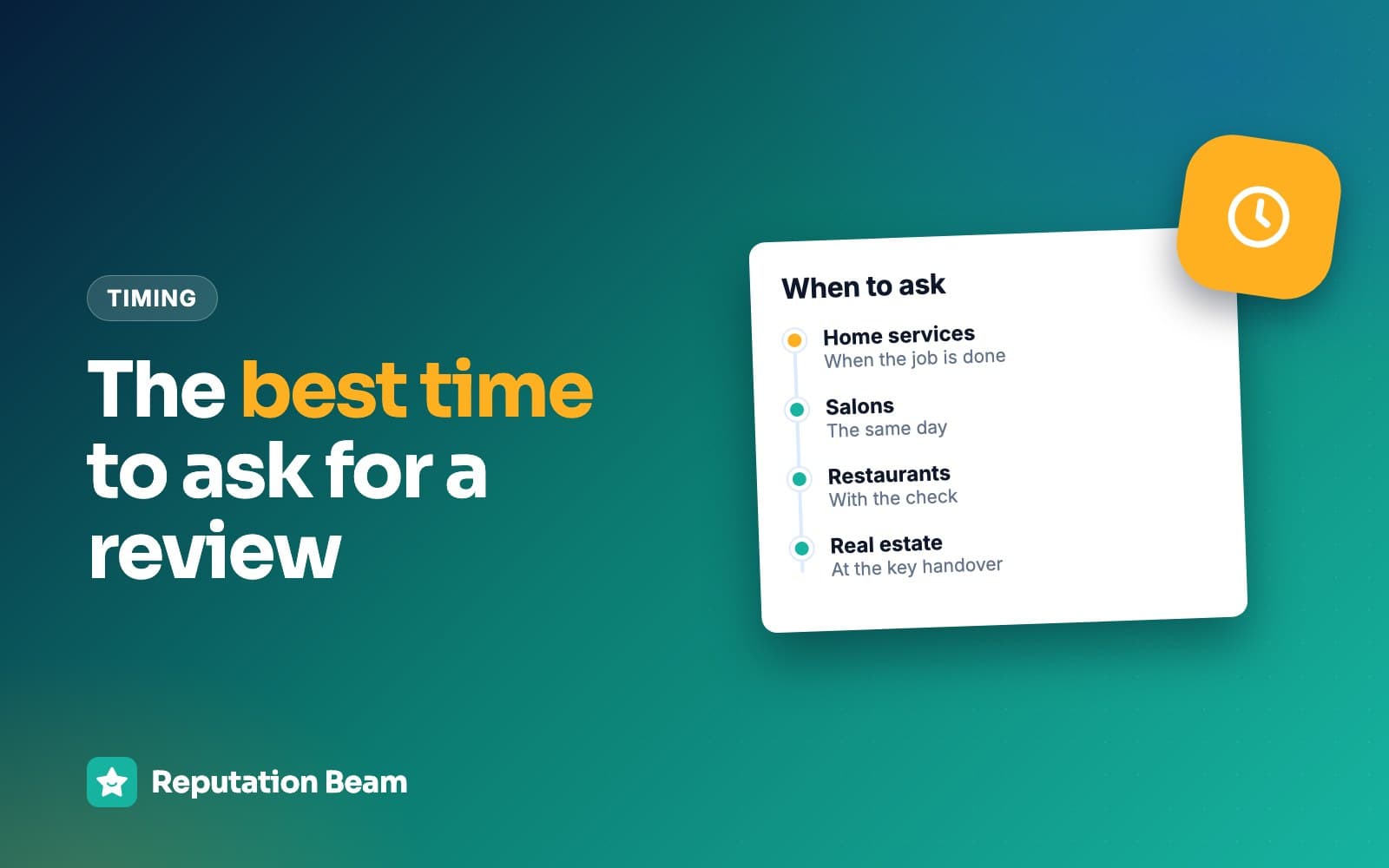
- Ask as soon as the customer can judge the finished result: the same day for a repair, a haircut or a meal, and at the milestone that ends the job for roofs, care plans, home sales and legal matters.
- Tie each request to an event in your records, such as a paid invoice, a checkout, a closing or a filed return, so every customer is asked at the same point.
- Send one follow-up at most, two or three days later for quick jobs and about a week later for big ones, then stop.
- Send texts in daytime hours in the customer's time zone. A job that ends late at night gets its request the next morning.
In this guide
- The best time to ask for a review, in one rule
- How to find the right moment for your business
- When to ask for a review: timing by type of business
- How long after service to ask for a review
- Timing for long projects, care plans and insurance jobs
- Best time of day and day of week to send a review request
- When to send the one follow-up
- Review request templates timed for the moment
- Keep when to ask separate from who to ask
- Common review timing mistakes
- Where Reputation Beam fits
- Keep going
A lot of advice on review timing stops at "ask while it's fresh." That works for a haircut. It goes wrong for a roof still waiting on an insurance check, or a patient halfway through a care plan. The best time to ask for a review is the point where the customer can judge the finished result, and that point is different for an emergency plumber, a physical therapist and a law firm.
This guide gives you that moment for more than 20 kinds of local business: the first ask, the one follow-up and the reasoning, so you can adjust it to your own jobs. It also covers time of day, day of week and quiet hours for texts, with templates written for each moment.
For what to say and the rules on asking, start with how to ask customers for reviews. This guide picks up where its timing section stops.
The best time to ask for a review, in one rule
Ask as soon as the customer can judge the finished result, and tie the request to an event in your records so every customer is asked at the same point. For quick jobs that's the same day. For projects it's the milestone that ends the job, such as the final invoice or the closing. Send one follow-up, then stop.
Same day
Quick jobs: repairs, haircuts, meals, cleanings
Last milestone
Projects: the step that actually ends the job
1 follow-up
Then stop asking about that job
9 a.m. to 8 p.m.
A rule of thumb for texts, in the customer's time zone
Two things pull against each other. Ask too early and the customer is reviewing half a job: the furnace hasn't run through a cold night, the house hasn't closed. Ask too late and the details have faded, and a two-minute favor starts to feel like homework. For most local businesses the result and the fresh memory land on the same day. For some they're weeks apart, and that's where timing goes wrong.
How to find the right moment for your business
Three questions place any business, including ones not listed below.
- When can the customer judge the result? A haircut is judged in the mirror, a new furnace after a night of running, a tax return once it's filed.
- What event in your records marks that moment? A paid invoice, a checkout, a closing date, a discharge. If the moment isn't recorded anywhere, nobody will send requests at it consistently.
- Is there a second finish line? A permit inspection, an insurance claim, the second visit for a dental crown. When there is one, it's usually the right one.
Repairs, haircuts, meals
One visit
The result is visible before the customer leaves. Invite them in person at the end, then send the link the same day so they can review later on their own phone.
Roofs, installs, closings
A project
The work ends on one day and the job ends later, when the paperwork, inspection or last payment is done. Ask then.
Cleaners, lawn care, care plans
An ongoing service
No single finish line, and asking after every visit becomes noise. Pick one point, such as the second visit or the end of a plan, and use it for everyone.
Keep the in-person ask an invitation. Google's Maps user-generated content policy says merchants "should not require or pressure users to leave ratings or write reviews while on the premises," so the review itself happens later, from the link.
- 1
Name the finish line
The point where the customer can judge the result.
- 2
Pick the record that marks it
Invoice paid, checkout, closing date, matter closed.
- 3
Send the first ask
Every customer, when that record appears.
- 4
One follow-up, then stop
A few days to a week later, only if they haven't reviewed.
When to ask for a review: timing by type of business
Every row below is a rule of thumb, worked out from how each kind of job ends. None of it comes from a controlled test, so treat it as a starting point and adjust it once you see what your own customers do. "Same day" means a few hours after the visit, inside daytime hours.
Plumbers, HVAC, roofers and other home services
| Business | First ask | One follow-up | Why |
|---|---|---|---|
| Emergency plumber | Same day, or next morning if the job ended late | 2 or 3 days later | Relief is fresh; a midnight text isn't welcome |
| HVAC install | Spoken ask at the walkthrough, text the next day | About a week later | They've felt it run overnight |
| HVAC tune-up or repair | Same day, once it's running | 2 or 3 days later | The result is immediate |
| Electrician | Same day; after the inspection for permitted work | 2 or 3 days later | The inspection is the real finish |
| Roofer | When the final invoice is paid and any insurance claim closes | About a week later | The job feels over when the paperwork is |
| House cleaner, recurring | After the second clean, for every client | 3 days later | Two cleans show the routine |
| Lawn care, recurring | After the third visit | About a week later | A pattern of service to judge |
| Landscaping install | At the final walkthrough, text the same day | About a week later | The finished yard is in front of them |
| Pest control | After the first full service cycle, including any follow-up visit | About a week later | Results take days to show |
| Moving company | The day after the move | 3 or 4 days later | Moving day is exhausting |
Emergency jobs often end at night, with the customer grateful and exhausted. Thank them at the door, say the link will come in the morning, and send it after 9 a.m.
For an HVAC install, the day after beats the day of, because a new system is judged on whether the house stays comfortable through its first night. Getting more Google reviews as an HVAC company covers what techs say at the walkthrough. Electrical work that needs a permit has the inspection as its finish line: before it passes, the customer may be reviewing a job that needs changes.
Roofing is the clearest case of the work and the job ending on different days. On an insurance job, the roof can be on for weeks before the claim settles and the final invoice is paid. A request in between asks the customer to review your roof while they're on hold with their insurer. Wait until the last payment posts. On a cash job, the finish line is the paid invoice after the walkthrough.
Dentists, chiropractors, physical therapists and vets
| Business | First ask | One follow-up | Why |
|---|---|---|---|
| Dentist, checkup or cleaning | Same day | 2 or 3 days later | Short visit, fresh memory |
| Dentist, multi-visit treatment | After the final visit of the treatment | About a week later | Mid-treatment is half a job |
| Chiropractor | At a fixed care-plan milestone, such as the first re-exam | About a week later | Results build over several visits |
| Physical therapist | At discharge or the end of the plan of care | About a week later | The plan has a natural end |
| Vet, routine visit | Same day, after pickup | 2 or 3 days later | The visit is judged at pickup |
| Vet, surgery | After the recheck or stitch removal | About a week later | The pet is home and healing |
| Vet, end-of-life visit | A written rule set in advance (see below) | None | Grief; decide by visit type |
| Groomer | Same day, after pickup | 2 or 3 days later | The result is in front of them |
A chiropractor or physical therapist who asks after the first visit is asking for a review of an intake form. Choose one milestone already in your process, such as the first re-exam or discharge, and send the request at that point to every patient. Patients who stop coming before the plan ends get the same request when you discharge them.
Keep the message itself general. A text can appear on a lock screen, so write "your visit" and leave out the treatment, the provider and anything that hints at why the person came in. HIPAA-compliant review responses covers the reply side, and getting more Google reviews for a dental practice covers requests at the front desk.
Salons, auto shops, restaurants and gyms
| Business | First ask | One follow-up | Why |
|---|---|---|---|
| Salon or barber, cut | At checkout, text the same day | 2 or 3 days later | A cut is judged in the mirror |
| Salon, color | A text 2 or 3 days later | 3 or 4 days after that | Color is judged in daylight and after a wash |
| Spa or massage | Same day | 2 days later | The feeling is strongest that day |
| Auto repair | Evening of pickup or next morning | 2 or 3 days later | They've driven it |
| Restaurant | On the check or receipt; next late morning by text for guests who agreed | Usually none | One meal, one ask |
| Gym or fitness studio | After the first month or the end of an intro program | About a week later | The first week is new and sore |
A cut is mostly decided in the chair. Color gets its real verdict over the next few days, in daylight and after the first wash at home. So a salon can ask about cuts at checkout and send every color client a request two or three days after the appointment. Getting more salon reviews has scripts for the chair and the front desk.
Auto repair customers judge the work on the drive home and the next commute, so a request that evening or the next morning lands right after they've noticed the brakes are quiet. Getting more Google reviews for an auto repair shop covers asking at pickup.
Restaurants are where a follow-up makes the least sense: a second message about one dinner is more than most guests want. Put the request on the check or receipt, and text the next late morning only to reservation guests who agreed to texts. Getting more Google reviews for a restaurant goes deeper. If you're thinking of Yelp, its content guidelines say "Businesses should never ask customers to write reviews," so every timing rule here is about the best time to ask for a Google review.
Real estate agents, lawyers and accountants
| Business | First ask | One follow-up | Why |
|---|---|---|---|
| Real estate agent | 3 to 7 days after closing | About a week later | Keys and the move come first |
| Law firm | After the matter closes and the final bill goes out | About a week later | The outcome is known |
| Accountant or tax preparer | After the return is filed, away from the deadline rush | About a week later | The client has proof of filing |
| Bookkeeper on retainer | After the first quarter or year-end close | About a week later | One full cycle to judge |
A real estate agent who asks on closing day is competing with movers and utility transfers. A few days later, while the client unpacks, the request lands better. Getting Google reviews as a realtor has the call and the follow-up email.
A law firm should ask after the matter closes, and the request should never name the type of matter: "your divorce" on a lock screen tells anyone nearby something private. State bar rules on advertising and client communication differ by state, so check yours before setting up requests.
Accountants have a natural finish line in the filed return and a natural bad time in the weeks before a deadline. If you prepare tax returns, there's a federal rule to check first. The regulation under Section 7216 explains that the law sets a criminal penalty for preparers who "knowingly or recklessly disclose or use tax return information for a purpose other than preparing a tax return," and it defines tax return information to include "a taxpayer's name, address, or identifying number" given to you in connection with the return (26 CFR 301.7216-1). The regulations also list exceptions, so ask a lawyer or your professional body whether a review request is a permitted use before you send one. This is general information, not legal advice.
How long after service to ask for a review
For a one-visit job, ask a few hours after the visit, the same day. For a project, ask within a few days of the finish line. Waiting until the result is visible is good timing. Waiting past that point gains nothing: the customer remembers less, and the request feels like a bigger favor.
Why the same day works for one-visit jobs
- The customer still remembers who came out and what was fixed
- They've seen the result, so they have something to say
- The request feels like part of the visit, so it's expected
- A spoken ask at the end of the visit is still fresh when the link arrives
What goes wrong when you wait
- Details fade, and the customer has less to say
- The request feels out of the blue a week later
- Batching requests at the end of the month means asking about visits weeks old
- The customer has moved on to the next problem in their week
As a rule of thumb, a request for a quick job that arrives more than a week after the visit feels disconnected from it. For a project, treat a few weeks after the finish line as the outer edge. The opposite mistake is asking before there's anything to judge: at booking, in the appointment reminder or while the work is still going on.
Timing for long projects, care plans and insurance jobs
Projects need a written schedule most, because the finish line is easy to lose track of. Here is how a made-up roofer, Ridgeway Roofing, times requests on an insurance job. The same shape fits remodels, solar installs and anything with a final payment that arrives after the work.
Day 0: roof complete
Final walkthrough. The roofer mentions the review link will come once everything is settled.
Weeks later: claim settles
The insurance paperwork closes and the final invoice is paid. This is the finish line.
That day or the next
The request goes out by email, with a text for customers who agreed to texts.
About a week later
One follow-up, only if there's no review yet.
After that
Stop. The next request is for the next job.
The walkthrough is still the best time to mention the review in person, even though the link comes later. It sets the expectation, so the message doesn't arrive out of nowhere weeks after the crew left.
You
That's everything. Flashing's done around the chimney, gutters are cleaned out, and the photos are in your email for the insurance company.
Customer
Looks great. I just hope the insurance side goes as smoothly.
You
We'll stay on it with you. Once the claim's closed and everything's paid up, I'll send you a link in case you'd like to leave a review. No rush on that.
Customer
Sounds good.
Care plans work the same way with a different finish line. A made-up clinic, Harbor Physical Therapy, puts "review request" on its discharge checklist. Every patient gets it at that step, whether they finished the full plan or stopped early, and nobody at the front desk has to remember or decide.
Best time of day and day of week to send a review request
We haven't found published, checkable data on the best hour or weekday for local review requests, so everything in this section is a rule of thumb. The one we'd put first: the time since the visit matters more than the clock, so a request a few hours after the visit is a better bet than a perfectly timed one three days later.
| If the visit ends | Send the request |
|---|---|
| In the morning or around midday | Mid-afternoon, the same day |
| In the afternoon | Early evening, the same day |
| After about 7 p.m. | The next morning, after 9 a.m. |
| Overnight (an emergency call) | The next morning, after 9 a.m. |
| On a Saturday | The same day, inside daytime hours |
- A text that arrives at 11 p.m. is easy to ignore or resent, and by morning it's buried under newer messages.
- For clients you deal with during working hours (accountants, lawyers, commercial cleaners), send on a weekday during business hours. For households, any day is fine at a reasonable time.
- Skip major holidays, when a request competes with family plans.
- Use the customer's time zone. For most local businesses that's yours, but a vacation-rental guest or a client who has moved may be elsewhere.
Texts also have a legal side. The FCC's rule bars telephone solicitations "before the hour of 8 a.m. or after 9 p.m." in the recipient's local time (47 CFR 64.1200(c)(1)), and paragraph (e) extends that rule to texts sent to mobile numbers. The rule defines a telephone solicitation as a message meant to encourage a purchase, and the definition leaves out messages to people who gave permission or have an established business relationship with you, so a review request to a customer may fall outside it. State laws can set their own hours, and they differ. Staying between 9 a.m. and 8 p.m. keeps you well inside the federal window either way. This is general information, not legal advice; the rules for texting customers covers consent, opt-outs and state hours in detail.
When to send the one follow-up
Send one follow-up, only to customers who haven't reviewed, then stop. For quick jobs, send it two or three days after the first ask. For projects, care plans and professional services, about a week later. Keep it shorter than the first message and include the review link again.
One follow-up catches the customers who meant to review and got distracted. A third and fourth message about the same visit start to feel like pressure, and on text they invite STOP replies.
You won't always know who has already reviewed, because people post under whatever name their Google account shows. Word the follow-up so it reads well to someone who already left one.
Text: one follow-up, any business
Hi [First name], [Business name] again. If you have a minute to review your [visit] on Google, here's the link: [review link] If you already have, thank you. Reply STOP to opt out.
Count the follow-up across channels. If the first ask went by text and the follow-up by email, that's your one follow-up. A text, then an email, then another text is three requests.
Review request templates timed for the moment
These templates match the timing in the tables. Each names the business, says why the message is arriving now, asks one question and carries your direct Google review link. Texts go only to customers who agreed to texts, and each ends with an opt-out line.
Next morning, after a late emergency call
Text: emergency plumber, the morning after
Hi [First name], it's [Your name] from [Business name]. Thanks for calling us out last night. I hope the rest of your night was dry. If you have a minute, would you leave an honest review on Google? [review link] Reply STOP to opt out.
The day after an install
Text: HVAC install, the next day
Hi [First name], [Business name] here. Your new [system] has had its first night now. Would you take a minute to leave an honest review on Google? [review link] If anything needs a look, reply here and we'll come back out. Reply STOP to opt out.
A few days after a color appointment
Text: salon, 2 or 3 days after color
Hi [First name], it's [Stylist first name] at [Salon name]. You've had a few days with your new color now. Would you take a minute to leave us an honest review on Google? [review link] Reply STOP to opt out.
After an insurance job closes
Email: roofer, after the final invoice and claim close
- To
- [Customer email]
- Subject
- Your roof is all wrapped up
Hi [First name],
Now that the paperwork is closed and everything is settled, thank you again for choosing [Business name] for your new roof.
If you have a few minutes, would you leave an honest review on Google? It helps other homeowners in [town] decide who to call.
Leave a review: [review link]
If anything with the roof ever needs attention, call me at [phone number].
Thanks, [Your name]
[Business name], [street address, city, state, ZIP]. Don't want emails like this? [unsubscribe link]
At the end of a care plan
Text: physical therapy or chiropractic, at discharge
Hi [First name], it's the front desk at [Practice name]. Thank you for choosing us these past few weeks. If you have a moment, would you leave an honest review on Google? [review link] Reply STOP to opt out.
The same shape works for an accountant after filing or a law firm after a matter closes: thank them for trusting you, ask for an honest review, give the link and leave out anything about the return or the matter. Review request email templates has more emails by situation, including one for a business client.
Keep when to ask separate from who to ask
Timing decides when a customer gets the request. Every customer whose job reaches the finish line gets the same request at the same point, including the ones who complained. The only exceptions should be written rules about a type of visit, like the end-of-life rule above, that cover everyone with that visit type.
Google's Maps user-generated content policy says merchants may not "Discourage or prohibit negative reviews, or selectively solicit positive reviews from customers." The FTC's guide Soliciting and paying for online reviews puts it plainly: "Don't ask for reviews only from customers you think will leave positive ones." Asking only the customers you expect to be happy is often called review gating, and timing rules are an easy place for it to slip in. Each rewrite below turns a judgment about the customer into a rule about the job.
Before
Send requests to the customers who seemed happy at pickup.
After
Send a request for every repair order closed today.
The record decides, so nobody picks who gets asked.
Before
Wait and see how they feel about the color, then decide.
After
Send every color client a request three days after the appointment.
A fixed delay for a service type is timing. Waiting to judge the mood is selection.
Before
Skip anyone who called with a complaint this week.
After
If the work isn't finished, the request waits until it is, for every customer.
An open job is a timing question. An unhappy customer with a finished job still gets the request.
Events to tie a review request to
- Invoice paid
- Job marked complete
- Appointment checked out
- Vehicle picked up
- Inspection passed
- Insurance claim closed
- Closing date
- Patient discharged
- Return filed
- Matter closed
- Second recurring visit
If a customer is unhappy, fix the problem because it's the right thing to do, and keep the fix separate from the review. If a critical review appears, how to respond to negative reviews has worked examples. For everything else Google allows and prohibits, see Google's review policy for businesses.
Common review timing mistakes
Most timing mistakes come from asking at a moment that suits the business instead of the customer, or from letting someone decide case by case.
Do
- Ask when the customer can judge the finished result
- Tie each request to an event in your records
- Use the second finish line on projects: the inspection, the claim, the closing
- Pick one point for recurring services and use it for everyone
- Send texts between about 9 a.m. and 8 p.m. in the customer's time zone
- Send one follow-up, then stop
Avoid
- Ask at booking or in the appointment reminder
- Save requests up and send a batch at the end of the month
- Ask after every visit of a weekly service
- Send requests at midnight because that's when you caught up on paperwork
- Hold requests back from customers who seemed unhappy
- Follow up three or four times about the same job
How to test your own timing
To turn a row from the tables into tested advice for your business, change one thing at a time. A made-up example: a lawn care company moves its request from the first visit to the third, keeps the wording and the link the same, and compares the reviews from a month of requests before the change with a month after. Each version goes to every customer during its month, so timing is the one thing the company changed. Seasons and workload shift from month to month too, so treat a small difference as noise.
Review timing rules for your business
0 of 8 done
Where Reputation Beam fits
Timing rules only work if someone sends the request at the finish line, for every customer. With Reputation Beam you send review requests by text or email from the dashboard, using templates with placeholders for the customer's name, your business name and the review link. Customers can be added one at a time or imported from a CSV file, and each customer's permission to be texted is recorded. If you book through Square, a request can go out after an appointment. Your Google and Yelp reviews arrive in one feed, and you can reply to Google reviews from there.
Keep going
For the words, the in-person ask and the rules, read how to ask customers for reviews. Before you text anyone, the rules for texting customers covers consent, opt-outs and quiet hours. For building review volume without breaking Google's rules, see how to get more Google reviews.
Trade plans go deeper on timing: physical therapy marketing, veterinary marketing ideas, orthodontic marketing, roofing marketing ideas, landscaping marketing ideas and gym marketing ideas.
Questions people ask
What is the best time to ask for a Google review?
Ask as soon as the customer can judge the finished result. For a repair, a haircut, a meal or a cleaning, that is the same day, a few hours after the visit. For a long project it is the milestone that ends the job, such as the final invoice, the closing or the last visit of a treatment. Tie the request to that event so every customer is asked at the same point, then send one follow-up at most.
How long after a service should you ask for a review?
For a one-visit job, a few hours after the visit, while the details are fresh and the customer has seen the result. Past a week, a request for a quick job starts to feel like it came out of nowhere. For projects, ask within a few days of the finish line: the final walkthrough, the passed inspection, the closing date or the matter closing. Waiting for the result to be visible is fine. Waiting past that point gains you nothing, because the customer remembers less.
What time of day should I send a review request text?
Send during the day in the customer's time zone. A workable rule of thumb is between 9 a.m. and 8 p.m., a few hours after the visit ends. The FCC's rule bars telephone solicitations before 8 a.m. or after 9 p.m. local time, and while a review request to a customer may fall outside that rule, a late-night text still annoys people. Some states set tighter hours. If a job ends after about 7 p.m., send the next morning.
Should I wait until a problem is fixed before asking for a review?
If the work itself is unfinished, such as a part on order or a return visit already booked, the job isn't done yet and the request waits until it is, the same as for every customer. What you shouldn't do is hold back requests from customers who seem unhappy once the job is complete. Google's policy prohibits selectively soliciting positive reviews, so the request goes to everyone at the same point.
How many times should I follow up on a review request?
Once. Send one short follow-up if the customer hasn't reviewed: two or three days later for a quick job, about a week later for a project. Then stop asking about that job. You can't always match a review to a customer, so word the follow-up so it reads fine to someone who already left one, for example by thanking them either way.
Should a vet send a review request after a euthanasia appointment?
Decide in advance, by visit type, and write it down. A review request the day after losing a pet can be painful to receive, so a sensible rule is to leave end-of-life appointments out of review requests entirely. What matters is that the rule covers every client with that visit type. Staff should never decide case by case based on how a client seemed, because that becomes choosing who gets asked.
Was this guide helpful?
Get the free review request checklist and new guides
Twenty checks to run before you ask customers for reviews, as a one-page PDF. After that, a short email when new guides go up, at most once a week.