Key takeaways
- A roof is a big purchase a homeowner rarely makes, so they read reviews closely. Ask at the final walkthrough, after cleanup, and send the link once the final inspection passes. Ask every customer the same way.
- Homeowners worry about storm chasers. A license number, a local address, finished roofs in nearby towns and a plain explanation of how you handle insurance claims all set you apart from the crew that leaves town next month.
- Answer the usual complaints calmly: nails in the driveway, a leak after the install, jobs that dragged on. Don't post what anyone paid or what their insurer did.
- A customer may not need another roof for decades, so the marketing that pays is neighbors, referrals from agents and property managers, and repair work. Buy leads and ads only for work your crew can reach.
In this guide
- Roofing marketing ideas, in the order to try them
- When to ask for a review after a roofing job
- Roofer review templates: texts and email to copy
- Roofing reputation management: replying to the usual complaints
- How a local roofer stands apart from storm chasers
- Your Google Business Profile as a roofer
- Roofing service pages homeowners actually read
- How to get roofing leads from neighbors, referrals and repeat work
- Paid ads for a small roofing company
- Common roofing marketing mistakes
- Where Reputation Beam fits
- Keep going
Most homeowners shop for a roof only a few times in their lives, often right after something scary, and often with a stranger knocking on the door. They want proof you'll do the job properly and still answer the phone in three years. The most useful roofing marketing ideas for a small company are the ones that supply that proof: honest reviews, finished roofs nearby and a clear answer on insurance.
This guide starts with reviews: when to ask on a job that spans days, who says what, texts and emails to copy, and how to answer complaints about nails and leaks. Then it covers standing apart from storm chasers, your Google profile, service pages, neighbors, referrals and how to get roofing leads without paying for the same lead as everyone else. Painters have their own version.
Roofing marketing ideas, in the order to try them
Start with reviews, because they cost almost nothing and they're the first thing a nervous homeowner checks. Then fix your Google profile, write pages for your main jobs, use each finished roof to reach the neighbors, and build referrals. Buy leads and ads last, after the rest gives them something to land on.
Google says "More reviews and positive ratings can help your business's local ranking" (Google Business Profile Help). This order is a rule of thumb for a small company.
When to ask for a review after a roofing job
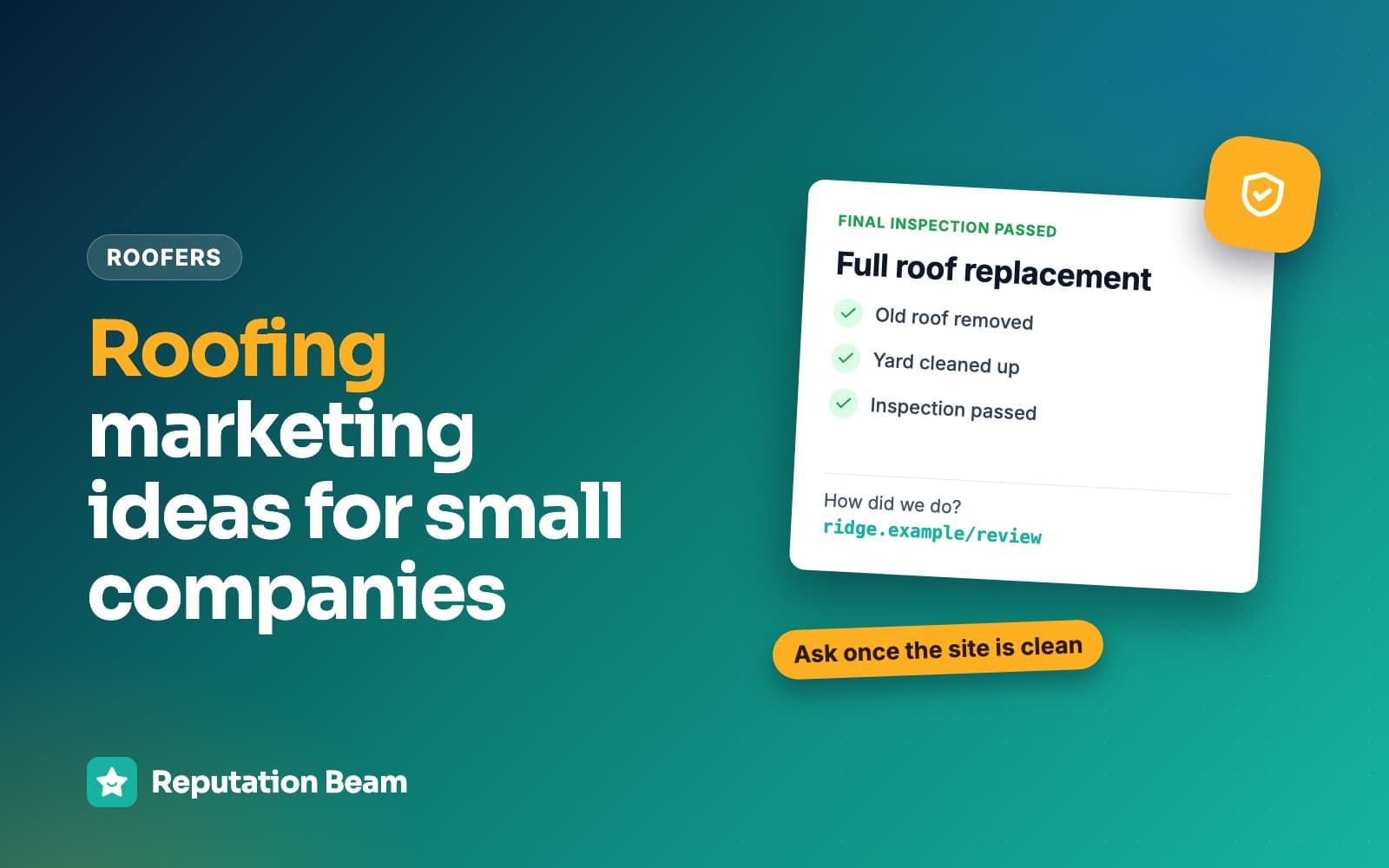
Ask at the final walkthrough, once the roof is done and the yard is clean, and send the link by text after the final inspection passes. Nobody judges a roof fairly during tear-off with shingles in the flower beds. Repairs are simpler: ask when the work is done, then text the same day.
The final inspection is the natural finish because the job isn't officially done until then, where your town requires one. Use the table as a starting point, and write down your own version so that the customer who complained about the dumpster gets asked too.
| Job | Spoken ask | Text with the link (rule of thumb) |
|---|---|---|
| Full replacement | Final walkthrough, after cleanup | After final inspection passes |
| Insurance replacement | Same walkthrough | Same rule, without waiting for the insurer's last check |
| Leak or shingle repair | When the repair is done | Same day |
| Tarp or emergency call | When the permanent fix is done | After the permanent fix |
| Gutters added to a roof job | With the roof | One request for the whole job |
| Inspection with no work sold | No ask | Decide once: charged inspections get one, or none do |
| Property manager or landlord | Don't ask every job | Once a year at most |
Insurance jobs tempt people to wait, because the homeowner's mood can follow the adjuster's. Holding the request until the last check clears means anyone mid-dispute with their insurer is never asked. Your work is finished at the final walkthrough, so that's what they're reviewing.
Contract signed
Consent line for texts, and a line asking permission to use photos of the finished roof.
Tear-off and install
No ask. Keep the homeowner told about weather delays.
Cleanup
Magnet sweep for nails, check the beds and gutters, haul the dumpster.
Final walkthrough
The project manager shows the work, hands over the warranty packet and asks.
Final inspection passes
The text with the review link goes out that day.
A few days later
One reminder. Then leave it alone.
What the roofer says at the final walkthrough
The person who sold or managed the job asks, because that's who the homeowner has trusted since the estimate. Ask after showing the work and handing over the warranty packet, in one sentence, the same sentence on every job. Here are two made-up versions.
You
We've run the magnet over the driveway and the beds, and here are your warranty papers. Call this number if anything ever looks wrong up there.
Customer
It looks great. I can't believe it only took three days.
You
Glad to hear it. We ask every customer for an honest Google review, since it helps neighbors tell the local roofers from the ones passing through. We'll text you the link after the city signs off, if you'd like to leave one.
Customer
My insurance still hasn't sent the rest of the money. I'm not happy with them.
You
I understand. Their timing is theirs, and I'll get you any paperwork they ask for. Our part is finished once the inspector signs off. We ask everybody for an honest review of our work, and we'll text you the link.
Roofer review templates: texts and email to copy
Send a text after the final inspection that names your company and the job, asks for an honest review and has one link. A big job justifies an email too. Text only customers who agreed, and add the consent line to your contract.
The FCC's rule (47 CFR 64.1200) requires prior express written consent for texts that include an advertisement or count as telemarketing, and it treats a "stop" reply as a reasonable way to revoke consent. This is general information, not legal advice, and the texting rules guide has more.
Consent and photo lines for a roofing contract
I agree that [Business name] may text me at the number above about this job and to ask for a review afterward. Message and data rates may apply. Reply STOP to opt out. Agreeing is not a condition of service.
Photos: [Business name] may use photos of the finished roof in its marketing, without my name or street number. Yes ___ No ___ Initials ___
Text: after the final inspection
Hi [First name], it's [Your name] from [Business name]. Your new roof passed its final inspection today. Would you take a minute to leave an honest Google review of our work? [review link] Reply STOP to opt out.
Text: repair
Hi [First name], [Business name] here. Thanks for having us out to fix [the leak by the chimney]. Would you share an honest review on Google? [review link] Reply STOP to opt out.
Leave-behind card, in the warranty packet
Your warranty papers are in this folder. If anything ever looks wrong, call [Your name] at [phone number]. We'll answer.
If you have a minute, an honest Google review helps your neighbors choose a roofer they can trust. Scan the code or visit [review link].
Email: after a full replacement
- To
- [Customer email]
- Subject
- Your new roof passed inspection
Hi [First name],
Your roof passed its final inspection on [date], so that wraps up our work at your home. Your warranty papers are in the folder we left with you, and my number is [phone number] if anything comes up.
If you have a few minutes, would you leave an honest review on Google? Homeowners in [town] are often deciding who to trust after a storm, and what you write helps them.
Leave a review: [review link]
Thanks, [Your name]
[Business name], [street address, city, state, ZIP]. Don't want emails like this? [unsubscribe link]
How to find your Google review link covers getting the link, and a Google review QR code makes the card easier to use. Yelp's content guidelines say "Businesses should never ask customers to write reviews," so keep Yelp off the card. The FTC's guide on soliciting reviews adds: "Don't ask for reviews only from customers you think will leave positive ones."
Roofing reputation management: replying to the usual complaints
Reply to every review within a few days, in three or four sentences, with a name and number. Roofing reputation management is mostly this and fixing what complaints point to. Don't post what the job cost, what the insurer paid or the homeowner's address, and never trade anything for a changed review.
| Complaint | What's usually behind it | What the reply does |
|---|---|---|
| "Nails all over my driveway" | Cleanup rushed, or a flat tire | Apologizes, offers a return sweep, asks them to call |
| "New roof leaks" | Flashing, or a separate problem | Offers to inspect under your workmanship warranty |
| "Started, then disappeared for a week" | Weather, or a crew pulled to another job | Explains in general, says what you're changing |
| "They said insurance would pay it all" | A sales promise, or a claim decision | Says the insurer decides, offers to go through the paperwork |
| "Crushed my bushes" | Tear-off debris | Offers to make it right, separately from the review |
| "Never returned my calls about the warranty" | Nobody owns warranty calls | Gives a name, and takes the call |
Here are three made-up examples.
Pat R. (example)
GoogleNew roof looks fine, but three weeks later I picked up a nail in my tire in my own driveway. Then I found more by the fence. They clearly rushed the cleanup.
Reply from Ridgeline Roofing (example)
I'm sorry, Pat. A nail in a tire after a job is exactly what our cleanup is supposed to prevent. We'd like to come sweep again and talk through the tire. Please call me at [phone number]. Mike, owner
Jordan S. (example)
GoogleThe sales guy told us insurance would cover everything. Now I'm out a lot more than I expected and nobody will explain it.
Reply from Ridgeline Roofing (example)
I'm sorry, Jordan. Your insurer makes the coverage decisions, and our team should be clear about that from the first visit. If you heard something different, I want to know. Please call me at [phone number], and we'll go through the paperwork together. Mike, owner
Lee C. (example)
GoogleThis company knocked on my door after the hail, took a deposit and vanished. Scammers.
Reply from Ridgeline Roofing (example)
I'm sorry you went through that. We don't have a job we can match to this review. If it may have been another company, your state licensing board can help. If it was us, please call me at [phone number]. Mike, owner
Don't threaten a reviewer. The FTC says a business can't use an "unfounded or groundless legal threat" or intimidation to stop or remove a review (FTC questions and answers). Fix a warranty problem because it's your warranty, separately from the review: Google prohibits "requests for revision or removal of a review or rating in exchange for an incentive." How to respond to negative reviews has more, and how to respond to fake reviews on Google covers a review that isn't yours.
How a local roofer stands apart from storm chasers
Show proof that lasts longer than one storm: your license number where your state issues one, a real local address, reviews dated over several years, finished roofs in nearby towns, and a named person who takes warranty calls. Homeowners worried about storm chasers are checking that you'll still be here. Answer that directly, with no scare tactics.
You can't outshout strangers on the street after hail, but you can tell a homeowner what to check. This made-up one-sheet works in an estimate folder.
One-sheet: what to check before you hire any roofer
Before you sign with any roofer, including us:
- Ask for the license number where your state issues one, and check it with the state.
- Ask for a certificate of insurance that comes from the insurer.
- Read reviews from before the last storm, too.
- Ask who to call about the warranty, and where that person works.
- Ask your insurer about your claim directly. The insurer decides what's covered.
[Business name], [local address], [phone number], license [number].
Be careful about what you say on insurance. A plain "we'll give you the paperwork your insurer asks for, and your insurer decides what's covered" is honest and reassuring. Rules on deductibles and on how contractors deal with insurers vary by state, so ask your state's insurance department or a lawyer before you advertise anything about a deductible, a free roof or handling a claim. This is general information, not legal advice.
Before
Your insurance will pay for a free new roof. We handle everything.
After
Your insurer decides what's covered. We'll document the damage and give you the paperwork they ask for.
You can't promise what someone else decides, and an honest line heads off a two-star review later.
Your Google Business Profile as a roofer
Set up as a service-area business under your real name, with roofing contractor as your category, the towns you actually work in and each service you offer. Hide your home address if customers don't come to it. Skip the storm-season add-ons in the name ("Ridgeline Roofing," with no "Hail Experts" after it), and post photos of your own finished roofs with no house numbers showing.
Google's guidelines say "you should hide your business address from customers" if you're a service-area business, and that your area "shouldn't extend farther than about 2 hours of driving time from where your business is based," though larger areas may suit some businesses. They also say "including unnecessary information in your business name isn't permitted, and could result in the suspension of your Business Profile." A virtual office isn't eligible unless it's staffed during business hours, so a rented mailbox near last month's hail doesn't get you a listing there.
Google's services page explains Edit services. List what you really do: roof replacement, leak repair, storm damage repair, roof inspection, gutters, flat roofs or metal roofs if you install them.
Roofing service pages homeowners actually read
Write one page for each main job: replacement, repair, storm damage, plus any specialty such as metal or flat roofing. A homeowner looking at a replacement is worried about cost and mess, and one looking at repair is worried about being sold a whole roof. Answer that worry at the top of each page.
| Page | What the homeowner is worried about | What the page should say |
|---|---|---|
| Roof replacement | Cost, mess, how long | What drives the price, how you protect the yard, days on site |
| Roof repair | Being sold a whole roof | When a repair is enough, and when it isn't |
| Storm damage | Scams, insurance | What you document, what the insurer decides, who you are |
| Warranty | Whether you'll be around | Workmanship and manufacturer terms, who to call |
Put your license number on the site and everything you print, and check your state's rules. In California, the Contractors State License Board's advertising guidelines say licensed contractors must include their license number in "all forms of advertising." Other states differ, so ask your own licensing board. Skip town pages for places you don't work, and don't copy one page twenty times with the name swapped. How to add Google reviews to your website shows how to display them.
How to get roofing leads from neighbors, referrals and repeat work
The best way to get roofing leads without buying them is from people who already see your work or see a lot of roofs: the neighbors on the street, real estate agents, home inspectors and property managers. Past customers can't buy another roof for a long time, but they can recommend you.
Neighbors, photos and the job site
Every roofing job is a billboard for a week, because the whole street sees it. Keep the site clean, put up a yard sign with the homeowner's permission, and photograph the finished roof if the customer agreed, avoiding house numbers, plates and people. Before the noise starts, drop a polite note on nearby doors that doesn't name the customer.
Neighbor note, before a tear-off
Hi neighbor. We're replacing a roof on your street on [dates]. Expect some noise and a dumpster from about [start time]. If a truck blocks you or you find any stray nails, please call [Your name] at [phone number] and we'll come right over.
[Business name], license [number]
Check your town's rules before any door-to-door selling.
Referrals and repeat work
Agents, inspectors, property managers and other trades can send you steady work, and past customers still call about gutters, repairs and a rental they own.
Worth trying for a small company
- Real estate agents, who hear about roofs during every sale
- Home inspectors, who hand buyers a list of problems
- Property managers and small landlords, for steady repairs
- Gutter, siding and painting contractors
- A referral credit for past customers, with no link to reviews
Be careful with
- Lead sites that sell the same homeowner to several roofers
- Paying inspectors or agents for referrals, without asking a lawyer
- Reward cards tied to leaving a review, which Google prohibits
You can reward a past customer for a referral. You can't do it for a review: Google prohibits offering "payment, discounts, free goods and/or services" for one. How to get recommendations on Nextdoor helps too, since a roofing question comes up on neighborhood threads after every storm.
For repeat work, keep your number on the warranty packet and on a sticker in the attic near the access hatch, and send one useful email a year, such as a reminder to check gutters before the wet season.
Paid ads for a small roofing company
Paid ads suit a roofer with crew time to fill and a job size that can absorb the cost of a lead. Try Local Services Ads first, in the towns you can reach easily. Be careful with shared leads, and pause everything when you're booked out, since an estimate you can't schedule for weeks is a bad first impression.
Google's Local Services Ads page lists "Roofers" as a US category and says "Pay only for leads related to your business and the services you offer." Its screening page lists business and owner checks, state-level licenses and general liability insurance for roofers, several marked "Select users only," so see what applies to you when you sign up.
A rule of thumb: count signed jobs, not calls, and allow for the long gap between a roofing estimate and a signature. Set a test amount you could lose without it hurting, and ask every caller how they found you.
Common roofing marketing mistakes
Most wasted roofing marketing comes from chasing storms and forgetting the rest of the year.
- Asking for reviews on the day of the tear-off, or only when the customer seems pleased.
- Promising a free roof or anything else an insurer decides.
- Keywords in the business name, or a rented address near the latest hail.
- Posting what someone paid, or what their insurer did, in a reply.
- Letting warranty calls go unanswered.
Roofing marketing setup
0 of 8 done
Where Reputation Beam fits
Reputation Beam sends review requests by text and email from one dashboard. If you run jobs in Housecall Pro or Jobber, visits can come in from there, and a request follows each one unless you turn that off on the connection. A roof can take several visits, so a roofer may prefer to turn it off and send the request from the dashboard when the final inspection passes. Templates use placeholders for the name, your business and the review link, and follow-up reminders can go to people who haven't responded. Each request has its own link. Imported customers aren't texted until their permission is recorded. Google and Yelp reviews arrive in one feed, and you can reply to Google reviews from there.
Keep going
Google's review policy has the full rules on asking, and the best time to ask for a review covers other trades. Neighboring trades have their own versions in plumbing marketing ideas and electrical contractor marketing.
Questions people ask
What is the best way to market a small roofing company?
For a small roofing company, start with Google reviews and a complete Business Profile, since a homeowner spending this much money will read what past customers wrote. Then write pages for replacement, repair and storm damage, and show finished roofs in nearby towns, with permission. Next, build referrals from real estate agents, home inspectors and property managers. Add paid ads last, for jobs and towns your crew can actually reach.
When should a roofer ask for a review?
A roofer should ask at the final walkthrough, once the cleanup is done and the yard has been checked for nails, and send the link by text after the final inspection passes. Don't ask on day one or during tear-off. For a repair, ask when the work is done and send the text the same day. On an insurance job, stick to the same rule and don't wait for the insurer's last check.
How do roofers get leads without buying them?
Roofers get leads without buying them by collecting steady Google reviews, keeping a complete Business Profile, and writing pages for each main job. Yard signs on jobs, with the homeowner's permission, and a note to neighbors bring people who already saw your work. Real estate agents, home inspectors and property managers refer repeat work. Past customers remember you if you leave your number on the warranty packet and offer a yearly gutter or roof check.
What is roofing reputation management?
Roofing reputation management means asking every customer for an honest review after each job, replying to the reviews you get, and fixing what complaints point to. Roofers tend to hear about nails left behind, leaks after an install, delays and insurance confusion. A short calm reply with a name and number helps the next homeowner more than an argument. Never pay for reviews, offer a discount for one or threaten a reviewer.
How can a local roofer stand out from storm chasers?
A local roofer stands out from storm chasers with proof that lasts longer than one storm: a license number where your state issues one, a real local address, reviews dated across several years, photos of finished roofs in nearby towns, and a named person who answers warranty calls. Explain how you handle insurance claims in plain words. Don't scare people or promise that a claim will be paid, since the insurer decides that.
Was this guide helpful?
Get the free review request checklist and new guides
Twenty checks to run before you ask customers for reviews, as a one-page PDF. After that, a short email when new guides go up, at most once a week.