Key takeaways
- Write one review rule per visit type, because a skin check, a biopsy, an acne follow-up and an injectable appointment all finish at different times. Then ask every patient on that rule, including the one who waited.
- Reply to reviews without confirming that anyone is a patient. Skip the mole, the filler, the wait on Tuesday and the pathology bill, even when the reviewer brought them up. HHS has settled with practices over replies to online reviews.
- Waits are a common theme in dermatology reviews. Fix what you can at check-in and on the phone, and don't run ads for medical visits you can't book for months.
- Before-and-after photos need a signed authorization, and a photo of a skin condition can identify someone. After reviews, build referrals from primary care, separate medical and cosmetic pages, and add cosmetic ads last.
In this guide
- Dermatology practice marketing: what to do first
- When to ask dermatology patients for a review
- What the front desk and the injector say
- Dermatology review templates: texts and email
- Dermatologist reputation management: replying to patients privately
- Your Google Business Profile as a dermatology practice
- Medical and cosmetic dermatology pages
- Referrals from primary care, and yearly recall
- Paid ads for a small dermatology practice
- Common dermatology marketing mistakes
- Where Reputation Beam fits
- Keep going
A patient with a changing mole wants to know two things: can this practice see me soon, and will someone take me seriously when I get there? A patient shopping for laser treatment wants something else, and may read every review you have before calling. Dermatology marketing for an independent practice has to serve both people from one small front desk.
This guide starts with reviews, since they speak to both. You'll get a rule for each visit type, what the front desk and the injector say, texts and emails that keep care private, and replies to the complaints dermatologists see most, without confirming anyone is a patient. Then come your Google profile, medical and cosmetic pages, photos, primary care referrals, recall and ads. For more scripts, see how to get more patient reviews.
Dermatology practice marketing: what to do first
Start with patient reviews, then your Google Business Profile, then separate medical and cosmetic pages, then primary care referrals and yearly recall, with paid ads last. An independent dermatology practice can't outspend a hospital group, and it doesn't need to if a nearby patient can read recent reviews and get an answer on the phone.
Google says "More reviews and positive ratings can help your business's local ranking" (Google Business Profile Help). The order below is a rule of thumb for one location.
- 1
Reviews
A rule for each visit type, one sentence at checkout, every patient.
- 2
Google profile
The right setup for your doctors, services and real hours.
- 3
Two kinds of page
Medical care and cosmetic care answer different questions.
- 4
Referrals and recall
Primary care offices and yearly skin checks.
- 5
Paid ads
Only for slots you can fill soon, starting with cosmetic.
Skin check, acne, eczema, biopsy
Medical patient
Usually comes through insurance, often on a referral. Worries about how soon they can be seen, whether you take their plan and who will actually see them. Often comes back for years.
Injectables, lasers, peels
Cosmetic patient
Usually pays directly and compares options. Worries about results, safety, cost and whether the injector listens. May decide over weeks of reading. For this side of the business, med spa marketing ideas has more.
When to ask dermatology patients for a review
Write one rule per visit type, and apply it to everyone. A routine medical visit gets the ask at checkout and a link the same day. A biopsy gets a fixed date, so no one decides based on the result. Injectables and lasers get the ask at a follow-up or on a set date, since results take time to show.
Writing it down matters because Google's policy says merchants may not "selectively solicit positive reviews from customers," and the FTC's guide on soliciting reviews says "Don't ask for reviews only from customers you think will leave positive ones." A rule by visit type takes the choice away from whoever is at the desk.
| Visit type | Spoken ask | Text with the link (rule of thumb) |
|---|---|---|
| Routine medical visit, skin check | At checkout | Same day |
| Acne, eczema or psoriasis follow-up | At the first follow-up | Same day, once a year at most |
| Biopsy or minor procedure | No spoken ask that day | A fixed date, about three weeks later |
| Mohs or other cancer surgery | No spoken ask | Decide with your doctors, then write it down |
| Injectables | At the two-week follow-up, if you hold one | Two weeks after the visit either way |
| Laser or peel series | After the second session | After the second session, or a set date |
The biopsy row needs some thought. Someone waiting on pathology shouldn't get a cheerful message that week, and tying the request to the result puts someone in the position of deciding who gets asked. A set date is the simplest answer. If your doctors want to leave out patients in active cancer treatment, keep the exception narrow and written, decide it by clinical situation and never by how the visit went, and have your lawyer look at the wording.
What the front desk and the injector say
On the medical side, the person at checkout asks in one sentence, the same for every patient, and says a text is coming. On the cosmetic side, the injector or laser technician can ask at follow-up, because that's who the patient has a relationship with. Neither one names the treatment in the message.
You
You're all set for today. We ask all of our patients for an honest Google review, since we're an independent practice and it helps people find us. We'll text you the link, if you'd like to.
Patient
Sure. Sorry I was short earlier, that was a long wait.
You
I understand, and I'm sorry about that. Dr. Rao is running behind this afternoon. If you'd like to tell us about it, the office manager's number is on your paperwork.
You
That's settled in nicely. Here's when to book your next one. We also ask everyone for an honest review on Google, and we'll send you the link.
Patient
Will my name show up with what I had done?
You
Only what you choose to write. Google shows the name on your account, and you don't need to say anything about your treatment.
Keep staff out of the numbers. Google's policy lists "merchants requesting that staff solicit a certain number of reviews," and it says merchants "should not require or pressure users to leave ratings or write reviews while on the premises." So no bonus for injectors, no target for the front desk and no tablet in the exam room. A QR code on a card in the checkout tray is fine, as the Google review QR code guide explains.
Dermatology review templates: texts and email
Send one short message with one link, and keep the visit out of it. "Thanks for coming in about your rash" is a health detail in a text preview on someone's lock screen. Name only your practice. Text only patients who agreed, and give everyone else the email or the card.
The FCC's rule (47 CFR 64.1200) requires prior express written consent for texts that include an advertisement or count as telemarketing, and it treats a "stop" reply as a reasonable way to revoke consent. This is general information, not legal advice, so have your lawyer review the form. The texting rules guide covers it in more depth. Add a line like this one to your intake paperwork.
Consent line for dermatology intake forms
I agree that [Practice name] may text me at the number above about my appointments and to ask for feedback and reviews. Message and data rates may apply. Reply STOP to opt out. Agreeing is not a condition of receiving care.
Signature: ____________ Date: ________
Text: same day, after a routine visit
Hi [First name], it's the front desk at [Practice name]. Here's the review link we mentioned: [review link] Thank you for trusting us with your care. Reply STOP to opt out.
Text: a fixed date after a procedure
Hi [First name], this is [Practice name]. If you have a minute, we'd appreciate an honest review on Google: [review link] Questions about your care? Call us at [phone number]. Reply STOP to opt out.
Text: cosmetic patients, two weeks after a visit
Hi [First name], it's [Staff first name] at [Practice name]. If you have a minute, an honest Google review helps others decide whether we're right for them: [review link] Reply STOP to opt out.
Email: for patients who didn't agree to texts
- To
- [Patient email]
- Subject
- Would you review [Practice name] on Google?
Hi [First name],
Thank you for choosing [Practice name]. As an independent practice, we rely on honest reviews to help people in [town] find us. If you have a minute, we'd be grateful for yours.
Leave a review: [review link]
The team at [Practice name]
[Practice name], [street address, city, state, ZIP]. Don't want emails like this? [unsubscribe link]
Keep the subject line free of anything clinical. HHS's FAQ on emailing patients says covered providers may communicate electronically "provided they apply reasonable safeguards," and a message that names no condition is an easy one to send. How to find your Google review link covers getting the link right. Leave Yelp out of all of this: its content guidelines say "Businesses should never ask customers to write reviews."
Dermatologist reputation management: replying to patients privately
Dermatologist reputation management means replying to reviews without ever confirming that the reviewer is a patient, and fixing what the reviews keep pointing at. Thank them, say you can't discuss anyone's care in public, state your general practice and give a name and number. Leave out the condition, the procedure, the date and the bill, even if the reviewer posted them first.
HHS has settled over this. It says New Vision Dental used social media to respond to patient reviews and disclosed protected health information, and calls that illegal under HIPAA. Manasa Health Center settled after disclosures in response to negative online reviews. Whether HIPAA covers you depends on the definition of a covered entity (45 CFR 160.103). A cash-only cosmetic practice should ask a lawyer, and it can write replies this way regardless. This is general information, not legal advice.
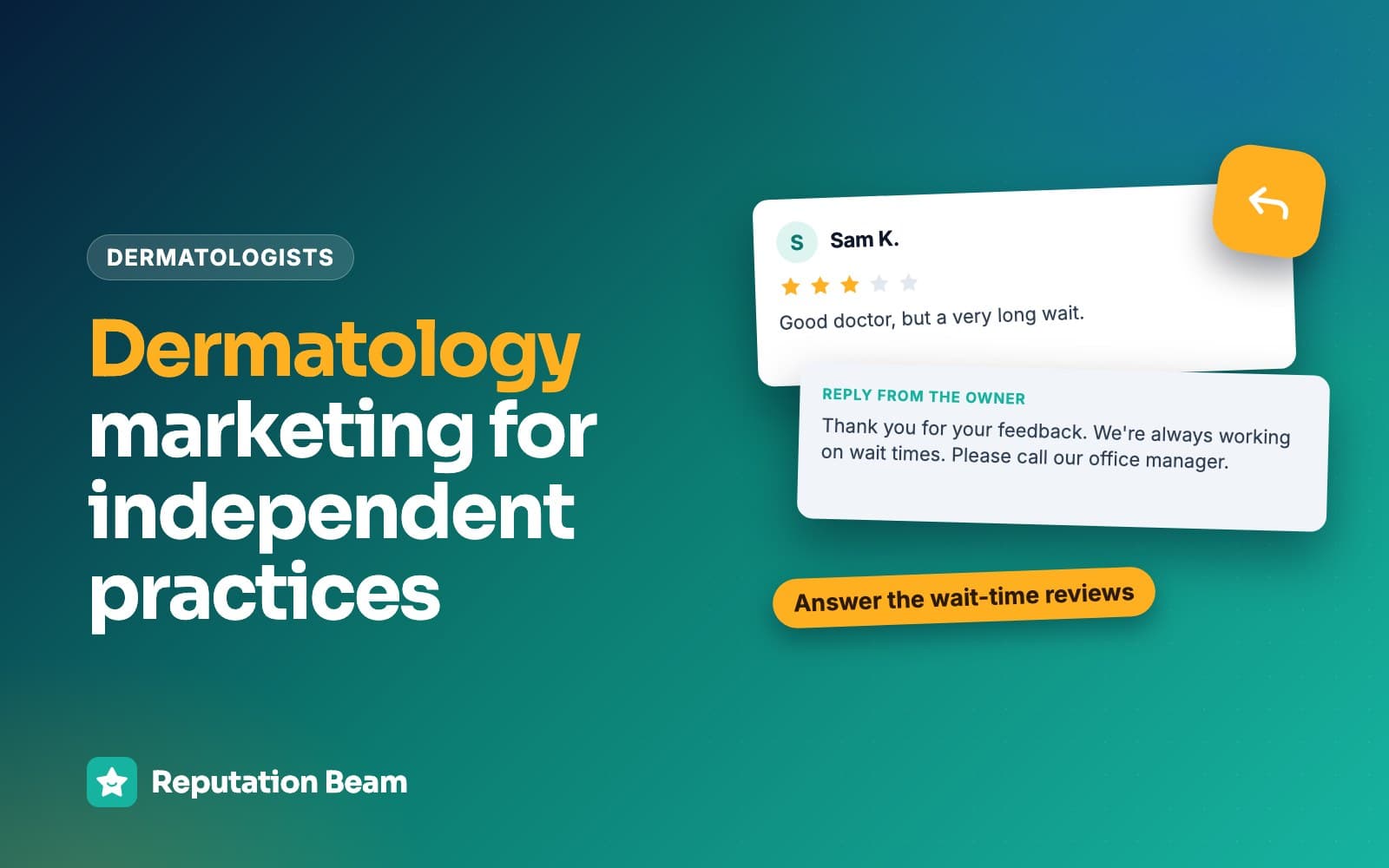
Waits come up again and again in dermatology reviews, both the months to get an appointment and the time in the waiting room. That's our observation, with no count behind it, so test it against your own reviews.
| Complaint | What not to say | What the reply does |
|---|---|---|
| "Waited an hour past my appointment" | "Dr. Rao had an emergency that day" | Says waiting is frustrating, states what you do about delays |
| "Three months to get in" | "We have no record of you" | Explains how to ask for cancellations and urgent slots |
| "Saw a PA, never the doctor" | "Our PA treated you because..." | Says who sees patients is explained at booking |
| "Pushed cosmetic products at a medical visit" | "You asked about your wrinkles" | Says nobody should feel pressured, gives a manager's number |
| "Surprise bill for the biopsy lab" | "Your pathology was billed separately" | Offers the billing contact, in general terms |
| "Filler looks uneven" or "laser left a mark" | Anything clinical at all | Takes it seriously, asks them to call the doctor directly |
Here are three made-up examples.
Dana M. (example)
GoogleWaited an hour and ten minutes past my appointment time for a skin check, then the doctor was in and out in five minutes. Nobody even apologized.
Reply from Northgate Dermatology (example)
Thank you for writing. We can't discuss anyone's care here, but waiting without an explanation is frustrating for anyone, and our front desk should tell people when we're running behind. Please call Maria, our office manager, at [phone number]. She'd like to hear from you.
Theo L. (example)
GoogleGot filler here and one side still looks bigger three weeks later. I paid a lot for this and nobody got back to me.
Reply from Northgate Dermatology (example)
Thank you for letting us know. We can't discuss anyone's care in a public reply, but a concern like this should reach a clinician quickly. Please call Dr. Rao's office line at [phone number] and ask for Priya, who will make sure the doctor hears about it.
Marisol T. (example)
GoogleDr. Rao caught something my last doctor missed and explained every step. I'm so grateful.
Reply from Northgate Dermatology (example)
Thank you for taking the time to write this. Kind words like these mean a lot to our whole team.
HIPAA-compliant review responses has a staff policy you can adapt, and how to respond to fake reviews on Google covers what to do about the suspicious ones. Never threaten a reviewer: the FTC says a business can't use an "unfounded or groundless legal threat" or intimidation to stop or remove a review (FTC questions and answers).
Fixing the wait before anyone writes about it
A reply can only do so much here. These rules of thumb head off the table above.
- Tell patients at check-in when a doctor is running behind, and by how much.
- Keep a cancellation list for new patients.
- Train the phone team to ask if a spot has changed recently, then follow the doctor's written rule for getting it seen sooner.
- Say at booking who the patient will see.
- Tell people at the biopsy how and when they'll hear the result, and who to call if they don't.
Your Google Business Profile as a dermatology practice
Match your profile to how the practice is built. A solo dermatologist at a branded practice shares one profile with the practice. A group has a profile for the location, separate from any individual doctor's. Choose dermatologist as your category, list the services you actually offer, and post your real hours and photos with no patients in them.
Google's guidelines cover individual practitioners, using doctors as an example, and say "including unnecessary information in your business name isn't permitted, and could result in the suspension of your Business Profile." So "Northgate Dermatology" stays that way, with no "Botox and Skin Cancer" added on. Use Edit services for skin cancer screening, acne treatment, Mohs surgery, laser treatment and the rest, if you really offer them.
One place outside Google matters too. Patients with insurance often check their insurer's directory first, so check how each doctor is listed with each plan you take, including whether they're accepting new patients.
Medical and cosmetic dermatology pages
Write separate pages for medical and cosmetic care, because those patients ask different questions. Medical pages should answer who you see, which insurance you take and how soon you can get in. Cosmetic pages should answer who performs the treatment, what it involves, what it costs and what to expect afterward.
- 1
Northgate Dermatology sees adults and children for skin checks in Northgate and nearby towns.
Who and where
Say who you see before anything else.
- 2
New patient visits are booking about six weeks out. If a spot has changed, tell us when you call.
How soon
An honest wait is better than a surprise one. Keep it current.
- 3
You'll see Dr. Rao or Sam, our physician assistant. We'll tell you which when you book.
Who sees you
This heads off a common complaint.
Dermatology advertising needs evidence behind its health claims. The FTC's advertising FAQ says "advertising must be truthful and non-deceptive," and that health or safety claims generally need "competent and reliable scientific evidence." So describe what a treatment involves and who does it, and leave out "erases wrinkles" and "cures your acne for good." Check your state medical board's rules before you use terms such as "board certified" or run any offer, since these differ by state.
Before-and-after photos
Before-and-after photos sell cosmetic dermatology, and they are also a patient's health information. A covered practice "must obtain an authorization for any use or disclosure of protected health information for marketing," with narrow exceptions (45 CFR 164.508). "Full face photographic images and any comparable images" appear on HIPAA's list of identifiers (45 CFR 164.514), and a close-up of a distinctive scar or tattoo could be comparable, so cropping out the eyes doesn't settle it. Use the signed form your privacy officer or lawyer gives you, keep it with the photo, and take the photo down if someone revokes permission.
Using customer reviews in marketing explains how to show reviews on your site.
Referrals from primary care, and yearly recall
Primary care offices are the steadiest referral source for a medical dermatology practice, and they care about two things: can their patient get seen, and will a note come back? Make both easy. Then bring your own patients back for yearly skin checks, since a patient you already have needs no ad.
Start with the office manager, who usually handles the referral phone calls. A letter like this one gives them what they need.
Letter to a primary care office
Dear [Office manager name],
I'm [Your name], the practice manager at [Practice name], about [distance] from your office. We see adults and children for skin checks, rashes, acne and skin surgery, and we take [plans].
For a lesion your doctors are worried about, please call our referral line at [phone number]. We'll do our best to see that patient quickly, and we'll send the consult note back to you within [number] days.
Could I bring by a stack of referral forms next week?
[Your name], [Practice name]
Other offices are worth a visit too: pediatricians, OB/GYN practices, and rheumatologists who see patients with skin involvement. HHS's Office of Inspector General says the federal Anti-Kickback Statute prohibits paying remuneration to induce or reward patient referrals for items or services payable by federal health programs. Ask a lawyer about anything with cash value, and check your state's rules.
For recall, book the next skin check before the patient leaves, if your doctor recommends one, and send one reminder around eleven months to anyone without a booking, keeping the reason general. A promotion is a different kind of message: don't send a filler special to medical patients on the basis of their chart until your privacy officer or a lawyer has looked at it, since the HIPAA marketing rule above may apply.
Paid ads for a small dermatology practice
Paid ads suit a dermatology practice only where you have open slots. If new medical patients already wait months, ads add callers you can't serve and produce reviews about the wait. Cosmetic services usually make a better test, because the slots are open and patients are comparing.
Google's Local Services Ads page lists "Dermatologist" as a US category and says "Pay only for leads related to your business and the services you offer." Its screening page lists provider and practice checks and state licenses for dermatologists, so allow time for that. Google's personalized advertising policy lists health among categories with targeting restrictions, so expect limits on remarketing, and ask a lawyer before uploading any patient list for targeting.
A rule of thumb: test one service with an amount you could lose without it hurting, and count booked visits for a full month.
Common dermatology marketing mistakes
- Asking for a review only after cosmetic visits, because those patients seem happier.
- Mentioning a biopsy, a treatment or a condition in a review text or email.
- Posting before-and-after photos with verbal permission only.
- Advertising new medical patients while the wait runs for months.
Dermatology marketing setup
0 of 5 done
Where Reputation Beam fits
Reputation Beam sends review requests by text and email from one dashboard, or as scheduled campaigns, which suits a rule built on fixed dates. Add patients one at a time or import a CSV file. Each patient's permission to be texted is recorded, imported patients aren't texted until it is, and a hosted opt-in form with a QR code lets people agree for themselves in the waiting room. Templates use placeholders for the name, your practice and the review link. Each request has its own link. Google and Yelp reviews arrive in one feed, and you can reply to Google reviews from there.
Keep going
Google's review policy has the full rules on asking. Other health practices have their own versions in optometry marketing, chiropractic marketing, physical therapy marketing, plastic surgery marketing and urgent care marketing.
Questions people ask
What is the best marketing for an independent dermatology practice?
For an independent dermatology practice, start with Google reviews and a complete Business Profile, since patients often check both before booking. Then write separate pages for medical and cosmetic care, keep insurer directories correct, and build referrals from primary care offices that send you suspicious lesions. Recall patients for yearly skin checks. Use paid ads last, for cosmetic services or medical slots you can actually offer soon.
When should a dermatologist ask a patient for a review?
A dermatologist should ask according to a written rule by visit type. For a routine medical visit, ask at checkout and send the link the same day. For a biopsy, use a fixed date after the visit so nobody decides based on the result. For injectables and lasers, ask at the follow-up or on a set date. Never choose patients by how the visit seemed to go, and never name the visit in the message.
How should a dermatologist reply to a review about long wait times?
A dermatologist should reply without confirming the reviewer was seen or scheduled. Say the practice can't discuss anyone's care in public, that waiting is frustrating for anyone, describe in general what the practice does about waits, and give a name and number. Skip the appointment date, the doctor's schedule that day and any reason specific to the visit. Then fix the check-in or scheduling problem behind the complaint. This is general information, not legal advice.
Can a dermatology practice post before-and-after photos?
A covered practice generally needs a patient's signed authorization first. HIPAA says a covered entity must obtain authorization for most marketing uses of protected health information, and full-face photographs and comparable images are on its list of identifiers. Cropping may not remove the need, since a scar or a distinctive skin feature can identify someone. State medical boards can add advertising rules, so ask your privacy officer or a lawyer before posting.
How do dermatologists get referrals from primary care doctors?
Dermatologists get primary care referrals by making them easy and fast. Give referring offices a direct line and a way to get a suspicious lesion seen quickly, send the consult note back promptly, and say what you treat and which insurance you take. A one-page letter and a visit from the office manager is a good start. Don't pay for referrals: the federal Anti-Kickback Statute covers federal program patients, and state rules can add limits.
Was this guide helpful?
Get the free review request checklist and new guides
Twenty checks to run before you ask customers for reviews, as a one-page PDF. After that, a short email when new guides go up, at most once a week.