Key takeaways
- Reviews come first for an independent optometrist, because the chain down the road has the bigger sign and your patients' words are what set you apart. Ask after the glasses fit or the contacts settle, on a written rule.
- Replies must never confirm that someone is a patient. Skip prescriptions, insurance details and anything about their eyes, even when the reviewer brought it up.
- The FTC's eyeglass and contact lens rules shape your marketing: the prescription goes to the patient automatically, and an exam-and-glasses offer can't make the exam depend on buying.
- Your recall list is your cheapest source of booked exams. Work it before you spend anything on ads.
In this guide
- Optometry marketing, in the order to try it
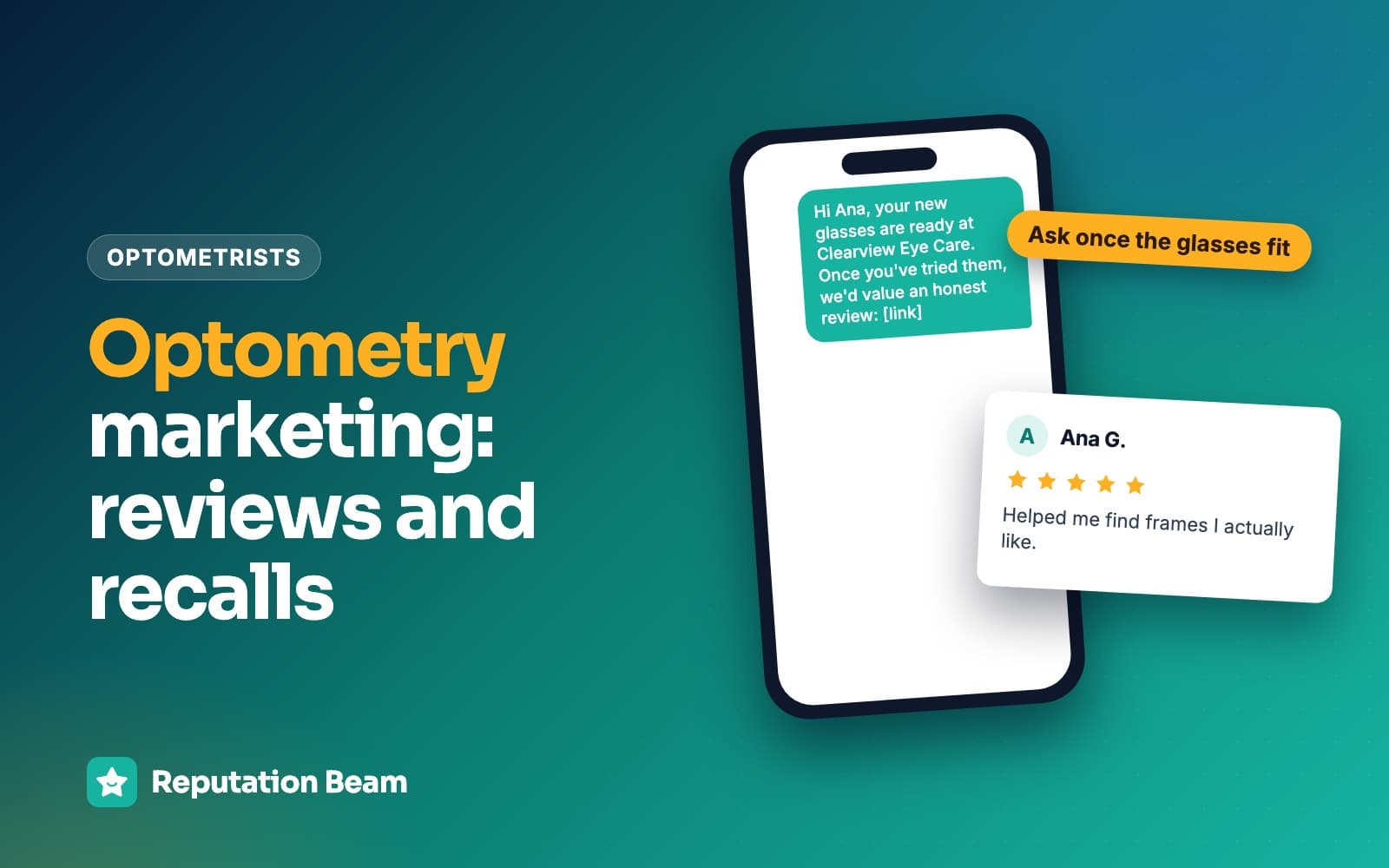
- When to ask for a review after an eye exam or new glasses
- Review texts and emails for optometrists to copy
- Optometrist reputation management: replies that keep the chart private
- The FTC eyeglass and contact lens rules behind your marketing
- Your Google Business Profile as an optometrist
- Annual recalls: the repeat business you already have
- Competing with chain optical stores
- Referrals and paid search for a small eye practice
- Common optometry marketing mistakes
- Where Reputation Beam fits
- Keep going
Patients choosing an eye doctor can usually find a chain optical store a short drive away, with long hours and a big sign. Good optometry marketing gives an independent practice something the sign can't: recent words from real patients, and a reason for last year's patients to come back. The most useful work happens around the optical counter and the recall list, and it costs little.
This guide starts with reviews: when to ask after glasses and contacts, who says what, texts to copy, and how to answer complaints about insurance and prescriptions without confirming anyone is a patient. Then it covers the FTC rules that touch your offers, your Google profile, recalls, service pages, referrals and ads. For the broader health version, see how to get more patient reviews.
Optometry marketing, in the order to try it
Start with reviews, then your Google Business Profile, then your recall list, then pages for exams and contact lenses, then referrals. Paid ads come last. An independent optometry practice already has years of patients who trust it, so most early gains come from asking them and reminding them.
Google says "More reviews and positive ratings can help your business's local ranking" (Google Business Profile Help). Treat this order as a rule of thumb.
| Order | What to do | Effort | Why it suits an eye practice |
|---|---|---|---|
| 1 | Ask for a review on a written rule | One sentence, one text | Sets you apart from the chain's listing |
| 2 | Complete your Google profile | An afternoon | People search for an eye doctor nearby |
| 3 | Work the recall list | An hour a month | Patients you already earned, due again |
| 4 | Pages for exams, contacts, urgent visits | A weekend | Answers what people search before booking |
| 5 | Pediatricians, primary care, schools | A few visits | Steady new patients from people they trust |
| 6 | Paid search | Money and tracking | Fills open exam slots you can't fill otherwise |
When to ask for a review after an eye exam or new glasses
Ask when the patient has lived with the result: after glasses are picked up and fit, after contacts pass the final fit visit, and the same day for an exam with no purchase. Base the timing on the visit type and apply it to every patient.
Here's a rule of thumb. Adjust it to your own lab times, then write it down so nobody at the front desk has to guess.
| Visit | Spoken ask | Text or email with the link |
|---|---|---|
| Routine exam, no purchase | At checkout, once | Same day |
| Exam, glasses ordered | At pickup, after the fit check | Next day |
| Progressives or a big prescription change | At pickup, with a note about adjusting | A week or two after pickup |
| New contact lens wearer | At the final fit visit | Day after that visit |
| Urgent visit, such as a red eye | Skip the spoken ask | Next day, same as everyone |
The progressive wait has a catch: some people need longer to adapt, and a few need a remake. Don't hold the request until you're sure they're happy, because that turns into asking only the happy ones. Google's policy says merchants may not "selectively solicit positive reviews from customers," and the FTC's guide on soliciting reviews says "Don't ask for reviews only from customers you think will leave positive ones." The date on the calendar decides.
Who asks, and what they say at the optical counter
The person who handed over the finished glasses or fit the lenses should ask, because that's when a patient is looking in the mirror and saying thanks. The doctor can ask at the end of a routine exam. Here are two made-up versions.
You
How does the bridge feel? I can take a little more off the temple if you want.
Patient
No, that's great. I can read the menu board across the street.
You
Good. We ask all our patients for an honest Google review, since we're a small practice. We'll text you the link tomorrow, if you'd like to leave one.
Patient
So I just keep wearing these? The bottom part still feels strange.
You
That's common with progressives, and most people settle in over a couple of weeks. If it still bothers you by then, call and we'll have you back. We'll also send a note in about ten days to check in, with a link for a Google review if you'd like.
Review texts and emails for optometrists to copy
Send a short text naming your practice with one link, and leave out anything about the patient's eyes, prescription or purchase, since a preview can show on a locked phone. Text only patients who agreed to it. Everyone else gets email.
The FCC's rule (47 CFR 64.1200) requires prior express written consent for texts that include an advertisement or count as telemarketing, and it treats a "stop" reply as a reasonable way to revoke consent. HHS's FAQ on emailing patients says covered providers may communicate electronically "provided they apply reasonable safeguards." This is general information, not legal advice. Texting customers for reviews goes further.
Consent line for your intake form
I agree that [Practice name] may text me at the number above about appointments and to ask for a review after a visit. Message and data rates may apply. Reply STOP to opt out. Agreeing is not a condition of care.
Text: same day, after an exam
Hi [First name], it's [Practice name]. Thanks for coming in today. Would you take a minute to leave an honest Google review? [review link] Reply STOP to opt out.
Text: after a pickup (next day, or ten days or so for progressives)
Hi [First name], it's [Practice name]. Just checking in: if anything isn't right, call [phone number] and we'll see you. If you have a minute, would you leave an honest Google review? [review link] Reply STOP to opt out.
Email: one time, to patients seen in recent months
- To
- [Patient email]
- Subject
- Would you review [Practice name] on Google?
Hi [First name],
We're asking all our recent patients for an honest review on Google. It takes a minute, and it helps people nearby choose an eye doctor.
You don't need to share anything about your health or your visit that you'd rather keep private.
Leave a review: [review link]
Thank you, [Doctor or office manager name]
[Practice name], [street address, city, state, ZIP]. Don't want emails like this? [unsubscribe link]
How to find your Google review link covers testing the link, and a Google review QR code works on a card in the glasses case. Yelp's content guidelines say "Businesses should never ask customers to write reviews," so keep Yelp out of the request. More wording is in review request email templates.
Optometrist reputation management: replies that keep the chart private
Optometrist reputation management means replying as if you can't see the chart or the sale. Thank the reviewer, say you can't discuss anyone's care or account in public, state your general practice, and give a name and number. Never confirm that the person is a patient, even when they named their prescription or their plan first.
HHS has settled over this. Manasa Health Center settled after disclosing patient information in response to negative online reviews, and HHS says of New Vision Dental that responding this way is illegal under HIPAA. Whether HIPAA covers your practice depends on the definition of a covered entity (45 CFR 160.103), which includes a provider who sends health information electronically for a covered transaction. Ask a lawyer if you're unsure, and write every reply this way regardless.
| Complaint | Don't say | The reply does this |
|---|---|---|
| "My plan was supposed to cover it" | "Your plan only covers..." | Says the office explains benefits when it can, gives the billing contact |
| "Charged a fitting fee on top of the exam" | "Contact fittings aren't routine for you" | Says fees should be explained first, offers a call |
| "New glasses gave me headaches" | "Progressives take time for you" | Takes it seriously, offers a call with the doctor |
| "Pushed into expensive frames" | "You bought the premium package" | Says the choice is always the patient's |
| "Wouldn't give me my prescription" | Anything about their record | Says your policy, offers to fix it today |
Here are two made-up examples.
Sam K. (example)
GoogleDr. Lee told me my insurance would cover my contacts and then I got hit with a $140 fitting fee. Felt misled.
Reply from Cedar Lane Eye Care (example)
Thank you for raising this. We can't discuss anyone's care or account here, but costs should be clear before any service, and I want to know if we fell short. Please call Ana in our office at [phone number] and she'll look into it.
Marisol T. (example)
GoogleDr. Lee caught something my last eye doctor missed, and Ana found frames I actually like. So grateful.
Reply from Cedar Lane Eye Care (example)
Thank you for taking the time to write this. Kind words like these mean a lot to our whole team.
Don't threaten a reviewer. The FTC says a business can't use an "unfounded or groundless legal threat" or intimidation to stop or remove a review (FTC questions and answers). HIPAA-compliant review responses has more replies and a staff policy you can adapt. Reviews that look fake get the same general reply, since "we have no record of you" also discloses something, and how to respond to fake reviews on Google covers what comes next.
The FTC eyeglass and contact lens rules behind your marketing
The FTC requires eye doctors to hand over prescriptions automatically, and that shapes your offers. A patient gets a glasses prescription right after a refractive exam and a contact lens prescription at the end of a fitting, unasked. You can charge for the exam, but you can't charge extra for the prescription or require a purchase.
The FTC's Eyeglass Rule page says the copy goes out "immediately after completing any refractive eye examination," "whether or not the patient asks for it," and "before offering to sell the patient glasses." You can't require patients to "sign a waiver or release, as a condition of releasing the prescription." A practice that sells glasses must ask patients to confirm receipt in writing, and that request "shouldn't be part of any pre-appointment paperwork." The Contact Lens Rule guide sets similar duties at the end of a fitting. This is general information, not legal advice.
1 year
The FTC's floor for a contact lens prescription's expiration, absent a documented medical reason
8 hours
Business hours to answer a seller's verification request before it's treated as verified
3 years
How long to keep signed confirmations of receipt
Why this belongs in a marketing guide: a review saying "they wouldn't give me my prescription" is a compliance problem before it's a reputation problem. Offers need care too. Asked about advertising one price for an exam and glasses, the FTC answers "Yes," but "The exam cannot be contingent on the purchase of eyeglasses," and the patient should be able "to pay the routine cost of an examination and walk away with no eyeglasses, but with their prescription."
Before
Free eye exam when you buy glasses!
After
Exam and one pair of glasses from our value collection, one price. Prefer the exam alone? It's [price], and your prescription is yours either way.
The second version shows the exam doesn't depend on buying. Check your state board's rules and your plan contracts as well.
The FTC's advertising FAQ says "advertising must be truthful and non-deceptive," and health claims generally need "competent and reliable scientific evidence." Be careful with myopia control, dry eye and blue light claims, and read your state board's advertising rules before you print anything.
Your Google Business Profile as an optometrist
Build your profile around how the practice is set up, list optometrist as your primary category, add every service you really offer, and keep hours accurate. A solo optometrist at a branded practice shares one profile. A practice with several doctors has one for the location, and each doctor's own profile, if any, stays separate from it.
Solo
One doctor, branded practice
Google's guidelines say to create a single profile named "[brand/company]: [practitioner name]". All your requests point there.
Group
Several doctors
Google says the organization "should create a Business Profile for this location, separate from that of the practitioner." Choose one link and send every patient to it.
Google says "including unnecessary information in your business name isn't permitted, and could result in the suspension of your Business Profile," so "Cedar Lane Eye Care Best Optometrist LASIK Glasses" is a risk with nothing to gain. Add comprehensive exams, contact lens fittings, pediatric exams, dry eye care and whatever else fits through Edit services. Show photos of your frame wall, your exam equipment and your team, with no patients in them unless they've given permission.
Annual recalls: the repeat business you already have
Your recall list is the cheapest marketing an optometry practice has, because those patients already chose you. Remind each one when they're due, by the channel they agreed to, and ask the front desk to book the next exam before they leave.
At checkout
Offer to book next year's exam on the spot, and note the month they're due.
A month before due
Send an email or a text if they agreed to one, with your booking link or phone number.
Due month
Send one reminder to anyone who hasn't booked.
Two months late
The front desk calls, because a person catches a move or a change of plan.
Email: annual exam reminder
- To
- [Patient email]
- Subject
- Time to book your yearly visit at [Practice name]
Hi [First name],
Our records show you're about due for your yearly visit. Book online at [booking link] or call us at [phone number]. We have openings in [month], including [early morning or Saturday, if true].
If you've moved or chosen another practice, reply and we'll update our list.
[Doctor or office manager name], [Practice name]
[Practice name], [street address, city, state, ZIP]. Don't want emails like this? [unsubscribe link]
Contact lens wearers have a built-in date. The Contact Lens Rule guide says "The Rule sets a floor, or minimum, expiration date of one year," so tie your reminder to the prescription date you wrote, stated plainly and without pressure. Keep the message free of test results and diagnoses, and keep promotions out of any text sent under appointment-only permission.
Competing with chain optical stores
Compete on what a chain finds hard to promise: the same doctor each year, time for questions, adjustments and repairs by people who know the patient, and frames you've chosen yourself. State those as facts on your site and let patients say the rest in reviews. Avoid fighting on price, and never knock a chain by name in an ad or a reply.
Where an independent practice can stand out
- The same doctor, year after year, if that's true of your practice
- Urgent visits for a red eye or a scratched cornea, if you offer them
- Free adjustments for anyone, wherever they bought their glasses
Where to stop trying
- Beating the lowest two-pair deal in town
- Comparative claims you can't back up
Optometry service pages that answer the search
Write one page per kind of visit, in the words a patient would search: eye exam, contact lens fitting, children's eye exam, red eye or urgent visit, dry eye. Each page says what happens, who you see, and how insurance works.
| Page | What the patient wonders | What the page should say |
|---|---|---|
| Eye exam | How long, will I be dilated | Time, what to bring, driving after dilation |
| Contact lens fitting | Why it costs extra | What a fitting includes, how plans usually treat it |
| Children's eye exam | What age, will they cooperate | What you do with kids, what parents should bring |
| Urgent eye care | Can I be seen today | How to call, what belongs in an emergency room |
The insurance page is the one patients check first. Keep the list current, and say that "vision plan" and "medical insurance" can pay for different visits. A patient's story used on your own site is different: HIPAA says a covered practice "must obtain an authorization for any use or disclosure of protected health information for marketing" (45 CFR 164.508), so get it signed first.
Referrals and paid search for a small eye practice
Good optometry referrals come from pediatricians, primary care offices, school nurses and the ophthalmologists you co-manage with. Introduce yourself in person and send a short note back after a shared patient, with the proper permissions. Add paid search only for exams you have room to book, and test it on one or two services.
The Office of Inspector General at HHS says the federal Anti-Kickback Statute prohibits paying remuneration to induce or reward patient referrals for items or services payable by federal health programs, and warns "you may not advertise that you will forgive copayments." It's written for physicians, but read it if you see Medicare or other federal program patients, and ask a lawyer before offering anything of value for a referral or a waived copay. State rules may add more.
For ads, a rule of thumb: try search ads on phrases like "eye exam near me" and "pediatric eye doctor," set a test budget you could lose. Stop ads in any month your schedule is already full.
Common optometry marketing mistakes
Most wasted effort in an eye practice comes from asking too early, sounding like a chain or forgetting the list you already have.
- Asking for a review while the patient's pupils are still dilated, or before the glasses arrive.
- Waiting until a progressive wearer seems happy, which turns timing into selective asking.
- Replying "glad your new contacts are working" or "your plan doesn't cover that."
- An exam-and-glasses offer that makes the exam depend on buying.
Optometry marketing setup
0 of 6 done
Where Reputation Beam fits
Reputation Beam sends review requests by text and email from one dashboard. An optometry practice can add patients one at a time or import a CSV file exported from its practice software, then send requests as a scheduled campaign, which suits a rule like "ten days after pickup." Templates use placeholders for the name, your practice name and the review link, and reminders can go to people who haven't responded. Each request has its own link. Each person's permission to be texted is recorded, and imported people aren't texted until it is. Google and Yelp reviews arrive in one feed, and you can reply to Google reviews from there.
Keep going
Google's review policy has the full rules on asking, and how to respond to negative reviews goes deeper on hard replies. Other health practices have their own versions in dental reviews, chiropractic marketing and dermatology marketing.
Questions people ask
What is the best way to market an independent optometry practice?
For an independent optometry practice, start with Google reviews and a complete Business Profile, since people often search for an eye doctor nearby and read what patients wrote. Then work your recall list so existing patients return each year, write pages for exams, contact lenses and urgent eye problems, and build referral relationships with pediatricians and primary care offices. Add paid search last, aimed at exams you have room to book.
When should an optometrist ask a patient for a review?
An optometrist should ask after the patient has experienced the result. For glasses, that means after pickup and fitting, with progressives a little later so the patient has had time to adjust. For contacts, ask after the final fit visit. For an exam with no purchase, ask the same day. Write the rule by visit type and apply it to everyone, including patients who seemed unhappy.
How should an optometrist reply to a negative Google review?
Reply without confirming the person is a patient. Thank them, say you can't discuss anyone's care or account in public, state your general practice, and give a name and number to call. Never mention a prescription, an eye condition, an insurance plan or a purchase, even if the reviewer did. HHS has settled with health practices that disclosed patient information when responding to online reviews.
Do optometrists have to give patients their glasses prescription?
Yes. The FTC's Eyeglass Rule says a prescriber must give the patient a copy immediately after a refractive exam, whether or not they ask, and before offering to sell glasses. You can charge for the exam, but you can't charge extra for the prescription or require a purchase or waiver. Practices with a financial interest in glasses sales must also ask for written confirmation of receipt. This is general information, not legal advice.
Can an optometrist advertise a free exam with the purchase of glasses?
Be careful. The FTC says a single price for an exam and glasses can be advertised, but the prescription must still come before any offer to sell glasses, and the exam cannot be contingent on buying them. The patient must be able to pay the routine exam cost and leave with a prescription and no glasses. Check your state board's advertising rules and your vision plan contracts too.
How can a small eye care practice compete with chain optical stores?
A small eye care practice competes by showing what a chain can't easily promise: the same doctor each year, time to answer questions, adjustments and repairs from people who know the patient, and care for urgent eye problems if you offer it. Put those on your site and profile as plain facts. Let patient reviews make the case in their own words, and avoid claims about chains that you can't prove.
Was this guide helpful?
Get the free review request checklist and new guides
Twenty checks to run before you ask customers for reviews, as a one-page PDF. After that, a short email when new guides go up, at most once a week.