Key takeaways
- People are handing you a key, so a cleaning business sells trust first. Reviews from real clients do that better than anything you can write about yourself.
- Ask recurring clients once, after the second or third clean, using the same number for everyone. Ask deep clean and move-out clients the day the job ends, and don't wait for the deposit decision.
- A client may name a cleaner on their own, but you can't ask them to, set a review quota or pay per review. Reply with a first name at most, and never mention schedules or when a home is empty.
- Recurring work is the prize. Turn deep cleans into regular visits, give clients a referral credit unconnected to reviews, and build relationships with realtors and property managers.
In this guide
- Cleaning business marketing, in the order to try it
- When to ask a cleaning client for a review
- Who asks when the client isn't home
- Cleaning business review templates: texts, a note and emails
- How to reply to cleaning complaints in reviews
- Your cleaning business on Google Business Profile
- Cleaning service pages that earn the key
- How to get more cleaning clients through referrals and repeat work
- Paid ads for a small cleaning business
- Common cleaning business marketing mistakes
- Where Reputation Beam fits
- Keep going
Hiring a house cleaner means letting a stranger into your home, often while you're out, often with a key. So cleaning business marketing is mostly about being trusted by someone who has never met you, and the strongest thing you can show them is a neighbor who already trusts you.
This guide starts with reviews: when to ask a recurring client, what to do about staff named in reviews, texts to copy, and how to answer the complaints that worry cleaning owners most, such as a broken vase or a missing item. Then it covers your Google profile, service pages, referrals, turning one-time jobs into regular visits, and when ads make sense. If you mainly do carpets, carpet cleaning marketing is the closer fit.
Cleaning business marketing, in the order to try it
Start with reviews, then your Google profile, then pages that explain keys and insurance, then referrals and recurring offers. Paid ads come last. A small cleaning business earns most of its money from clients who stay, so one trusted recurring client can be worth more than a run of bargain one-time jobs.
Google says "More reviews and positive ratings can help your business's local ranking" (Google Business Profile Help). This order is a rule of thumb.
| Order | Idea | Effort | What it does for a cleaner |
|---|---|---|---|
| 1 | One review ask for every client | A date in your system | Gives strangers a reason to hand over a key |
| 2 | Fix your Google profile | An afternoon | Shows you in your towns, with your home address hidden |
| 3 | Pages for recurring, deep and move-out | A weekend | Answers keys, insurance and who's coming |
| 4 | Referral credit | A printed card | Reaches friends who already asked about you |
| 5 | Offer recurring after every one-time clean | One sentence | Turns a single job into regular income |
| 6 | Paid ads | Money and tracking | Fills open slots in the towns you want |
When to ask a cleaning client for a review
Ask recurring clients once, after the second or third clean, and use the same number for every client. By then they've seen more than the first catch-up visit. Ask deep clean, move-out and post-construction clients the day the job ends. Don't ask on every visit, since a request every two weeks is how a good client starts ignoring you.
| Job | Who it goes to | When the link goes out |
|---|---|---|
| Recurring home cleaning | The client | Once, after your chosen clean: second or third |
| One-time deep clean | The client | Same day, after they've seen it |
| Move-out clean | Whoever paid | Same day, before the deposit decision |
| Post-construction clean | The homeowner or builder | After final walkthrough |
| Office cleaning | The office manager | Once a year at most |
| Vacation rental turnovers | The host, never the guests | Once a year at most |
Why the second or third clean works for recurring clients
The first clean tends to be the hardest and the most impressive, with weeks of buildup gone. What recurring clients are really buying is the fourth and the fourteenth clean looking like the first. A rule of thumb is to ask after the third, which gives the client something real to say about consistency.
Pick the number and apply it to all recurring clients, including the one who texted about a missed baseboard. If you decide case by case, you'll drift into asking only those who seem pleased, and the FTC's guide on soliciting reviews says: "Don't ask for reviews only from customers you think will leave positive ones." If you've never asked your existing clients, send the one-time email below to all of them and then switch to the rule.
Move-out cleans and the deposit
A move-out client often judges the clean by whether the landlord returns the deposit, and that can take weeks and involve things you never touched. Don't wait for it. Ask the same day, while they're relieved to have one job done, and ask whoever actually paid you. If that's a property manager or agent, treat them as an account and ask once a year at most.
Who asks when the client isn't home
With recurring clients, the office asks by text or email, because the home is usually empty when your team is there. When a client is home, the cleaner can mention it in one sentence and leave a card. Cleaners shouldn't ask while standing in someone's kitchen waiting for an answer: it's awkward, and Google says merchants shouldn't pressure people to review on the premises.
Customer
You got the shower door clear. I didn't think that was possible.
You
It took a couple of tries. Thank you. The office asks every client for an honest Google review around now, so you may get a text from them. Either way, see you in two weeks.
Cleaners, their families and your friends shouldn't be reviewing you, either, and can employees leave Google reviews explains why. Since cleaners change, plan for a review naming someone who has left: thank the client and leave it alone.
Cleaning business review templates: texts, a note and emails
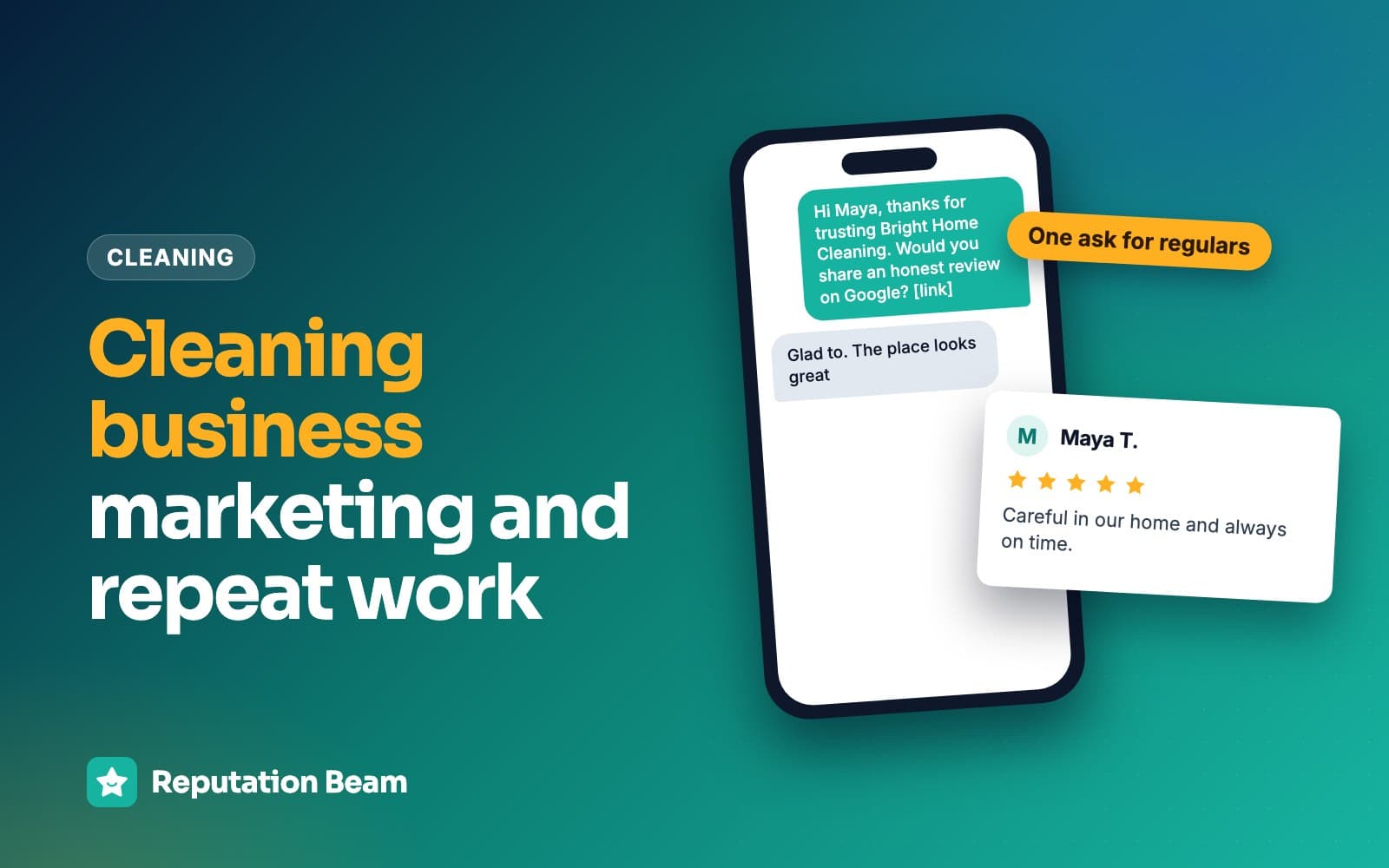
Send a short text that names your business, says the client has now had a few cleans, asks for an honest review and gives one link. Leave out when your team comes or whether the client's home, since phones get read by others. Text only people who agreed to texts, and email or leave a note for everyone else.
The FCC's rule (47 CFR 64.1200) requires prior express written consent for texts that include an advertisement or count as telemarketing, and it treats a "stop" reply as a reasonable way to revoke consent. This is general information, not legal advice. The texting guide has more, and the line below can go on your booking form.
Consent line for a cleaning booking form
I agree that [Business name] may text me at the number above about my cleaning visits and to ask for a review. Message and data rates may apply. Reply STOP to opt out. Agreeing is not a condition of service.
Text: after the third recurring clean
Hi [First name], it's [Your name] from [Business name]. Thanks for having us in your home. We ask every client once, around now, for an honest Google review. Would you leave one? [review link] Reply STOP to opt out.
Text: deep clean
Hi [First name], [Business name] here. Your deep clean is done. Call [phone number] if we missed anything. If you have a minute, would you leave an honest Google review? [review link] Reply STOP to opt out.
Text: move-out clean
Hi [First name], [Business name] here. One less job on your moving list, we hope. If you have a minute, an honest Google review would help us: [review link] Good luck with the move. Reply STOP to opt out.
Note left on the counter, with the code
Your home's been cleaned by [Business name]. Anything we missed? Call [phone number] and we'll fix it.
If you'd like to leave an honest Google review, scan the code or visit [review link].
Email: one time, to all current clients
- To
- [Customer email]
- Subject
- Would you review [Business name] on Google?
Hi [First name],
We're asking all of our clients, once, for an honest review on Google. People choosing a cleaner are deciding who to let into their home, and they read what other clients say.
Leave a review: [review link]
If there's anything we could do better, reply here and it comes straight to me.
Thanks, [Your name]
[Business name], [street address, city, state, ZIP]. Don't want emails like this? [unsubscribe link]
How to find your Google review link covers the link, and a Google review QR code makes the note quicker to use. Yelp's content guidelines say "Businesses should never ask customers to write reviews," so leave Yelp off it.
How to reply to cleaning complaints in reviews
Reply within a few days in three or four sentences, with a name and number. Say what you do in general, and keep details for the phone. A cleaning reply has one extra rule: never mention schedules, keys, alarm codes or when a home is empty, because anyone can read it.
| Complaint | What's usually behind it | What the reply does |
|---|---|---|
| "Missed the baseboards" | Scope not agreed, or a rushed visit | Offers a return visit under your re-clean policy |
| "Broke my vase" | A real accident | Takes responsibility, explains how damage is handled |
| "Something's missing" | Unknown, and serious either way | Asks for a call, accuses nobody |
| "Different cleaner every time" | Staff changes not explained | Explains how you assign teams and tell clients |
| "Charged for a canceled visit" | Lockout or late-cancel fee | Explains the policy in general, offers to review it |
| "Ruined my floor" | Wrong product on stone or wood | Offers a look, explains how you check surfaces |
| "Landlord still kept my deposit" | Issues beyond the clean | Offers to go through what was cleaned |
Three made-up replies.
Joanne F. (example)
GoogleAfter their visit something valuable was gone from my bedroom. Nobody has given me a straight answer.
Reply from Brightwell Home Cleaning (example)
Joanne, I take this very seriously and I'd like to speak with you myself today. Please call me at [phone number] so I can look into it and explain the next steps. Dee, owner
Aaron S. (example)
GooglePaid for a move-out clean and the landlord still took money from my deposit. Waste.
Reply from Brightwell Home Cleaning (example)
I'm sorry, Aaron, that's frustrating after a stressful move. We can't speak for a landlord's decision, but we do stand behind our cleaning. If the landlord named anything on our checklist, please call me at [phone number] and we'll go through it together. Dee, owner
Nadia W. (example)
GoogleRosa has been cleaning our place for a year and I trust her completely. Our home has never looked better.
Reply from Brightwell Home Cleaning (example)
Thank you, Nadia. I'll pass this along to Rosa, and it means a lot to the whole team.
Don't threaten a reviewer: the FTC says a business can't use an "unfounded or groundless legal threat" or intimidation to stop or remove a review (FTC questions and answers). Replace what you broke because you broke it, since Google prohibits "requests for revision or removal of a review or rating in exchange for an incentive." See how to respond to negative reviews for the wider method and how to respond to positive reviews for good ones.
Your cleaning business on Google Business Profile
Set up your profile as a service-area business, hide your home address, list the towns you actually clean in and add each service. Use the business name on your invoices. Many cleaning companies run from a home, which is fine: customers don't visit you, so Google asks you to hide that address.
Google's guidelines say "If you're a service-area business, you should hide your business address from customers," and that your area "shouldn't extend farther than about 2 hours of driving time from where your business is based." For a cleaning team paid by the visit, the sensible area is usually much tighter, because drive time between homes is unpaid. Google adds that "Including unnecessary information in your business name isn't permitted."
Before
Brightwell Best Maid Service House Cleaning Deep Clean Near Me
After
Brightwell Home Cleaning
Services go in the services list. Keywords in the name risk your profile.
Before
A stock photo of a smiling cleaner with a spray bottle
After
Your real team in uniform, your car, a kitchen with the client's permission
Keep family photos, mail and anything identifying out of the shot.
On Google's services page, list recurring house cleaning, deep cleaning, move-in and move-out cleaning, post-construction cleaning and office cleaning, if you do them.
Cleaning service pages that earn the key
Write separate pages for recurring cleaning, deep cleaning, move-out and move-in, post-construction and offices. Each one should say what's included, what isn't, how you quote and who comes to the home. A clear included list heads off "missed the baseboards" complaints before they happen, and it answers what people searched for.
| Page | What the client is worried about | What the page should say |
|---|---|---|
| Recurring cleaning | Same person? Trust with a key? | Team assignment, key handling, how to skip a visit |
| Deep cleaning | What's the difference? | A room-by-room list, and how long it takes |
| Move-out | Will I get my deposit back? | Your checklist, and that the landlord decides |
| Office cleaning | After-hours access | Who has access, how you lock up |
What to say about insurance, bonding and products
These are the questions a person asks before handing you a key, so answer them on the page. Say what you truly hold. A rule of thumb: ask your insurance agent exactly what your policy and any bond cover before you print "bonded and insured," and keep proof ready to show. If you run background checks on staff, say so and say what they cover.
- 1
The same two-person team whenever we can manage it. We tell you first if that changes.
Who comes
Answers the most common recurring complaint.
- 2
Your key or code is logged, kept off the van and never labeled with your address.
Keys
Only promise what you actually do.
- 3
Tell us within 48 hours and we'll repair, replace or claim on our insurance.
If something breaks
Use your real policy. This is what people fear.
- 4
We bring our own products. Tell us about any you'd like us to avoid.
Products
Useful for allergies and stone floors.
If you advertise green cleaning, be specific. The FTC's summary of its Green Guides tells marketers to avoid "broad, unqualified general environmental benefit claims," with "green" and "eco-friendly" as its examples, and says a qualifier should be "clear, prominent, and specific." Name what the product actually does or leaves out, and only if you can back it up. Licensing and registration differ by state and town, so check yours. Show reviews on these pages with how to add Google reviews to your website.
How to get more cleaning clients through referrals and repeat work
To get more cleaning clients cheaply, ask current clients to tell a friend, offer every one-time client a regular schedule, and build contacts who see people moving. Keep referral credits completely separate from reviews.
- 1
One-time job
A deep clean or move-in clean, with a checklist they can see.
- 2
The offer
On the day: would you like us back every two or four weeks?
- 3
Recurring client
Same team when you can, and notice if that changes.
- 4
The referral
A credit on their next clean when a friend books.
Worth trying for a small cleaning team
- A referral credit, on a card left with the note
- Realtors and agents, for move-in and listing cleans
- Property managers, for turnover cleans
- Movers and home organizers
- Vacation rental hosts in your towns
Be careful with
- A discount in return for a review, which Google prohibits
- Group coupons that bring one-time bargain hunters
- Lead sites that sell one client to several cleaners
- Before-and-after photos of a home without permission
- Prices too low to pay your team properly
You may reward a referral. You can't do the same for a review: Google prohibits offering "payment, discounts, free goods and/or services" for one. For nearby recommendations, see how to get recommendations on Nextdoor. Movers and property managers have their own guides in moving company marketing and property management marketing, which show what they want from a partner.
Referral card left with the note
Know someone who needs a cleaner? Give them this card. When they book their first clean with [Business name], you get [credit] off your next visit. Call [phone number].
Paid ads for a small cleaning business
Paid ads suit a cleaning business when you have open slots on existing routes and can keep the client for a while. Try Local Services Ads first, in the towns you already clean, and watch which leads become recurring. A one-time job at a low price rarely pays for the lead by itself.
Google's Local Services Ads page lists "House cleaning services" as a category and says you "only pay when a customer gets in touch from your ad." Its screening page describes these providers as performing "standard or deep cleans on offices or homes" and lists background, license and insurance checks for select users, so see what applies to you.
A rule of thumb: set a monthly test budget you could lose without it hurting, ask every caller how they found you, and count how many became recurring clients.
Common cleaning business marketing mistakes
Watch for these.
- Asking recurring clients on every visit, or only the friendly ones.
- Telling cleaners to get reviews, or naming them in the request.
- Mentioning schedules, keys or an empty home in a reply.
- Saying "bonded and insured" without checking what you hold.
- Vague "green" claims with nothing behind them.
- A one-time job that ends with no offer of regular visits.
Cleaning business marketing setup
0 of 10 done
Where Reputation Beam fits
Reputation Beam sends review requests by text and email from one dashboard. If you schedule cleans in Housecall Pro or Jobber, visits can come in from there, and a connected system sends a request after each visit unless you turn that off on the connection. For recurring clients on a once-only rule, turn it off and send requests from the dashboard. Each request has its own link, templates use placeholders for the customer's name, your business name and the review link, and each customer's permission to be texted is recorded. Google and Yelp reviews arrive in one feed, and you can reply to Google reviews from there.
Keep going
Google's review policy has the full rules, and the best time to ask for a review compares other trades. Another route business is covered in landscaping marketing ideas.
Questions people ask
What is the best way to market a small cleaning business?
For a small cleaning business, start with honest Google reviews and a complete Google Business Profile, because people are deciding who to let into their home. Then write pages for recurring cleaning, deep cleaning and move-out cleaning that explain insurance, keys and who will come. Add a referral credit for current clients, and meet realtors and property managers. Use paid ads last, when you have open slots.
How do I get more cleaning clients?
To get more cleaning clients, ask current ones to tell a friend, with a credit on their next clean for each referral who books. Offer every deep clean and move-out client a regular schedule when the job ends. Keep reviews coming so that new people can check you, and build contacts with realtors, property managers and movers. Ask new callers how they found you, and do more of what works.
When should a cleaning business ask for a review?
Ask recurring cleaning clients once, after the second or third clean, because the first visit is a catch-up and consistency is what they're paying for. Use the same number for every client. Ask deep clean and move-out clients the day the job ends. Send the link by text if they agreed to texts, otherwise by email, and don't repeat the request on every visit.
Can I ask clients to mention my cleaner's name in a Google review?
No. Google's policy lists asking for specific content among the things it prohibits, along with requesting that staff solicit a certain number of reviews. A client may still name a cleaner on their own. Thank the client, use a first name at most, and pass the compliment along. Don't pay cleaners per review or run a contest, because that pressures staff and clients alike.
How should a cleaning company reply to a review about a missing item?
Take it seriously, say you'd like to look into it, and give the owner's name and phone number. Don't accuse the client, don't describe the home, and don't say when your team was there or who has a key. Keep the details for the phone call. Then follow your normal process, including your insurer's if needed, whether or not the review changes.
Should a cleaning business say it is bonded and insured?
Say bonded and insured only if you actually hold both, and be ready to show proof. Insurance and bonds are different products, so ask your insurance agent what yours cover before you print the words. Clients handing over a key care about this, so explain what happens if something breaks. State and local rules differ, so check any licensing or registration requirement where you work.
Was this guide helpful?
Get the free review request checklist and new guides
Twenty checks to run before you ask customers for reviews, as a one-page PDF. After that, a short email when new guides go up, at most once a week.