Key takeaways
- You have two audiences. Owners hire you, tenants review you, and owners read those tenant reviews before they call. Plan for both.
- Use one written rule for asking: every owner and every tenant at the same events, whatever their balance, notices or disputes. Keep requests apart from rent, renewals and deposits, because you hold power over all three.
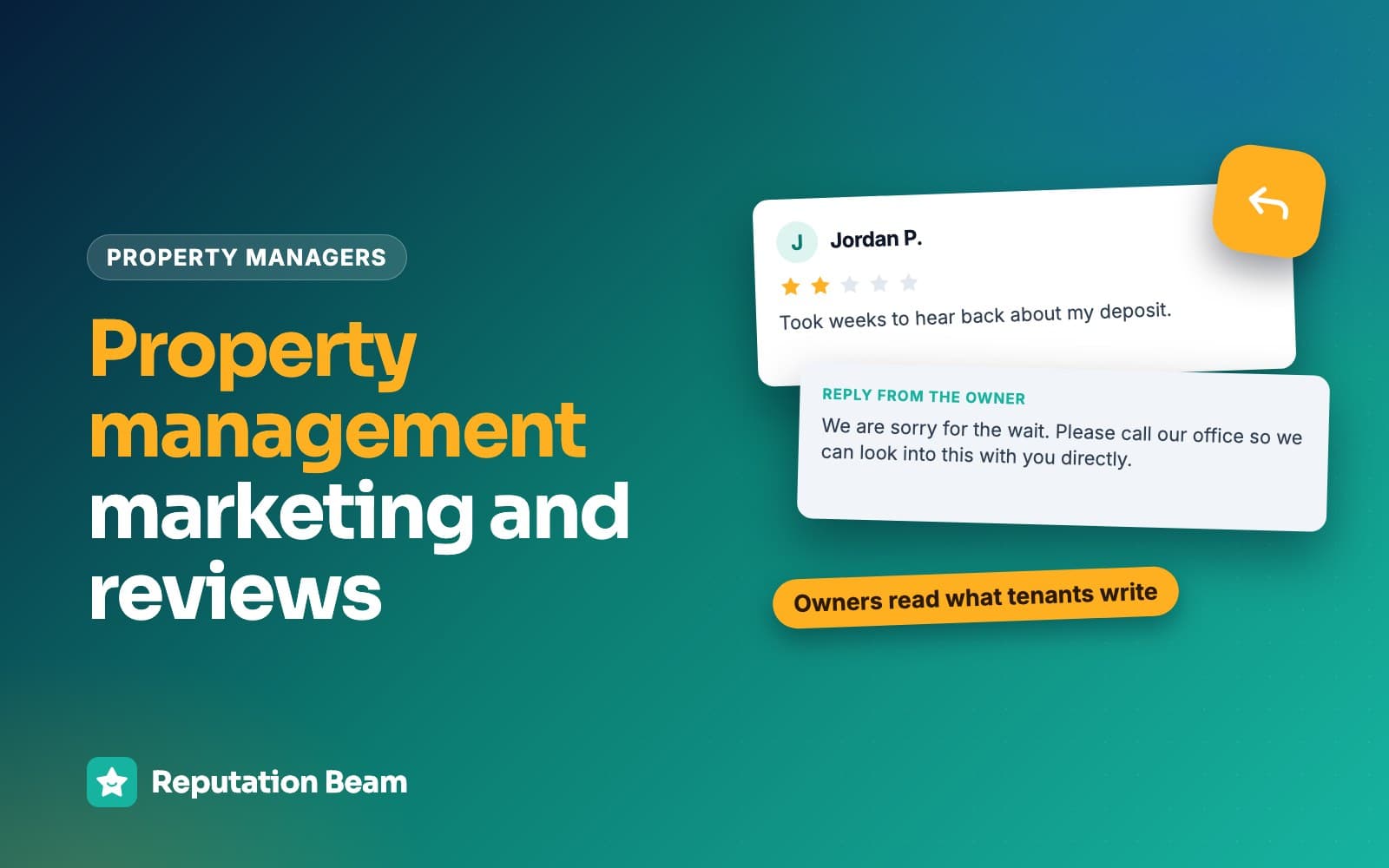
- Reply to a deposit or eviction complaint without confirming a unit, a balance, a notice or anything else about the person. Owners reading the reply want to see that you stay calm and keep details private.
- Keep ads inside fair housing rules. Describe the property and never the kind of person who should live there, and expect targeting limits on housing ads.
In this guide
- Property management marketing, in the order to try it
- Property management reviews: who to ask and when
- What to say to owners and tenants
- Property management review templates
- How to reply to angry tenant reviews
- Your Google Business Profile as a property manager
- How to get property management clients
- Fair housing care in your rental ads
- Paid ads for a small property management company
- Common property management marketing mistakes
- Where Reputation Beam fits
- Keep going
Property management marketing has a problem most local businesses don't face. The person paying you is the owner, and the person most likely to review you is the tenant who just got a late notice. A landlord deciding who to hire reads those reviews, so you need a plan for both audiences at once.
This guide starts with reviews: exactly when to ask owners and tenants, one rule that treats everyone alike, templates to copy and replies to deposit and notice complaints that give away nothing about the tenant. Then it moves to winning owners through your Google profile, a fee page and referrals from agents and attorneys, followed by fair housing care in rental ads and which paid ads are worth trying. Real estate agents have their own version of the review routine.
Property management marketing, in the order to try it
Start with a written rule for asking owners and tenants for reviews, then your Google profile, then a fee page and pages for each kind of owner you serve. Next build referrals from agents, attorneys and accountants, and write to absentee landlords. Paid ads come last, once someone answers owner enquiries fast.
Google says reviews feed into local visibility: "More reviews and positive ratings can help your business's local ranking" (Google Business Profile Help). Here's a rule-of-thumb order.
| Order | Step | Effort | What it does for a property manager |
|---|---|---|---|
| 1 | One rule for asking owners and tenants | One decision and a template | Evens out a profile that only hears from angry tenants |
| 2 | Google profile with a real office and service list | An afternoon | Shows up when an owner searches your town |
| 3 | Fee page and owner pages | A few weekends | Answers what owners ask on the first call |
| 4 | Referrals from agents, attorneys, accountants | Several visits | Owners arrive already trusting you |
| 5 | Letters to absentee owners | A list and a stamp | Reaches landlords who haven't started looking |
| 6 | Paid search | Money and tracking | Fills gaps once 1 to 5 work |
Property management reviews: who to ask and when
Ask owners after their first full statement and once a year after that. Ask every tenant a set time after move-in and again after the deposit statement goes out at move-out. Include people who are behind on rent or in a dispute with you. If you can't ask every tenant, ask no tenants and only ask owners.
It's tempting to ask only the tenants with no balance and no notices, and the rules forbid exactly that. Google's policy says merchants may not "selectively solicit positive reviews from customers." The FTC's guide on soliciting reviews says: "Don't ask for reviews only from customers you think will leave positive ones."
| Who | When to ask | Who asks | What they can honestly speak to |
|---|---|---|---|
| New owner | After the first full monthly statement | You or the portfolio manager | Onboarding, communication, statements |
| Long-term owner | Once a year, after the year-end statement | You or the portfolio manager | Vacancies, repairs, how you handled problems |
| New tenant | About 30 days after move-in | Leasing or office staff | Move-in, condition, how repairs were handled |
| Departing tenant | After the deposit statement is sent | Office staff | The whole tenancy, including the deposit |
| Vendors, staff, family | Never | Nobody | Google treats these as a conflict of interest |
Google's policy lists "Content that is based on a conflict of interest," including "current or former employment, a contractual or consultory relationship." Can employees leave Google reviews has more.
If you're in court with someone, your lawyer decides what you send them, and that's the one exception. Write it down in advance so it doesn't depend on how you think they'd rate you.
Keep the request away from rent, renewals and deposits
You hold a lot over a tenant: their deposit, their renewal and their repair queue. A request that arrives alongside any of these can feel like pressure, even if you mean none. Google says merchants "should not require or pressure users to leave ratings or write reviews while on the premises," and it prohibits offering "payment, discounts, free goods and/or services" for a review. So no rent credit for a review, and no "we'd love a review" in the renewal offer.
Keep these apart
- Send review requests as their own message, on their own date
- Wait until the deposit statement has gone out at move-out
- Use the same wording for everyone, whatever their account shows
Never do these
- Offer a rent credit, a waived late fee or a gift card for a review
- Ask at the door of a unit while a maintenance tech is working
- Hold back a move-out statement until someone has reviewed you
- Skip tenants with a balance or an open complaint
- Add a no-negative-reviews clause to a lease
What to say to owners and tenants
Owners get a personal ask from whoever manages their account, in the same conversation as a good statement or an annual review. Tenants get a short, neutral written request with a line saying it changes nothing about their lease. Most tenants should never hear a spoken ask at all, since you may be the person collecting their rent.
You
That's the year-end statement. The roof repair is on page two, and we're ready for the renewal in March.
Owner
Good. This was much less work than when I managed it myself.
You
We ask all of our owners once a year for an honest Google review, because other landlords read them before they hire anyone. I'll email you the link, if you have time.
Text consent should be its own line in the application or lease packet, apart from anything about rent notices. The FCC's rule (47 CFR 64.1200) requires prior express written consent for texts that include an advertisement or count as telemarketing, and treats a "stop" reply as a reasonable way to revoke it. This is general information, not legal advice, and the texting rules guide goes further.
Property management review templates
Keep tenant messages neutral and short, with a sentence saying the answer has no effect on their lease or deposit. Owner messages can be warmer and mention the work you did. Send one request and one reminder. Name no unit address in a tenant text, since other people may see the phone.
Consent line for the lease packet
I agree that [Company name] may text me at the number above to ask for feedback and reviews. Message and data rates may apply. Reply STOP to opt out. Agreeing is not a condition of renting, and it doesn't affect my lease or application.
Text: tenant, about 30 days after move-in
Hi [First name], it's [Company name]. How has it been so far? We ask all new residents for an honest Google review, good or bad. It has no effect on your lease: [review link] Reply STOP to opt out.
Text: former tenant, after the deposit statement
Hi [First name], it's [Company name]. We ask everyone who moves out for an honest Google review, good or bad. Your statement is already sent, and this changes nothing: [review link] Reply STOP to opt out.
Email: owner, after the first statement
- To
- [Owner email]
- Subject
- Your first statement from [Company name]
Hi [First name],
Your first full statement is in the portal. Call me at [phone number] if anything looks off.
We ask all of our owners for an honest Google review once they've seen how we work. Other landlords in [town] read them before they hire a manager. If you have a few minutes:
Leave a review: [review link]
Thanks, [Your name]
[Company name], [street address, city, state, ZIP]. Don't want emails like this? [unsubscribe link]
Email: tenant at move-out
- To
- [Tenant email]
- Subject
- Thanks for living at a [Company name] home
Hi [First name],
Your move-out statement has gone out, and it stands whether or not you answer this message.
We ask everyone who moves out for an honest Google review of how we did, good or bad. It helps future residents and it shows us what to fix.
Leave a review: [review link]
Thank you, [Your name]
[Company name], [street address, city, state, ZIP]. Don't want emails like this? [unsubscribe link]
How to find your Google review link covers getting and testing the link. Yelp's content guidelines say "Businesses should never ask customers to write reviews," so send requests to Google only.
How to reply to angry tenant reviews
Thank them, say you don't discuss anyone's tenancy or account in public, state your general practice and give a name and number. Don't confirm they lived there, and never mention rent, a notice, a balance, damage or a deposit amount. The owners reading it want to see that you stay calm and keep tenants' business private.
Your records may show the reviewer is plainly wrong. Posting them makes you the company that publishes a tenant's arrears, in front of the owner reading along. Run any serious dispute past your lawyer.
| Complaint | What's usually behind it | What the reply does |
|---|---|---|
| "Stole my deposit" | A move-out charge or a late statement | States that charges are itemized in general, offers a review by phone |
| "Slumlord, never fixes anything" | A slow or open repair | Gives the maintenance line and a manager's name |
| "Harassed me with notices" | Late rent or lease notices | Says you follow the lease and law, offers a call |
| "Evicted us at Christmas" | A legal process | Says you can't discuss anyone's tenancy, offers a contact |
| "Application fee and then rejected" | Screening criteria | Says criteria apply to everyone and offers a contact, gives no reason in public |
| "Owner: unit sat empty, fees too high" | Pricing or leasing delay | Offers to go through it, gives no figures |
| "Never rented from them" | Wrong company, or a former vendor | Same general reply, then flag it if it breaks Google's rules |
Here are three made-up replies. Each would read the same if the person had never rented from you. Thank a five-star reviewer just as briefly, with no unit or address.
Corey B. (example)
GoogleThey kept my whole deposit for 'cleaning' when I left the place spotless. Total scam company. Stay away.
Reply from Hillcrest Property Management (example)
Thank you for writing this. We can't discuss any resident's account here. Our practice is to itemize any move-out charges in writing, and we'll go over them with anyone who asks. Please call Lena at [phone number].
Jo M. (example)
GoogleThey put a notice on my door in front of my kids over a couple of days. Bullies.
Reply from Hillcrest Property Management (example)
Thank you for the feedback. We can't discuss anyone's tenancy in public. We follow the lease and local law on notices, and we want every resident treated with respect. If you'd like to talk it through, please call me directly at [phone number]. Sam, owner
Ruth A. (example)
GoogleI own a duplex they manage. Three weeks to return a phone call about a water leak. Fees are not cheap for that.
Reply from Hillcrest Property Management (example)
Thank you for raising this. That's not the response time we promise owners, and I want to hear what happened. Please call me directly at [phone number]. Sam, owner
Don't threaten a reviewer. The FTC says a business can't use an "unfounded or groundless legal threat" or intimidation to stop or remove a review (FTC questions and answers). Don't return a deposit in exchange for a deleted review either: Google prohibits "requests for revision or removal of a review or rating in exchange for an incentive." If you owe the money, pay it because you owe it. How to respond to negative reviews has more, how to remove a Google review covers what actually breaks the rules, and how to respond to fake reviews on Google covers the "never rented from them" case.
Your Google Business Profile as a property manager
Use your real company name, your staffed office, and the towns you actually manage in. Pick property management company as your category, list each service and put your maintenance line in reach. Tenants search your name when something breaks, so make the emergency number easy to find, or they'll tell the whole internet nobody answered.
Google's guidelines say "including unnecessary information in your business name isn't permitted, and could result in the suspension of your Business Profile." They also say virtual offices aren't eligible unless they're staffed during business hours, which rules out a rented mailbox in each town you'd like to work in. If owners and tenants never come to your office, Google says "you should hide your business address from customers."
Before
Hillcrest Property Management Rentals Homes for Rent Best Landlord
After
Hillcrest Property Management
Keywords in the name risk suspension.
Before
A profile for each apartment building you manage, all with your office phone
After
One profile for the company, based where it operates
A building that has its own on-site, staffed office is a separate question to check against the guidelines.
Google's services page explains Edit services. List what you really do: tenant screening, leasing, rent collection, maintenance coordination, inspections, eviction coordination if you handle it, HOA management if you offer it.
How to get property management clients
Owners come from referrals and search, and they're looking for proof that you'll keep their unit rented, their tenant reasonable and their repair bills honest. Publish your fees, build a page for each type of owner you serve, ask agents, attorneys and accountants for introductions, and write to absentee landlords by mail.
Pages an owner wants to read
Write a page for each worry, in the words owners use on the phone.
| Page | What that owner is worried about | What the page should say |
|---|---|---|
| Fees | Hidden charges, markups on repairs | Management fee, leasing fee, what's extra, repair markups |
| Accidental landlords | "I inherited this and don't know the rules" | What you take off their plate first |
| Out-of-state owners | "Who's looking at my property?" | Inspections, photos, statements, how they reach you |
- 1
Our management fee is [X] of monthly rent collected, with a leasing fee of [Y] when we place a tenant.
The number
Owners click away from 'call for a quote.' State yours.
- 2
Rent collection, statements, maintenance coordination, one inspection a year.
What's in it
Be specific, so owners can compare.
- 3
Eviction filing, court appearances, large project supervision.
What's extra
This prevents the 'hidden fees' review.
- 4
We call you before any repair over [Z], and we add no markup to vendor invoices.
Repairs
Only if true. If you mark up, say so.
Put your license details on the site, and check your state's rule first. California's Department of Real Estate tells landlords to "Check the property manager's Department of Real Estate license, which must be valid and active to collect rent and manage your property" (landlord's guide). Other states differ, so ask your own real estate commission.
Referrals from agents, attorneys and accountants
Agents who sell to investors, estate and family attorneys, accountants and insurance agents all meet owners at the moment they need a manager. One good introduction can mean several doors, and existing owners often have another property or a friend who does. Visit in person, explain who you do and don't take on, and send back any buyer or seller leads.
- 1
List 10 referrers
Investor-friendly agents, estate attorneys, accountants, insurance agents.
- 2
Visit with one page
Your fees, your area, the size of property you take.
- 3
Report back
Tell them what happened to everyone they sent.
- 4
Return the favor
Send owners who are selling to the agent who sent them.
Your state's license law may limit who can receive a referral fee on real estate work, so ask your commission or lawyer before paying anyone. Any thank-you to an owner who refers another owner must have no connection to a review.
Letters to absentee owners
An owner whose mailing address is different from the property's address is often a good fit, and county records usually show this. Send a letter. Texting that list is a bad idea: the FCC's rule above requires prior express written consent for marketing texts, and these people never gave you any.
Letter to an out-of-area owner
Dear [Owner name],
County records list you as the owner of a rental on [street name], and your mailing address is in [other town]. If you're happy managing it from there, please ignore this letter.
If it's become a chore, we manage [number] homes in [town]. Our fees are published at [website], and every owner gets a monthly statement and a named person to call.
If you'd like a straight answer about what your rental could bring in and what we'd charge, call me at [phone number].
[Your name], [Company name], [street address, city, state, ZIP]
Your current owners are the cheapest doors you'll ever add. A year-end call with the statement and a look at next year's rent gives you a reason to talk, and a second property often comes up.
Fair housing care in your rental ads
Describe the property, never the person who should live in it. HUD says the Fair Housing Act prohibits discrimination because of race, color, national origin, religion, sex, familial status or disability, and its rule covers ads, flyers and spoken statements. Check every listing, photo and targeting choice against that, and check your state's added protected groups.
HUD's overview of the Act lists the protected groups. Its guidebook chapter on fair housing, written for housing agencies, says the Act bars publishing "any notice, statement, or advertisement with respect to the sale or rental of a dwelling which indicates any preference, limitation, or discrimination." The regulation (24 CFR 100.75) covers written and oral statements, including applications, flyers, signs and banners. Its examples include words or images suggesting dwellings are or aren't available to a particular group, telling agents or employees about a preference, and choosing media or locations that keep certain groups from learning about housing.
These made-up rewrites show the habit. This is general information, not legal advice, and a fair housing lawyer or your state agency can review your standard ad wording.
Before
Perfect for a young professional couple. Quiet adult building.
After
One bedroom on the third floor, with a laundry room in the building.
Describes the unit. The first version signals age and family status.
Before
No kids, sorry.
After
Two bedrooms. Occupancy per local code.
Familial status is a protected group. There's a narrow exemption for housing for older persons, so ask a lawyer first.
Before
Walking distance to St. Anne's. Great Christian neighborhood.
After
Half a mile from the Oak Street bus stop and the grocery store.
Describe what's nearby in neutral terms. Don't describe who lives there.
Watch what owners ask for too. If an owner says "I'd rather not rent to families," passing that along to your leasing staff is one of the examples in the regulation. So don't promise owners "the right kind of tenant" in your sales material. Promise a written screening standard, applied to every applicant, and show them the page where you say so. Your reviews get the same care: never reuse a tenant's quote that describes their family, faith, disability or background.
Paid ads for a small property management company
Search ads can suit a manager with capacity, for owner terms such as "property management" plus your town. Count signed agreements, because leads are cheap to get and hard to close. Rental listing ads face housing targeting limits, so read those first.
Google's Local Services Ads page doesn't list property managers among its US categories, so that route is likely closed for now. Google's personalized advertising policy lists housing among its restricted categories, and says that in the United States and Canada you can't target those ads using gender, age, parental status, marital status or ZIP codes. Check any other ad network's housing rules before you spend there.
A rule of thumb: run a monthly test you could lose for at least a month, answer every owner enquiry the same day, and ask each caller how they heard about you. Compare the spend with what a signed owner brings you over a year. Be careful with lead sites that sell the same owner to several managers.
Common property management marketing mistakes
Most of these come from treating owners as the only audience.
- Asking only tenants with a clean ledger, or letting staff pick who gets asked.
- Asking for a review in a renewal offer or a deposit letter.
- Replying to a deposit complaint with the amount, the damage or the address.
- A no-negative-reviews clause sitting in an old lease addendum.
- Fee pages that say "call for details," then a one-star review about hidden charges.
Property management marketing setup
0 of 8 done
Where Reputation Beam fits
Reputation Beam sends review requests by text and email from one dashboard, as scheduled campaigns or after a visit. If you keep owners and showings in HubSpot or GoHighLevel, visits can come in from there and a request can follow each one. Tenant lists can be imported from a CSV file, so everyone at the same event gets the same message. Templates use placeholders for the person's name, your company name and the review link. Each request has its own link, and follow-up reminders can go to people who haven't responded. Each person's permission to be texted is recorded, and imported customers aren't texted until it is. Google and Yelp reviews arrive in one feed, and you can reply to Google reviews from there.
Keep going
Google's review policy has the full rules on asking, and the FTC fake review rule covers threats and fake reviews. For more wording, see review request email templates. Trades you already work with have their own versions in plumbing marketing ideas and cleaning business marketing, and they make good referral partners.
Questions people ask
How do property management companies get clients?
Small property management companies usually get owners through referrals from real estate agents, attorneys, accountants and existing owners, then through search and their Google profile. Owners read reviews and look for clear fees before they call, so start there. Build a page for fees and a page for each kind of owner you serve, and send plain letters to landlords who live out of the area. Add paid search last.
Should property managers ask tenants for Google reviews?
If you ask tenants, ask all of them at the same events, such as a set time after move-in and after the deposit statement goes out at move-out. Include tenants who are behind on rent or in a dispute with you. Google prohibits selectively soliciting positive reviews. Keep requests separate from rent, renewals and deposits, and offer nothing in return. If you can't ask everyone, ask no tenants and ask owners only.
How do you respond to a bad tenant review as a property manager?
Thank the reviewer, say you don't discuss anyone's tenancy or account in public, state your general practice and give a name and number. Don't confirm the person lived there, and don't mention rent, notices, deposits, damage, pets, family or health. Keep it to three or four sentences. Owners read these replies to judge how you'd treat their tenants, so calm and short is what they want to see.
Can a lease stop tenants from posting negative reviews?
Generally no. The federal Consumer Review Fairness Act voids form contract terms that restrict reviews or penalize people for posting them, and its definition of a form contract covers standardized terms used in selling or leasing goods or services. Check your lease and addenda for any no-disparagement clause and ask a lawyer to review them. Threatening a reviewer can also bring trouble under the FTC's rule on fake reviews.
What words should property managers avoid in rental ads?
Avoid words that signal who should or shouldn't live there. Under the Fair Housing Act, ads can't indicate a preference, limitation or discrimination based on race, color, religion, sex, disability, familial status or national origin. Phrases like perfect for a young couple, no children, or near the church can be a problem. Describe the unit and the location's features instead. State and local laws may add protected groups, so check yours.
Do you need a license to market property management services?
It depends on the state, and the license question usually turns on what you do for others, such as renting property and collecting rent. California's Department of Real Estate, for example, tells landlords that a property manager's license must be valid and active to collect rent and manage their property. Check your own state's real estate commission before you advertise management services, and ask whether a referral fee needs a license too.
What is the best marketing for a small property management company?
For a small company, the best marketing is a good reputation with the two groups that talk about you, plus being easy to find. Ask every owner and tenant for reviews on a fixed schedule, reply to each one and publish your fees. Build a referral list of agents, attorneys and accountants, then write to absentee owners by mail. Treat paid ads as an addition once your response time is fast.
Was this guide helpful?
Get the free review request checklist and new guides
Twenty checks to run before you ask customers for reviews, as a one-page PDF. After that, a short email when new guides go up, at most once a week.