Key takeaways
- Pet owners choose a vet on trust, and they read other owners' reviews to find it. A steady flow of honest reviews, asked for the same way at each visit type, is the place to begin.
- Never send a review request after euthanasia or a pet's death. Write the rule down, apply it to every client in that situation however the visit went, and don't stretch it to clients who are simply unhappy.
- Reply to every review as if you can't see the chart. Don't confirm the person is a client, even when they've named their pet and described the visit themselves.
- New puppy and kitten owners come back several times in their first months. Shelters, groomers and trainers meet them first, so those are the relationships to build.
In this guide
- Veterinary marketing ideas, in the order to try them
- When to ask a pet owner for a review
- Euthanasia and loss: the one situation where nobody gets asked
- What the front desk says at checkout
- Vet clinic review templates: texts and email
- Replying to veterinary reviews: bills, waits and loss
- Your Google Business Profile as a vet clinic
- Veterinary service pages that answer the search
- How to get more veterinary clients: puppies, kittens and repeat visits
- Paid ads for an independent vet clinic
- Common veterinary marketing mistakes
- Where Reputation Beam fits
- Keep going
A pet owner looking for a new vet can't judge the medicine, so they read what other owners say about how their animal was handled and whether the bill came as a shock. That puts honest reviews first among veterinary marketing ideas for an independent clinic, with a Google profile and a welcome for new puppy owners close behind.
This guide begins there: when to ask at each kind of visit, what the front desk says, texts to copy, and how to answer the review that says you only care about money. It also sets out the one situation where nobody gets asked, the loss of a pet. Then come your Google profile, service pages, new clients and ads. How to ask customers for reviews covers the general basics.
Veterinary marketing ideas, in the order to try them
Start with reviews and a rule for asking, then your Google Business Profile, then pages for your main services, then relationships with shelters, groomers and trainers. Paid ads come last. An independent veterinary clinic fills up mostly on trust between neighbors, which costs little to build.
Google says "More reviews and positive ratings can help your business's local ranking" (Google Business Profile Help). Here's a rule-of-thumb order.
| Order | Idea | Why it suits a vet clinic |
|---|---|---|
| 1 | Ask for reviews by visit type | Owners read how pets were handled |
| 2 | Google profile with honest hours | Answers "are they open, and who do I call at night?" |
| 3 | New puppy and kitten page, service pages | Meets the owner who's searching before a first visit |
| 4 | Shelters, groomers, trainers | They hear "do you know a good vet?" every week |
| 5 | Accurate reminders | Brings established clients back |
| 6 | Paid ads | Fills openings you really have |
When to ask a pet owner for a review
Ask when the owner can see how their pet is doing. After a wellness visit, text the link that day. After surgery or a hospital stay, wait until the pet is home and settled. Ask an established client about once a year. Choose by visit type in advance and apply it to everyone, including the client who sighed at the bill.
| Visit | Spoken mention | Text with the link |
|---|---|---|
| New client, or new puppy or kitten's first exam | At checkout | Same day |
| Established client, wellness or vaccines | At checkout, about once a year | Same day, about once a year |
| Sick visit with treatment | At checkout, if the pet's going home | Next day |
| Dental or surgery | At the recheck | After the recheck, or about three days later if there isn't one |
| Urgent or hospital stay | At discharge | The day after the pet is home |
| Euthanasia or a pet's death | Never | Never, see the rule below |
These are rules of thumb. Keep the visit's details out of the text itself, since family members may read it and a client may not want "surgery" on a shared screen.
A sick visit that's going slowly still gets the text. If you wait for the pet to recover before you ask, you end up asking only the clients whose pets did well, and Google prohibits merchants that "selectively solicit positive reviews" (Google's policy). The FTC's guide on soliciting reviews says the same: "Don't ask for reviews only from customers you think will leave positive ones."
Euthanasia and loss: the one situation where nobody gets asked
Never send a review request to a client after euthanasia or a pet's death. That's the rule, and it covers every client in that situation, whether they hugged your technician or walked out furious. It depends only on what happened to the pet, never on how you expect that person to rate you.
The rest of this guide tells you to ask everyone the same way, and this is an exception to that. Google's review policy doesn't carve out this situation, so it's a judgment call. It stays fair because the trigger is an event you can write down, and it leaves out kind clients as well as angry ones. It would stop being fair the day it stretched to "clients who had a hard visit," so keep it narrow.
| Situation | Review request? |
|---|---|
| Euthanasia at the clinic or at home | No |
| Pet died during a procedure or a hospital stay | No |
| Pet died at home after a recent visit, and you've been told | No, and pull any request not yet sent |
| Terminal diagnosis, hospice or comfort care | No, from that visit on |
| Serious diagnosis, with treatment going ahead | Yes, on the normal schedule |
| Unhappy about a bill, a wait or a staff member | Yes, on the normal schedule |
| Same household, another pet's ordinary visit later | Yes, on the normal schedule |
| A grieving client asks how to leave a review | Give them the link, since they asked |
A rule that relies on someone remembering will fail on a busy Friday. Build the check into how the list goes out.
- 1
Mark the record
Whoever closes the visit marks the pet deceased that day, in your practice software.
- 2
Check the list
Before any review request goes out, compare it against those records.
- 3
Stop the rest
Vaccine reminders, recall cards and promotional emails stop for that pet too.
- 4
Send the card
A sympathy card if you send them. Nothing in it asks for anything.
After a loss
- Write the rule down and teach it to every new hire
- Keep a short note of who was left out and why, so the owner can see it holds
- Leave the client alone until they contact you
Never
- Put a review link or offer in a sympathy card
- Ask gently a few weeks later
- Leave out a client because you think they'd be harsh or kind
- Discourage a client from writing about what happened
What the front desk says at checkout
At a veterinary clinic the ask usually comes from the front desk, since the vet may already be in the next room. Say one sentence at checkout, in the same words for everyone, and say a text is coming. These are made-up examples.
Client
She did so much better than last time. I think she likes Dr. Amara.
You
She was great. We ask our clients for an honest Google review, because it helps other pet owners find us. We'll text you the link later today if you'd like to leave one.
Client
This is a lot more than I expected for one visit.
You
I understand. Let me go through the invoice with you now, line by line, and Priya can call you tomorrow about any questions.
Ask for texting permission on the new-client form, and record the answer. The FCC's rule (47 CFR 64.1200) requires prior express written consent for texts that include an advertisement or count as telemarketing, and treats a "stop" reply as a reasonable way to revoke it. The guide to texting customers goes further. This is general information, not legal advice.
Vet clinic review templates: texts and email
Send a short text naming the clinic and the pet, with one link and no details of the visit. Text only clients who agreed. Everyone else gets the email, or a card with the invoice and a Google review QR code.
Consent line for a new-client form
I agree that [Business name] may text me at the number above about my pet's appointments and to ask for a review afterward. Message and data rates may apply. Reply STOP to opt out. Agreeing is not a condition of care.
Text: wellness visit, same day
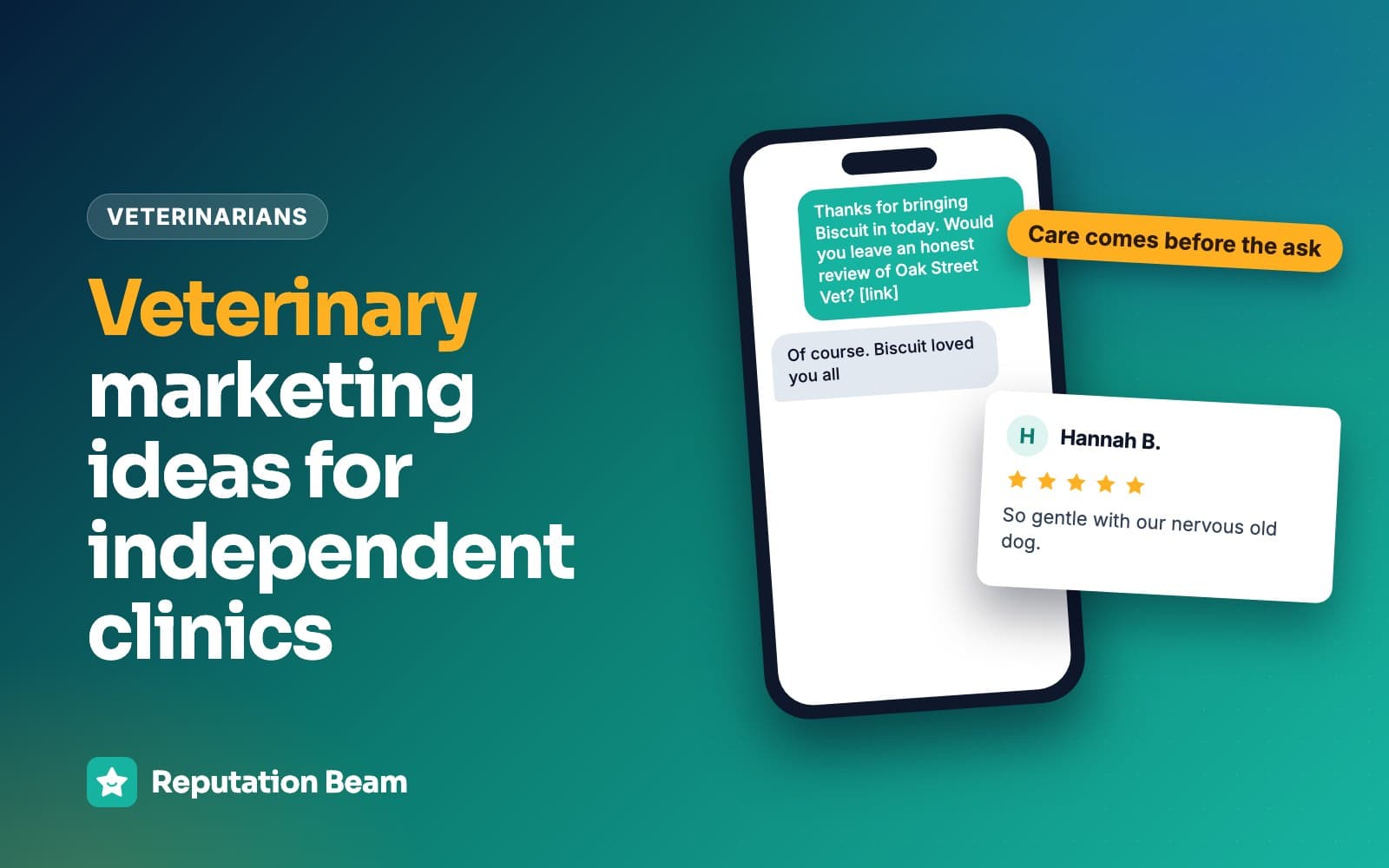
Hi [First name], it's [Business name]. Thanks for bringing [Pet name] in today. Would you take a minute to leave an honest Google review? [review link] Reply STOP to opt out.
Text: new puppy or kitten, first visit
Hi [First name], [Business name] here. It was lovely to meet [Pet name]! Would you share an honest Google review for other new pet owners? [review link] Reply STOP to opt out.
Text: after a recheck or hospital stay
Hi [First name], it's [Business name]. Hope [Pet name] is settling in at home. Call [phone number] with any questions. If you have a minute, would you leave an honest Google review? [review link] Reply STOP to opt out.
Email: new client
- To
- [Client email]
- Subject
- Thank you for choosing [Business name]
Hi [First name],
Thanks for trusting us with [Pet name]. Call us at [phone number] with any questions.
If you have a few minutes, would you leave an honest review on Google? It helps other pet owners in [town] choose a vet.
Leave a review: [review link]
[Your name], [Business name], [street address, city, state, ZIP]. Don't want emails like this? [unsubscribe link]
How to find your Google review link covers getting and testing the link. Keep Yelp out of these: Yelp's content guidelines say "Businesses should never ask customers to write reviews." Review request email templates has more wording.
Replying to veterinary reviews: bills, waits and loss
Reply as if you can't see the chart. Thank the reviewer, say you can't discuss any pet's care here, explain your general practice, and give a name and number. Never confirm the person is a client, repeat a pet's name, or post a diagnosis or a bill, even when the reviewer has shared those details.
HIPAA is written around people's health information and covered entities. What applies to veterinary records is a question for your state board or a lawyer, since states differ. Write replies this way regardless. A clinic that argues a pet's history in public looks worse to the next reader, and it may breach whatever your state does require. This is general information, not legal advice.
Reviews about a veterinary clinic are often emotional, and they can land hard on the person named. So the owner or manager writes the reply, and a review about a loss waits until the next morning. If a review alleges malpractice, call your liability insurer before you answer.
| Complaint | What not to say | What the reply does |
|---|---|---|
| "You only care about money" | The bill, or what was done | Says estimates are explained in general, offers a manager |
| "My pet died because of you" | Anything about the case | Offers sympathy and the owner's direct line |
| "Wouldn't refill without an exam" | "Your cat hasn't been seen since..." | Explains the general exam policy, invites a call |
| "Waited an hour past my appointment" | "An emergency came in with..." | Apologizes, says emergencies can move the schedule |
| "Wouldn't see my sick dog today" | "You aren't a client of ours" | Says how urgent calls are handled, offers a call |
Here are three made-up examples.
Ruth M. (example)
GoogleWe trusted them with Biscuit for eleven years and she died after a routine dental. Nobody has explained what happened. We are devastated.
Reply from Willow Bend Veterinary Clinic (example)
I'm so sorry for the pain in your words. We can't discuss any pet's care here, but I'd like to speak with you personally and answer every question I can. Please call me directly at [phone number]. Dr. Amara, owner
Terrence B. (example)
GoogleVets are all about money. $900 for what should have been a simple visit and they pushed every test they could.
Reply from Willow Bend Veterinary Clinic (example)
Thank you for writing. We can't discuss any visit here. Our practice is to go over an estimate and the options before treatment when time allows, and the decision belongs to the owner. If that didn't happen, I want to know. Please call Priya at [phone number].
Lena G. (example)
GoogleRefused to refill my cat's medication without another exam. Just a money grab.
Reply from Willow Bend Veterinary Clinic (example)
I understand that's frustrating. We can't discuss any pet's care here. In general, we need a current exam before prescribing, because of our medical standards and the rules we practice under. Please call us at [phone number] and we'll look for the quickest way to help.
Don't threaten a reviewer: the FTC says a business can't use an "unfounded or groundless legal threat" or intimidation to stop or remove a review (FTC questions and answers). Correct a billing error because it's an error, separately from the review, since Google prohibits "requests for revision or removal of a review or rating in exchange for an incentive." How to respond to negative reviews goes deeper, and how to remove a Google review covers reviews that break Google's rules.
Your Google Business Profile as a vet clinic
Use your clinic's real name, the category that fits, your true hours and a clear line on what happens after hours. List each service you provide, and add photos of your own building, team and exam rooms. The question a worried owner is asking at 9 p.m. is whether you're open, so make that answer accurate.
Google's guidelines say "including unnecessary information in your business name isn't permitted, and could result in the suspension of your Business Profile," so "Willow Bend Vet Best Emergency Animal Hospital" won't do. If several vets work at your clinic, Google says the organization "should create a Business Profile for this location, separate from that of the practitioner." Send every client to the clinic's link, so nobody picks and chooses whom to send where.
- Hours: list only when someone can see a pet. If you don't take emergencies, don't imply you do.
- After hours: name the emergency hospital you send people to, on your site and your voicemail.
- Services: wellness exams, vaccines, dentistry, surgery, senior care and exotics, only if you truly offer them.
- Photos: use client pets only with the owner's written permission, and keep names and charts out of the frame.
Veterinary service pages that answer the search
Write a page for each service an owner would search for, starting with new puppies and kittens, wellness care, dentistry and urgent visits. Each page should say what the visit involves, how you handle estimates, and which animals you see. Say how you handle a frightened animal, since that owner wants it first.
| Page | What that owner is worried about | What the page should say |
|---|---|---|
| New puppy or kitten | What's needed, and when | The first-months visit plan, what to bring |
| Wellness and vaccines | Too many tests or shots | How you tailor these, how you explain the options |
| Dentistry | Anesthesia, cost | How you assess, how you estimate first |
| Urgent care and after hours | Where to go right now | Your hours, and the hospital you refer to at night |
- 1
The first visit is an exam, a vaccine plan and time for your questions.
What happens
A nervous new owner wants to know what to expect.
- 2
We give you an estimate before anything's done.
Cost
Heads off the most common complaint.
- 3
Any shelter or breeder records, a stool sample, and your list of questions.
Bring
Useful enough on its own that they'll remember who told them.
How to add Google reviews to your website explains how to show reviews on these pages. Before quoting a client, read using customer reviews in marketing.
How to get more veterinary clients: puppies, kittens and repeat visits
New puppy and kitten owners are the clinic's best new clients, because the first months bring several visits and the habit often lasts for the animal's life. They usually meet someone else first, so introduce yourself to shelters, rescues, groomers and trainers. Then keep reminders accurate so established clients return.
New adoptions
Shelters and rescues
Ask what adopters need to know, and offer a one-page sheet on the first vet visit with your details on it.
Word of mouth
Groomers and trainers
Clients ask them which vet to use. Stop by, and refer back when your clients ask. Check your state board's rules before paying for any referral.
Practical need
Boarding kennels
Kennels often ask for vaccine records before a stay. Offer to send records quickly with the owner's permission, and they'll remember you.
Reminders work only if the list is right. Send them by email or with text permission. For neighbor recommendations, see how to get recommendations on Nextdoor. A referral credit between clients is fine if your state allows it, as long as it has nothing to do with reviews: Google prohibits offering "payment, discounts, free goods and/or services" for one.
Paid ads for an independent vet clinic
Paid ads suit a vet clinic when you have new-client openings and someone answers the phone. Google's Local Services Ads are worth checking first, then search ads for a short drive around the clinic. Skip them while you're booked three weeks out, since a new owner with a sick pet won't wait.
Google's Local Services Ads page includes "Veterinarian" among its categories and says to "Pay only for leads related to your business and the services you offer." Check whether it's offered in your area. A rule of thumb: set a test budget you could lose, ask every new client how they heard about you, and compare new clients with the spend after a month or two.
Common veterinary marketing mistakes
Most of these come from a list nobody checked.
- Sending a review request or vaccine reminder for a pet who has died.
- Stretching the loss rule to leave out clients who had a difficult visit.
- Replying to a review with the pet's history or what the bill covered.
- Asking regular clients for a review at every vaccine.
Veterinary marketing setup
0 of 7 done
Where Reputation Beam fits
Reputation Beam sends review requests by text and email from one dashboard. You can add clients one at a time or import a CSV file, for example an export from your practice software. It doesn't know about a loss, so take any client your rule excludes off the list before you add or import it, and check for clients already waiting to be asked. Templates use placeholders for the client's name, your business name and the review link, and each request has its own link. Each client's permission to be texted is recorded, and a hosted opt-in form with a QR code lets clients give it themselves. Google and Yelp reviews arrive in one feed, and you can reply to Google reviews from there.
Keep going
Google's review policy has the full rules on asking, and the best time to ask for a review compares timing across other kinds of business. How to respond to fake reviews on Google helps when a review doesn't match anyone you know. The reply stays the same, since "we have no record of you" discloses something too.
Questions people ask
What is the best way to market a small veterinary clinic?
For a small independent veterinary clinic, start with Google reviews and a complete Google Business Profile, since pet owners compare clinics on their phones. Then write pages for wellness care, new puppies and kittens, dentistry and what to do after hours. Build relationships with shelters, groomers and trainers, who meet new pet owners first, and keep your reminders accurate. Add paid ads last, and only when you can take new clients.
Should a vet clinic send a review request after euthanasia?
No. A veterinary clinic should never send a review request after euthanasia or a pet's death. Make it a written rule that applies to every client in that situation, however the visit went, and check the send list against it before each batch. If a grieving client asks how to leave a review, give them the link. Don't discourage a review, and don't use this rule to leave out clients who are merely unhappy.
When should a veterinary clinic ask for a review?
A veterinary clinic should ask on the same schedule by visit type. After a wellness visit or a new pet's first exam, text the link that day. After surgery or a hospital stay, wait until the pet is home and settled or has had its recheck. Ask an established client about once a year, so regulars aren't asked at each vaccine. Never ask after a loss, and use the same rule for every client.
How should a vet reply to a review about a pet that died?
Express real sympathy, say you can't discuss any pet's care in public, and give the owner's direct number. Don't repeat the pet's name, confirm the person is a client, or defend the treatment, even if the reviewer gave the details. Have the practice owner write it, and wait until the next morning. If the review alleges malpractice, call your liability insurer before replying. Then have the real conversation by phone.
How do you answer a review saying a vet only cares about money?
Thank the reviewer, say you can't discuss any visit in public, and explain your general practice, such as going over an estimate before treatment when time allows. Give a manager's name and number to talk it through. Don't post the bill or list what was done. Fix a billing mistake because it's a mistake, separately from the review, since Google prohibits offering refunds or discounts in exchange for changing one.
How can a vet clinic get more new clients?
To get more veterinary clients, make the clinic easy to find and easy to trust: recent reviews, accurate hours, and a page for new puppy and kitten owners. Introduce yourself to local shelters, rescues, groomers, trainers and boarding kennels, who are often asked to recommend a vet. Make new-client booking simple, and ask every new client how they found you, so you know which of these to keep doing.
Was this guide helpful?
Get the free review request checklist and new guides
Twenty checks to run before you ask customers for reviews, as a one-page PDF. After that, a short email when new guides go up, at most once a week.