Key takeaways
- Orthodontic reviews come in fixed moments: a set point early in treatment, the end of each phase, and debond. Put those moments in writing and apply them to every patient, including those who finish early or transfer out.
- For a minor, the request goes to the parent or guardian on the account, never to the teenager's phone. A patient who has turned 18 gets their own request.
- Reply as if you can't see the chart. No names, no braces, no timeline and no balance, even when the parent wrote all of it in the review. HHS has settled with practices over replies to reviews.
- General dentists are the referral source to look after first. Send them useful reports on the patients you share, and keep gifts and payments away from referrals.
In this guide
- Orthodontic marketing, in the order to try it
- When to ask for a review during orthodontic treatment
- What the treatment coordinator says at debond
- Orthodontic review templates: text, email and a card
- Replying to orthodontic reviews without confirming someone is a patient
- Your Google Business Profile as an orthodontist
- How to get more orthodontic patients with your website
- Referrals from general dentists
- Paid ads for a small orthodontic practice
- Common orthodontic marketing mistakes
- Where Reputation Beam fits
- Keep going
An orthodontic patient stays with you for many months, pays over many months and often isn't the person making the decision. That shapes all of orthodontic marketing. A parent choosing between two offices reads what other parents wrote, asks their dentist and looks at the cost page, then books the consultation.
This guide starts with reviews, because a long treatment gives you one great moment to ask and plenty of ways to waste it. It covers exactly when to ask, who gets the request when the patient is 14, what the treatment coordinator says at debond, texts to copy and replies that never confirm anyone is a patient. Then it covers your Google profile, the pages that bring consultations, the advertising rules that catch orthodontists out, dentist referrals and whether ads are worth paying for. For the wider patient scripts, see how to get more patient reviews. If you run a general practice too, the dental version of the review routine covers cleanings and family visits.
Orthodontic marketing, in the order to try it
Start with reviews at debond, then your Google profile, then pages for the questions parents and adults actually ask, then reports to referring dentists. Paid ads come last. A small orthodontic practice wins more starts by being easy to trust and easy to refer to than by outspending the group practice across town.
Google says reviews feed into local visibility: "More reviews and positive ratings can help your business's local ranking" (Google Business Profile Help). Here is a rule-of-thumb order.
| Order | Step | Effort | What it does for an orthodontist |
|---|---|---|---|
| 1 | Written rule for asking at debond | One staff meeting | Reviews stop depending on who remembers |
| 2 | Complete Google profile | An afternoon | Parents find you on the map, with real photos |
| 3 | Pages for first visits, adults, aligners, cost | A few weekends | Answers what they're searching before they call |
| 4 | Reports back to referring dentists | A template and a habit | Keeps your name in the operatory down the street |
| 5 | Consultation follow-up | A written process | Turns exams you already did into starts |
| 6 | Paid ads | Money and tracking | Fills consultation slots once 1 to 5 work |
When to ask for a review during orthodontic treatment
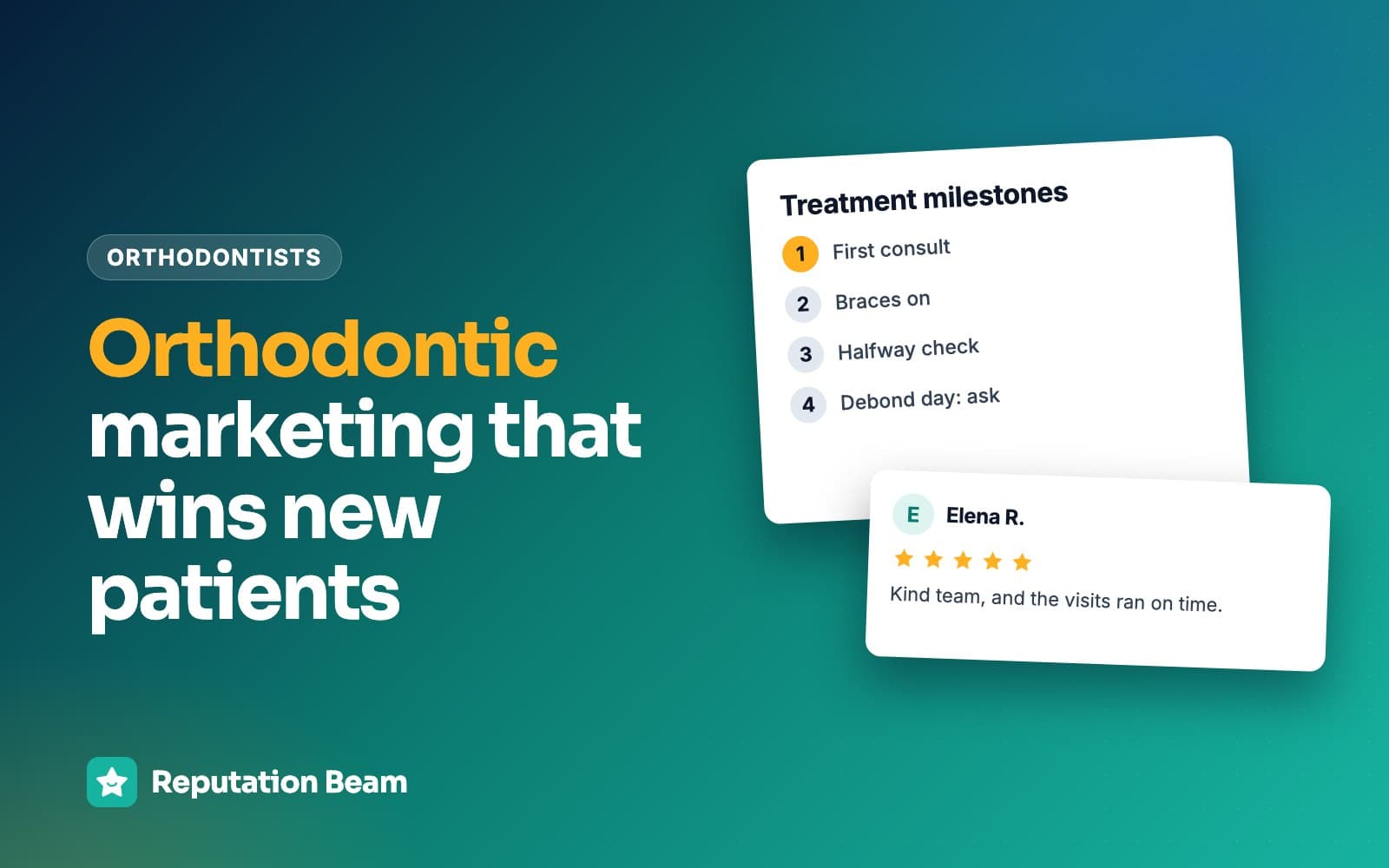
Ask at debond, after the patient has seen the result and the retainer instructions are finished, and send the link that day. Add one ask at a fixed point early in treatment, and one at the end of a first phase for children. Write these moments down and use them for every patient.
The early ask exists because debond can be a long way off. A parent six weeks in can honestly speak to how the options were explained, how the money was handled and how the staff treat their kid. If that parent later wants to say more, they can update the review they already left, and your debond text can say so.
Early in treatment
One ask at a set visit, such as the first adjustment after bonding or the first aligner check. Same visit for everyone.
End of phase one
For children in two-phase treatment, one ask when the first phase ends.
Debond or final aligner
The main ask. Spoken in the chair, link sent that day.
A few days later
One reminder to people who haven't responded.
Retainer checks
No ask. They've had theirs, and these visits are about the result staying put.
Here's how that looks by situation. Adjust the details, then hold to them.
| Situation | Spoken ask | Request with the link |
|---|---|---|
| Braces coming off | After the mirror and retainer instructions | Same day |
| Clear aligners finishing | At the final visit when retainers are delivered | Same day |
| Adult patient | Directly to them, in the chair | Same day |
| Teenager with a parent present | To the parent, at the chair or at checkout | Same day, to the parent |
| Teenager dropped off alone | Tell the teen a note is going to their parent | Same day, to the parent |
| Treatment stopped early or transferred out | At the last visit, or none if there isn't one | Same message, once the account is closed |
| Consultation with no start | No ask | Decide once for everyone: all of them or none |
The row people skip is the second-to-last. If you only ask at a finished debond, you've built a schedule that quietly leaves out the family who moved and the adult who quit at month ten. Google's policy says merchants may not "selectively solicit positive reviews from customers," and the FTC's guide on soliciting reviews adds: "Don't ask for reviews only from customers you think will leave positive ones." So the trigger is the end of treatment with you, however it ended. It also can't depend on whether the parent argued about the payment plan last spring.
Who to ask when the patient is a minor
Send the request to the parent or guardian who is the responsible party on the account, and never to the teenager's phone, even if the teen does all the scheduling. A patient who has turned 18 gets their own request, at their own number, because the record is theirs now.
HIPAA generally has a practice treat a parent or guardian with authority over a minor's health care decisions as the minor's personal representative, with exceptions (45 CFR 164.502(g)). That's about records and permissions, and state law can change the answer. This is general information, not legal advice. For review requests, the practical rule is that the adult on the account hears from you.
Set these once
- One request per guardian per debond day, even with two siblings finishing together
- Separated parents: the responsible party listed on the account, every time
- A patient who turned 18 mid-treatment: ask them, and update the contact details first
- Offer a printed card to a parent who prefers not to get texts
Avoid
- Texting a 15-year-old because their number is the one in the chart
- Asking a teenager in the chair to post from their own account
- Choosing the friendlier of two parents
Parents can write about what they saw: how options were explained, whether the office ran on time, how their child was treated. You can make it easier for them to protect their child with one sentence in the email: "Feel free to leave your child's name out." If a teen does post under their own account, treat it like any other review and write the same private reply.
What the treatment coordinator says at debond
The person who has built the relationship over the months asks, usually the treatment coordinator or the assistant at the chair, once the mirror moment and retainer instructions are done. It takes one sentence, and everyone on the team uses the same one. Here are made-up versions for three common days.
You
That's it. Retainer every night, and your first check is on the card. Take a good look, you've earned it.
Parent
I can't believe how different this looks. Thank you, everyone.
You
You've been great to work with. We ask all of our families for an honest Google review at this point, since parents read them when they're choosing an office. I'll send you the link today, if you'd like to.
Parent
We were told 18 months and it was closer to 26. And I'm still paying.
You
I hear you, and I'd like Dr. Okafor to go through the timeline with you. Do you have ten minutes now, or can she call you tomorrow? I can also ask the office manager to review the payment schedule.
Consent is simplest at the start. Treatment contracts already get read and signed, so put a texting line on the same packet and record the answer. The FCC's rule (47 CFR 64.1200) requires prior express written consent for texts that include an advertisement or count as telemarketing, and treats a "stop" reply as a reasonable way to revoke it. This is general information, not legal advice. The texting rules guide goes further.
Orthodontic review templates: text, email and a card
Keep every message to the practice name, a thank-you and one link. Don't name the child, the braces, the phase or the debond, because a lock screen can be read by anyone, and texts get shared on family plans. Send each person one request and one reminder.
Consent line for the treatment contract packet
I agree that [Practice name] may text me at the number above about appointments and to ask for feedback and reviews. Message and data rates may apply. Reply STOP to opt out. Agreeing is not a condition of treatment.
Signature of patient, or parent or guardian: ____________
Text: to a parent or guardian
Hi [First name], it's [Your name] at [Practice name]. Thank you for trusting us. If you have a minute, an honest Google review helps other parents choose: [review link] Reply STOP to opt out.
Text: one reminder, a few days later
Hi [First name], [Practice name] again. If you still have a minute for a Google review, here's the link: [review link] Either way, thank you. Reply STOP to opt out.
Email: to a parent or guardian
- To
- [Guardian email]
- Subject
- Thank you from [Practice name]
Hi [First name],
Thank you for trusting [Practice name] with your family's care. We know that takes a lot of trips and a lot of patience.
Would you take a few minutes to leave an honest review on Google? Other parents in [town] read them when they're choosing an office. Feel free to leave your child's name out, and if you've reviewed us before, you're welcome to update it.
Leave a review: [review link]
Thank you, [Your name]
[Practice name], [street address, city, state, ZIP]. Don't want emails like this? [unsubscribe link]
Card, tucked in with the retainer case
Thank you for trusting us. If you have a minute, an honest Google review helps other families find a practice they're comfortable with. Scan the code or visit [review link].
[Practice name], [phone number]
How to find your Google review link covers the link. Yelp's content guidelines say "Businesses should never ask customers to write reviews," so keep Yelp off the card.
Replying to orthodontic reviews without confirming someone is a patient
Reply as if you can't see the chart. Thank the reviewer, say you don't discuss anyone's care in public, and give a name and number. Don't confirm the person or their child is a patient, and don't mention braces, timelines, retainers or a balance. That holds when the parent posted all of it first.
HHS has acted on this. Its page on the New Vision Dental settlement says the practice disclosed patient information "in response to online reviews," and states: "This practice is illegal under HIPAA." Manasa Health Center settled over replies to negative reviews too. Whether HIPAA covers your practice depends on the definition of a covered entity (45 CFR 160.103). A cash-only office should ask a lawyer and can write replies this way regardless.
These are the complaints orthodontists tend to see.
| Complaint | What not to say | What the reply does |
|---|---|---|
| "Took 26 months, they said 18" | The child's compliance, missed visits, elastics | Says timelines matter to you, offers the doctor by phone |
| "Still paying after the braces came off" | The contract, the balance, the plan's terms | Offers the office manager's direct line |
| "Teeth moved back, they want more money" | Retainer wear, any retreatment fee | Offers a call with the doctor |
| "Doctor spent two minutes with my kid" | Who did what at which visit | Explains how visits work in general, offers a call |
| "Pushed braces on my 8-year-old" | Any finding or recommendation | Says options should come with the choice left to the family |
Here are two made-up replies.
Priya N. (example)
GoogleTold us 18 months for my daughter Ana and it took over two years. Her brackets kept coming off and nobody explained why. We're still making payments.
Reply from Maplewood Orthodontics (example)
Thank you for writing this. We can't discuss anyone's care or account here, but clear expectations matter to us and I'd like to hear from you directly. Please call Dr. Okafor at [phone number].
Tomás L. (example)
GoogleMy son's smile looks amazing and the whole team made him feel at home for two years.
Reply from Maplewood Orthodontics (example)
Thank you for taking the time to share this. Kind words like these mean a lot to our whole team.
Fake-looking reviews get the same general reply, since "we have no record of you" discloses something too. HIPAA-compliant review responses has more replies and a staff policy to adapt, and how to respond to negative reviews has the wider approach. Never trade a fee waiver or a refund for a changed review: Google prohibits "requests for revision or removal of a review or rating in exchange for an incentive."
Your Google Business Profile as an orthodontist
Choose orthodontist as your category, use your real practice name, set the hours each office is actually open, and list each service. A satellite office open two days a week needs those two days on its profile and no others.
Google's guidelines say "including unnecessary information in your business name isn't permitted, and could result in the suspension of your Business Profile," and virtual offices aren't eligible unless staffed during business hours. So "Invisalign Braces Orthodontist Near Me" doesn't go in the name, and a rented suite you never open doesn't get a profile.
Before
Maplewood Orthodontics Braces & Clear Aligners for Kids and Adults
After
Maplewood Orthodontics
Treatments belong in the services list.
Before
A wall of debond photos with patients' faces and names
After
Your waiting room, the treatment bay, parking and the team
A patient's photo needs written authorization. A parent signs for a minor.
Google's services page explains Edit services. List what you really do: braces, clear aligners, early orthodontic evaluation, adult orthodontics, retainers. Keep prices out of custom service names, as Google asks.
How to get more orthodontic patients with your website
Write a page for each decision a family or adult faces: a child's first visit, adult treatment, clear aligners or braces, and cost. Say plainly what happens at the first appointment, what it costs and how payment works. Each person has a different fear, so these shouldn't be one page with the word swapped.
| Page | What that person is worried about | What the page should say |
|---|---|---|
| First visit for a child | "Is my kid too young?" | What you check, and that many children just get monitored |
| Adult orthodontics | "Is it too late, and how will it look at work?" | Options you offer, how visits fit a work schedule |
| Clear aligners or braces | "Which one, and is the cheaper one fine?" | When you'd suggest each, in plain language |
| Cost and payment | "Can we afford this?" | Ranges you can stand behind, insurance, how plans work |
| Transfers | "We moved, or we're unhappy" | How you take over a case, what records you need |
The American Association of Orthodontists encourages parents to take their children "to see an orthodontist by age seven." Use it honestly on your first-visit page, and say what you'd do at that visit, including telling a family it's too early to do anything.
- 1
Treatment at Maplewood Orthodontics is priced after an exam, because it depends on what's needed and how long it takes.
The answer
People came for a number or a reason there isn't one. Give the reason.
- 2
Most of our comprehensive cases fall between [low] and [high].
A range
Only if your own records support the range.
- 3
We'll check your orthodontic benefit before you decide.
Insurance
Say what your office actually does.
- 4
We offer payment plans. Ask for the full terms at your consultation.
Payment
See the note on payment ads below.
The advertising rules that catch orthodontists
Three rules deserve an hour before anything goes to print. First, the word specialist. Many state dental boards regulate how specialties are described, and rules differ. In Texas, for example, 22 Tex. Admin. Code 108.55 requires a general dentist advertising specific services to show "General Dentist" or "General Dentistry" next to the name, in type no smaller than the service names, and spoken "in a clearly audible manner" on broadcast ads. A general dentist offering aligners should read their own board's rule first.
Second, the monthly payment ad. Regulation Z, the federal truth in lending rule, says that a credit ad stating "the amount of any payment" or the number of payments must also state the terms of repayment and the annual percentage rate (12 CFR 1026.24). Ask your lawyer whether your in-house plan or your financing partner's plan counts, because "Braces from $99 a month" is exactly the kind of line that rule looks at.
Third, smile galleries. HIPAA says a covered practice "must obtain an authorization for any use or disclosure of protected health information for marketing," with narrow exceptions (45 CFR 164.508). Get a signed authorization for each photo, from a parent or guardian for a minor. The FTC's Endorsement Guides say an endorsement about a key attribute can imply that the experience is what people will generally achieve, so don't let your best case stand in for the usual one, or promise a timeline from it. The FTC's advertising FAQ says "advertising must be truthful and non-deceptive." This is general information, not legal advice.
Referrals from general dentists
General and pediatric dentists are where many parents hear your name first. Win them by making referrals easy, reporting back on shared patients and returning those patients for routine care. Visit in person, give the office a direct number, and answer their questions the same day. Keep money and gifts well away from it.
- 1
They refer
A one-page form or a phone number that gets answered, with no referral portal to learn.
- 2
You report the first visit
A short note on findings and plan to that patient's dentist.
- 3
You report the milestones
Start of treatment and debond, plus anything that affects their work.
- 4
You send them back
Remind the family that routine dental care continues with their dentist.
Keep these reports to that patient's own dentist, and only to what they need for care.
Note to a referring dentist after a first visit
Dr. [Name],
Thank you for sending [Patient name] to see us. We saw them on [date]. Findings: [short summary]. Our plan: [monitor / treat, with timing]. Please continue routine care and cleanings as usual, and let me know if you see anything we should look at.
My direct line is [phone number].
[Your name], [Practice name]
The Office of Inspector General at HHS says the federal Anti-Kickback Statute prohibits paying remuneration to induce or reward patient referrals for items or services payable by federal health programs, and orthodontic care for children may involve those programs in your state. State boards can restrict paying for referrals as well. Bonuses per referral, gifts scaled to how many patients a dentist sends and "referral credits" need a lawyer's read before you start.
Keep a parent's referral conversation apart from any review request. Saying "if you know a family with questions, we're happy to talk" is fine. A discount for a referral needs your board's rules checked first.
Paid ads for a small orthodontic practice
Ads suit an orthodontist with open consultation slots and a front desk that returns calls fast. Try Google search for your town and a few real terms, or Google's Local Services Ads where available, and count treatment starts. Don't use patient lists for targeting, and check your ad text against the rules above.
Google's Local Services Ads page lists "Dentist" and "Orthodontist" as US categories and says you "only pay when a customer gets in touch from your ad." Google's personalized advertising policy lists health among categories with targeting restrictions, so expect limits on remarketing and audiences. A patient list uploaded for ad targeting is also a marketing use of patient information, and the HIPAA authorization rule above applies. Ask a lawyer before doing it.
A rule of thumb: set a monthly test you could lose without it hurting, run it for a full season, and ask at every first visit who told them about you. That answer also shows which dentists and pages are working.
Common orthodontic marketing mistakes
Most wasted effort in an orthodontic office comes from asking at the wrong time or replying too helpfully.
- Asking only at a successful debond, and never the patients who transferred or stopped.
- Texting the teenager because that's the number in the chart.
- Keeping "leave a review" on the rewards program list.
- Replying "We're so proud of Ana's smile" under a parent's review.
- Answering a complaint about timelines by blaming the patient's elastics in public.
- Running a monthly payment headline with none of the required terms.
Orthodontic marketing setup
0 of 9 done
Where Reputation Beam fits
Reputation Beam sends review requests by text and email from one dashboard, as scheduled campaigns or after a visit. For an orthodontic office, the usual route is a CSV file: export the patients or guardians who reached your review moment and import them, so everyone on the list gets the same message. Templates use placeholders for the person's name, your practice name and the review link, which makes it easy to leave treatment out. Each request has its own link. Follow-up reminders can go to people who haven't responded. Each person's permission to be texted is recorded, and imported customers aren't texted until it is. Google and Yelp reviews arrive in one feed, and you can reply to Google reviews from there.
Keep going
The best time to ask for a review covers timing for other kinds of practice, and Google's review policy has the full rules. Before you put patient words on your site, read using customer reviews in marketing. Neighboring practices have their own versions in chiropractic marketing, optometry marketing and dermatology marketing.
Questions people ask
What is the best way to market a small orthodontic practice?
Start with a written rule for asking every patient or parent for a Google review at debond, then complete your Google Business Profile and build pages for children's first visits, adult treatment, clear aligners and cost. Next, look after the general and pediatric dentists who send you patients by reporting back on shared cases. Add paid ads last, once your front desk is converting the consultations you already get.
When should an orthodontist ask for a review?
Ask at debond, once the patient has seen the result and the retainer instructions are done, and send the link by text or email that day. You can also ask once at a fixed point early in treatment, because finishing can be far away, and at the end of a first phase for children. Apply the same schedule to everyone, including patients who stop early or transfer.
Can a parent leave a review for their child's orthodontist?
Yes, a parent can write about their own experience with the practice, such as how the staff explained things and how scheduling went. Send the request to the parent or guardian on the account and never to the child's phone. You can suggest leaving the child's name out. Your reply shouldn't mention the child or the treatment, even if the parent did, because it would confirm the child is your patient.
How do you reply to an orthodontic review without confirming someone is a patient?
Thank the reviewer, say the practice doesn't discuss anyone's care in public, say what you care about in general terms and give a name and phone number. Leave out the patient's name, treatment, timeline, retainer and account. Use the same approach for five-star reviews and for reviews you suspect are fake. HHS has settled with practices over disclosures made in replies to reviews. This is general information, not legal advice.
How do orthodontists get more referrals from general dentists?
Make referring easy and report back. Send the dentist a short note after the first visit, at the start of treatment and at debond, and return the patient for routine care. Visit in person and give the office one direct number. Don't pay or reward anyone for referrals: federal rules restrict this where government health programs are involved, and state dental boards may have rules of their own. Ask a lawyer before starting any program.
Can a general dentist advertise orthodontic services?
That depends on the state, and many dental boards regulate how services and specialties are described. In Texas, a rule requires a general dentist who advertises specific services to show a General Dentist or General Dentistry label next to the name, in type at least as large as the service names. Check your state dental board's advertising rule before you print or publish anything that names orthodontics or uses the word specialist.
Can I offer rewards points to patients for leaving Google reviews?
No. Google prohibits offering payment, discounts, or free goods and services for a review, and that includes points in a patient rewards program, raffle entries and retainer discounts. You can keep a rewards program for on-time visits or good brushing as long as reviews earn nothing. Remove any review item from the list of ways to earn points, and check your state board's rules on the program itself.
Was this guide helpful?
Get the free review request checklist and new guides
Twenty checks to run before you ask customers for reviews, as a one-page PDF. After that, a short email when new guides go up, at most once a week.