Key takeaways
- A reply to a patient review should never confirm that the reviewer is a patient, even when they said so in the review. HHS has settled with practices whose replies disclosed patient information.
- Use one general reply for every review, good or bad: thank them for the review, say you don't discuss anyone's care in public, and give a first name and a phone number.
- Cut every 'your visit', 'your treatment', procedure name, date, bill and staff name tied to the reviewer. Have a second person check each reply, AI drafts included.
- Put it in writing. HIPAA requires covered practices to have privacy policies, train staff on them and apply sanctions, and HHS cited missing policies in these cases.
In this guide
- The rule for HIPAA-compliant review responses
- Review replies HHS has acted on
- Can doctors respond to Google reviews?
- A safe reply formula for any patient review
- Phrases that confirm someone is a patient
- How to respond to negative patient reviews: examples
- How to take a patient review offline without confirming anything
- Using AI to draft patient review replies
- A staff policy for replying to patient reviews
- Common mistakes in patient review replies
- Where Reputation Beam fits
- Keep going
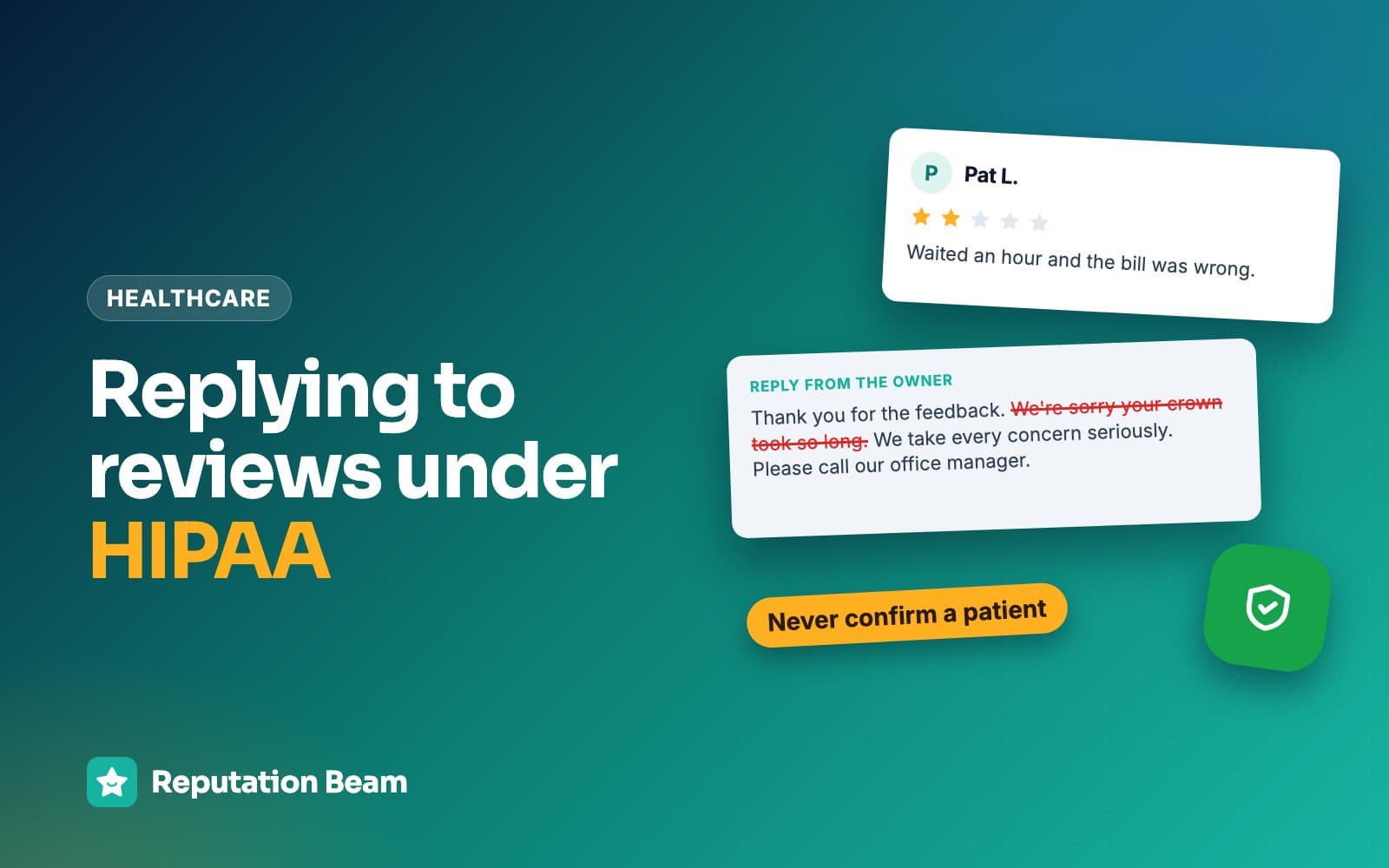
A one-star review from a patient stings, and the first urge is to set the record straight. For a dental office, a chiropractor, a physical therapist or a counseling practice, that urge is where the legal risk starts. The safest rule for HIPAA-compliant review responses is short: the reply should never confirm that the reviewer is a patient, even when the reviewer said so in the review.
This guide covers what that rule rests on, the cases HHS has settled, the phrases that give a patient away, and a reply formula that works for good and bad reviews alike. You'll get more than a dozen before-and-after rewrites across six kinds of practice, a phone script for taking it offline, a staff policy you can adapt and a checklist for AI-drafted replies. For replies outside health care, see how to respond to negative reviews.
This is general information about the HIPAA Privacy Rule as of October 2026, not legal advice. Your privacy officer or a health care lawyer should approve your standard reply, and state laws can add rules of their own.
The rule for HIPAA-compliant review responses
The safe approach is to never confirm in a reply that the reviewer is or was your patient, and never mention their condition, treatment, appointments, bills or insurance. That holds for positive reviews, negative reviews and reviews where the patient described everything themselves. Thank them, say you don't discuss care in public, and offer a phone call.
The Privacy Rule says a covered practice "may not use or disclose protected health information, except as permitted or required" by the rule (45 CFR 164.502). Outside those permissions, a disclosure needs the patient's valid written authorization (45 CFR 164.508). HHS has been blunt about review replies. Announcing a 2022 settlement, the director of its Office for Civil Rights (OCR) said that "Providers cannot disclose protected health information of their patients when responding to negative online reviews" (HHS).
Protected health information covers far more than a chart. The rule's definitions (45 CFR 160.103) include information about a person's "past, present, or future physical or mental health or condition," about "the provision of health care to an individual," and about payment for that care, when it identifies the person or could reasonably be used to. The reviewer's name sits right above your reply. Add "your crown" or "your last adjustment" and the reply ties a named person to care you gave them.
| What the reply reveals | Example phrase | Where it fits in the rule |
|---|---|---|
| That they're a patient | "We loved having you in" | Provision of care |
| A condition | "your back pain" | Health or condition |
| A treatment | "your crown", "your filler" | Provision of care |
| A visit | "your 2:00 appointment on Tuesday" | Provision of care |
| Who treated them | "Dr. Alex saw you that day" | Provision of care |
| Money | "your balance", "your insurer denied it" | Payment for care |
| A family member | "your daughter's cleaning" | Another person's care |
The patient said it first. Does that change anything?
The safe answer is no. The Privacy Rule limits what your practice discloses. It lists the permitted disclosures (164.502) and requires a valid authorization for most others, and a patient's own public post is not on the list. The HHS cases below don't say what the reviewers had written themselves, so they don't settle the point, and a lawyer can tell you how it applies to your practice. Until then, your reply adds nothing, corrects nothing and confirms nothing, even when agreeing would be friendlier and correcting would feel fair.
Review replies HHS has acted on
OCR, the part of HHS that enforces the Privacy Rule, has announced several settlements over review replies. Three of them show the pattern.
2019: Elite Dental Associates, Dallas
A patient complained that the practice replied to a review with the patient's last name and details of their health condition. OCR found it had disclosed several patients' information in replies on its Yelp page. It paid $10,000 and took on a corrective action plan with two years of monitoring.
2022: New Vision Dental, California
A complaint alleged that replies to online reviews disclosed patient names, treatment and insurance information. The practice paid $23,000 and agreed to a corrective action plan monitored for two years.
2023: Manasa Health Center, New Jersey
A psychiatric practice replied to a negative review with details of the patient's mental health diagnosis and treatment. OCR found three more patients' information in other replies. It paid $30,000 and agreed to a two-year corrective action plan.
The details are on HHS's pages for Elite Dental Associates (and its 2019 press release), New Vision Dental and Manasa Health Center. HHS now serves some of its older press releases from an archive, so a link may open there. Three things repeat across them.
- Size is no shield. OCR accepted a reduced amount from Elite in consideration of its size, financial circumstances and cooperation, but it still settled, and the 2023 announcement says OCR will act "no matter how large or small the organization."
- Missing policies were cited too. Elite had no policy on disclosures in social media, New Vision failed to implement privacy policies, and Manasa "failed to implement HIPAA Privacy policies and procedures."
- The payment came with more work. Manasa's plan required written policies, training for all staff including owners and managers, and breach notices to every patient whose information had been posted online without authorization.
The 2023 announcement was plainer still: "Simply put, this is not allowed" (HHS).
Can doctors respond to Google reviews?
Yes. Replying is allowed, and it helps: Google's help page on reviews says "helpful and positive replies to reviews can show that you're responsive to your customers," and it notifies the reviewer when you reply (Google Business Profile Help). Google's own tips also say to "never share a reviewer's private information" (Google). The same care applies on Yelp, Facebook, Healthgrades or any other site, since the Privacy Rule governs what you disclose wherever you post it. Manasa's corrective plan, for example, covered information disclosed "on any internet platform."
Who the Privacy Rule covers is set by its definition of a covered entity (45 CFR 160.103): health plans, clearinghouses, and any "health care provider who transmits any health information in electronic form in connection with" a standard transaction, such as an insurance claim. Most practices that bill insurance electronically fit. A practice that takes only cash may or may not, and that's a question for a lawyer. Each kind of practice has its own trap.
Two of the three cases
Dental
Procedure names creep in fast: crowns, implants, root canals, "your cleaning." Billing replies are the other risk, because dental reviews often complain about insurance.
Repeat visits
Chiropractic
Patients come often, so staff know them well and replies get chatty. "Glad your back is better" names a condition.
Referrals and plans of care
Physical therapy
Defending the plan ("your surgeon's protocol") discloses surgery, the body part and the referring doctor in one sentence.
Exams and eyewear
Optometry
Order delays invite replies about prescriptions and lenses. A prescription is health information about a named person.
Results and photos
Med spa
Arguing about results ("swelling is normal after filler") confirms the treatment. Never post or offer before-and-after photos in a reply.
The highest stakes
Counseling
Confirming that someone is in therapy is itself sensitive. Manasa's reply described a mental health diagnosis. Keep these replies to the bare template.
A safe reply formula for any patient review
The formula has five parts. Negative and mixed reviews get all five. A positive review needs only the thanks and the sign-off, and some practices add the privacy line to every reply so that all their replies read alike.
- 1
Thank you for taking the time to share this.
Thank them for the review
Thank them for writing, never for visiting. 'Thanks for coming in' confirms a visit.
- 2
We don't discuss anyone's care, or confirm whether someone is a patient, in a public reply.
The privacy line
It explains your silence, and because you say it to everyone, it confirms nothing about this reviewer.
- 3
We want every person who calls or walks in to feel respected and heard.
A general statement about the practice
Talk about how the practice runs, in the present tense, rather than about what happened to the reviewer.
- 4
Please call our practice manager, Dana, at (555) 010-0142.
The way to reach you
A first name and a direct line. Avoid 'we'll call you', which implies you have their number on file.
- 5
The team at Maple Street Dental
Sign-off
The practice name, or a first name and role. No clinician names linked to the reviewer.
Templates you can adapt
Template: negative or mixed review
Thank you for taking the time to share this. To protect everyone's privacy, we don't discuss anyone's care, or confirm whether someone is a patient, in a public reply. We take every concern seriously and would like the chance to talk with you directly. Please call [Practice name] at [phone] and ask for [First name], our [practice manager or privacy officer].
Template: positive review
Thank you for taking the time to write this. Kind words like these mean a great deal to our whole team, and we'll share them at our next team meeting.
Template: star rating with no comment
Thank you for your rating. If you'd like to share more, we'd be glad to hear from you at [phone].
Template: a review you can't place, or that seems to be about another business
Thank you for posting. We don't confirm whether anyone is a patient, but we take every concern seriously. If you'd like to talk about this, please call [First name] at [phone].
The positive template is deliberately plain. An enthusiastic, detailed reply to a five-star review has usually said too much, because the details are the patient's care. For more on short, warm replies to good reviews, see how to respond to positive reviews, and for blank ratings, how to respond to a Google review with no comment.
Phrases that confirm someone is a patient
Most risky replies are friendly ones. Every phrase below comes from good intentions, and every one ties the reviewer to your care.
Cut these from patient review replies
- Thanks for coming in
- Your visit
- Your treatment
- When you came in
- Your crown
- Your adjustment
- Your results
- Your therapist
- Your appointment
- Your account
- Your insurance
- Your bill
- We remember you
- Welcome back
- See you at your next visit
- We checked your records
- Our records show
- As we discussed
- Your son
- Since your surgery
Safe to use
- Thank you for sharing this
- We take every concern seriously
- We don't discuss anyone's care in public
- Please call [First name] at [phone]
- Our team works hard to
- We want everyone to feel welcome
- Kind words like these mean a lot
- We'd like to hear more
A grammar trick helps. Write about "we" in the present tense ("we aim to see everyone on time") and leave out "you" in the past tense ("when you waited"). The first describes your practice. The second describes the reviewer's visit.
How to respond to negative patient reviews: examples
Every review, practice and name below is made up. The "before" replies are the kind HHS has acted on, or close to it. The "after" replies confirm nothing.
Billing and insurance
Before
We submitted your claim twice, Ms. Ortiz. Your plan only covers one crown every five years, which we explained at your consultation.
After
Thank you for raising this. Billing questions deserve a clear answer, and we can't discuss anyone's account in a public reply. Please call Renee, our billing coordinator, at (555) 010-0177 and we'll go through it with you.
Dental office. The first names the patient, the treatment, the insurer's decision and a past consultation.
Before
Your knee rehab was out of network, and your surgeon's office gave you the wrong information.
After
We're sorry to hear about a surprise bill. We can't discuss anyone's coverage here, but our billing team can walk through any statement line by line. Please call Marcus at (555) 010-0120.
Physical therapy clinic. Blaming another office also discloses the surgery and the referral.
Wait times and scheduling
Jordan P.
GoogleSat in the waiting room for 50 minutes past my appointment time and nobody said a word. Exam was fine but I won't book a Monday morning again.
Reply from Clearview Eye Care
Thank you for taking the time to share this. We don't discuss anyone's visit in a public reply, but long, unexplained waits are something we want to fix. Our front desk should keep everyone updated when the schedule runs behind. If you'd like to talk, please call our office manager, Tess, at (555) 010-0163. The Clearview Eye Care team
Before
You missed two appointments in March, so our cancellation fee applied, as stated on the form you signed.
After
Our cancellation policy is posted at maplestreetdental.example/policies, and we're always glad to explain it. We can't discuss any account here. Please call Dana at (555) 010-0142.
Dental office. Pointing to a posted policy is fine. The first reply applies it to the reviewer's own appointments and paperwork.
A rude front desk
Before
Our front desk remembers you well, and you arrived 20 minutes late for your adjustment, so we had to reschedule.
After
Thank you for telling us. Everyone who calls or walks in should be treated with courtesy, and we'd like to hear more. Please call our office manager, Luis, at (555) 010-0195.
Chiropractic office. 'Remembers you' and 'your adjustment' both confirm the patient. Arguing about lateness puts their visit on trial in public.
A bad outcome or pain
Before
Swelling after lip filler is normal for up to two weeks, as we told you at your follow-up.
After
We take every concern about results seriously. We can't discuss anyone's care online, and our clinical director would like to speak with you. Please call Simone at (555) 010-0108.
Med spa. Explaining that a result is normal confirms the treatment and the follow-up visit.
Before
We're so sorry your extraction was painful. Dry socket can happen even when patients follow instructions.
After
Thank you for sharing this. We never want anyone to feel unheard about pain. Please call our office at (555) 010-0142 and ask for Dana, so we can talk directly.
Dental office. An apology that names the procedure and the complication is still a disclosure.
Before
Your plan of care followed your surgeon's protocol, so the same exercises each week were intentional.
After
Thank you for the feedback. We want every person to understand why their care looks the way it does, and our clinic director is glad to talk it through. Please call Marcus at (555) 010-0120.
Physical therapy clinic. The first reveals surgery, a referral and the treatment plan.
Counseling and mental health
Before
Your counselor was on medical leave, and we offered you telehealth sessions with another clinician.
After
Thank you for posting. We don't discuss whether anyone receives services from us. We want scheduling to be reliable for everyone, and our intake coordinator, Priya, would like to hear from you at (555) 010-0131.
Counseling practice. The first confirms the reviewer is in therapy and shares a staff member's medical leave. Keep these replies short.
A parent reviewing a child's visit
Before
We remember Liam! Lots of kids his age are nervous about fillings, and he did great by the end.
After
Thank you for sharing this. Helping young people feel calm and safe is something our whole team cares about. If you'd like to talk, please call Dana at (555) 010-0142.
Pediatric dental office. The parent posted, and the information is still the child's. The first names him and the treatment.
A reviewer who was never a patient
Before
We have no record of you ever being a patient here.
After
Thank you for posting. We don't confirm whether anyone is a patient, but we take every concern seriously. Please call Tess at (555) 010-0163 so we can look into it.
Optometry practice. If you say 'not a patient' to non-patients and stay silent for real patients, the silence itself confirms who is.
If the review looks fake or meant for another business, reply with the template and report it to Google. How to respond to fake reviews on Google covers the evidence that helps.
A review that names another patient
Before
The woman you mention has since been dismissed from our practice.
After
We don't discuss anyone's care, or confirm who is a patient, in a public reply. We take every concern seriously. Please call Luis at (555) 010-0195.
Chiropractic office. The review named another person in the waiting room. The first reply confirms her as a patient and adds a fact about her.
A review that names someone else and describes their health can break Google's rules. Its content policy says "Do not distribute or post personal information without consent" and counts "medical information" as personal information about others. Report it from your Business Profile: open Read reviews, select the report icon next to the review, choose a reason and send the report. Google says evaluation usually takes several days, and you can appeal once if the report is rejected (Google). How to remove a Google review explains what Google will and won't take down.
Positive reviews that name a procedure
Sam R.
GoogleI had my implants done here and I can finally eat steak again. The whole team was patient with all my questions.
Reply from Maple Street Dental
Thank you for taking the time to write this. Our team works hard to make every visit comfortable and to answer every question, and kind words like these mean a lot to all of us. The Maple Street Dental team
Two more made-up examples, from a dental office and a chiropractic office.
Before
We'll pass this on to Maria. She loved working on your cleanings this year!
After
Thank you for the kind words about our team. We'll be sure everyone sees this.
Dental office. Naming the hygienist who saw the reviewer confirms care and who gave it.
Before
So happy your sciatica is finally under control after six weeks with us!
After
Thank you for sharing this. Reviews like yours mean a great deal to our team.
Chiropractic office. A cheerful reply can disclose a condition and a length of treatment.
How to take a patient review offline without confirming anything
The public reply gives a phone number and stops. For complicated situations, Google's tips suggest asking the reviewer to contact you through a private channel (Google), and that fits HIPAA well. Let them call you. Avoid "we'll reach out" or "we've left you a voicemail," which tell readers you have their number on file.
Once you're on the phone with the patient, the rule is different. The Privacy Rule permits disclosure "to the individual" (164.502), so you can discuss their own care with them. Confirm you're speaking with the patient the way your office normally does before you open the account.
Customer
Hi, I left a review about my bill. Your reply said to call Renee.
You
This is Renee, thanks for calling. Before I pull anything up, can you confirm your date of birth and the address we have on file?
Customer
Sure, it's March 4, and 12 Elm Street.
You
Thank you. I see the statement. Let's go through each line, and I'll tell you what I can fix today.
Customer
Okay. Honestly, I just want to understand the second charge.
Two things to leave out of the call. Don't ask the patient to remove or change the review in return for a refund, a credit or anything else: Google's tips list incentives to change or remove reviews as prohibited. And don't pressure them at all. Google notes that customers can still change their review after reading your reply, so if the call goes well, that's their decision.
The "we spoke with the patient" update trap
After a good call, owners often edit the reply to show the problem was solved. That edit is an easy place to slip.
Before
Update: We spoke with Ms. Rivera and refunded her copay for the March visit. Glad we could make it right!
After
(Leave the original reply as it was.)
A made-up example from a med spa. The update names the patient, confirms a visit and discloses a payment. The safest update is none.
If the review led you to change something for everyone, you can say so in general terms in a reply to a later review, or on your website: "We've added a second person at the front desk during the morning rush." Tie it to the practice, never to the reviewer.
Using AI to draft patient review replies
AI writing tools are good at sounding warm, and a common way they do it is by echoing the review back: "We're so sorry your root canal was painful, Sam." That's the kind of disclosure HHS has acted on. A tool can also repeat the same mistake across every reply in a week, which is worse than one person slipping once.
Two rules keep AI drafts safe.
- Give the tool the review and your template, nothing else. Never paste chart notes, appointment history or billing details into it to personalize a reply. The Privacy Rule lets a covered practice share protected health information with a business associate acting on its behalf if the practice "obtains satisfactory assurance that the business associate will appropriately safeguard the information," and that assurance must be documented in a written agreement (164.502(e)). Ask your privacy officer before any tool touches patient records.
- A person checks every draft before it posts, against a short list.
Before an AI-drafted reply goes live
0 of 8 done
A staff policy for replying to patient reviews
HHS cited missing policies in all three cases above, and the rule requires them. A covered practice "must implement policies and procedures with respect to protected health information," "must train all members of its workforce" on them, and "must have and apply appropriate sanctions" against staff who don't follow them (45 CFR 164.530). The workforce includes employees, volunteers and trainees (160.103), so the front desk and the student hygienist count.
- 1
Review arrives
One named person reads it. Nobody replies from a personal account or in the moment.
- 2
Draft from the template
Start from the approved reply and change only the general practice line.
- 3
Second check
A second person checks it against the list above. If in doubt, use the plain template.
- 4
Post, then wait for the call
Post the reply, log it, and handle details only with the patient, by phone.
Template: review reply policy (have your privacy officer or lawyer review it)
[Practice name] review reply policy, version [number], effective [date]
- Only [role, such as practice manager] and [backup role] reply to online reviews, from the practice's own business accounts.
- Every reply starts from an approved template. Replies never confirm that the reviewer is or was a patient and never mention any condition, treatment, visit, date, staff member, bill, insurer or family member.
- A second trained person checks each reply before it is posted. AI tools may be used only with the review text and the template, never with patient records.
- Replies never ask a reviewer to change or remove a review, and never offer anything for doing so.
- Details are discussed only with the patient or their personal representative, privately, after confirming identity under our usual procedure.
- Edits that add details after a conversation ("update" posts) are not allowed.
- A reply that may have disclosed patient information is removed at once and reported to [privacy officer] the same day.
- All staff are trained on this policy when hired and when it changes. Breaking it leads to sanctions under our privacy policy.
If a reply already shared too much
Move fast. Google lets you edit or delete a reply from Read reviews (Google Business Profile Help), so take it down first and rewrite it from the template later.
Go back through older replies too. Replies posted years ago are still public, and New Vision's complaint dated from 2017, five years before the settlement.
Common mistakes in patient review replies
Do
- Use one approved template for every review, positive or negative
- Thank people for the review, never for the visit
- Say you don't discuss anyone's care or confirm who is a patient
- Give a first name and a direct phone number
- Have a second person check every reply, including AI drafts
- Train every staff member who might reply, and write it down
- Remove a risky reply at once and tell your privacy officer
Avoid
- Greeting the reviewer by name and then mentioning their visit
- Correcting the patient's account of their own treatment
- Thanking a happy reviewer for a named procedure
- Telling a reviewer they were never a patient
- Posting an update after you spoke with the patient
- Offering a refund or credit in exchange for changing the review
- Pasting chart notes into an AI tool to personalize a reply
The urge to defend your work is strongest when a review is unfair. Future patients read the reply, too, and a calm, private-minded answer tells them their own information would be safe with you. Asking every patient for a review the same way helps too. Google's content policy says merchants may not "selectively solicit positive reviews from customers," and asking everyone the same way matches that rule. It also means the occasional unfair review sits among many honest ones.
Where Reputation Beam fits
Reputation Beam brings your Google and Yelp reviews into one feed in the dashboard, and replies to Google reviews can be written and posted from there. Yelp reviews are read-only in the dashboard. Writing each reply, and checking it against your template and policy, is still your job.
Reputation Beam also sends review requests by text and email from the dashboard. It records each patient's permission to be texted, and its message templates use placeholders for the name, the business name and the review link, so no treatment details need to go into a request.
Keep going
If you're asking patients for reviews, how to ask customers for reviews covers wording for every channel, and texting customers for reviews explains consent and opt-outs, including why health practices need consent for review texts. Dental offices should also read how to get more Google reviews for your dental practice. For the mechanics of posting and editing a reply, see how to reply to Google reviews, and for Google's wider rules, the Google review policy.
To bring in more reviews, read how to get more patient reviews. Practice-specific plans include chiropractic marketing, physical therapy marketing, dermatology marketing, urgent care marketing, home care marketing and plastic surgery marketing.
Questions people ask
Can doctors respond to Google reviews?
Yes. Nothing stops a doctor, dentist or therapist from replying, and Google says helpful replies show you're responsive. The limit is what the reply says: a HIPAA-covered practice may not disclose a patient's health information without permission or another basis the Privacy Rule allows, and HHS has settled with practices whose replies did. Keep replies general, confirm nothing about the reviewer, and move the conversation to a phone call. This is general information, not legal advice.
Is responding to a patient review a HIPAA violation?
Replying is allowed. The risk is in what the reply discloses. HIPAA's Privacy Rule protects information that identifies a person and relates to their health, their care or payment for it, and HHS has taken action against practices that revealed names, conditions, treatment or insurance details in review replies. A reply that thanks the reviewer and invites a call, without confirming they're a patient, avoids that. Ask a lawyer about your own replies.
What if the patient already shared their health information in the review?
It doesn't change what is safe to say. The Privacy Rule limits what your practice discloses, and it doesn't list a patient's own post as a permission to confirm or add details. HHS's published cases don't say what the reviewers wrote themselves, so the safe course is to add nothing, correct nothing and confirm nothing. Repeat none of the details, even to agree, and handle the rest by phone. Ask a lawyer how this applies to you.
Can I say 'thank you for being our patient' in a review reply?
It's safer not to, because it confirms the reviewer received care from you. The same goes for 'thanks for coming in', 'see you at your next visit' and 'glad your treatment went well'. Thank the reviewer for the review itself instead: 'Thank you for taking the time to share this. Kind words like these mean a lot to our team.' It reads just as warmly and confirms nothing.
How do I respond to a negative patient review?
Thank the reviewer, say your practice doesn't discuss anyone's care or confirm who is a patient in public, say you take every concern seriously, and give a phone number with the first name of the person who will help. Don't defend the treatment, correct the facts or mention a visit. Keep it to three or four sentences, then handle the conversation privately and fix what you can.
Does HIPAA apply to veterinarians and med spas?
HIPAA protects people's health information, so a pet's records fall outside it, though your state may have its own rules for veterinary records. A med spa, counselor or other practice is a HIPAA covered entity if it is a health care provider that sends health information electronically for standard transactions such as insurance claims. If you're unsure, ask a lawyer, and write replies as if you're covered anyway.
Can I delete a review reply that shared too much?
Yes. Google lets business owners edit or delete a reply from the Read reviews screen. Do it at once, then tell your privacy officer or lawyer. HIPAA requires covered practices to reduce the harm of an improper disclosure where they can, and in one case HHS required breach notices to every patient whose information had been posted online. Whether you must notify anyone is a question for your lawyer.
Was this guide helpful?
Get the free review request checklist and new guides
Twenty checks to run before you ask customers for reviews, as a one-page PDF. After that, a short email when new guides go up, at most once a week.