Key takeaways
- Reviews come first for a mover, because customers hand a stranger everything they own and many have heard a horror story. They read your reviews before they ask for a quote.
- Ask every customer after delivery, never after pickup. If a damage claim is open, the request waits until it closes and then goes out in the same words. Never tie a claim payment to a review.
- Most bad moving reviews are about a final bill above the quote, or damage and how the claim went. A calm reply gives a name and a number, posts no amounts and shows the next customer how you handle problems.
- Explain how you price before anyone asks, say whether your own crew does the work, and put your slower months into realtor and property manager relationships. Run ads only when you have trucks open.
In this guide
- Moving company marketing: where to start
- When to ask moving customers for a review
- What the crew lead says after the last box
- Moving company review templates: text and email
- Replying to moving reviews about price disputes and damage
- Your Google Business Profile as a mover
- Earn trust before the quote: pages that answer the fear
- How to get more moving customers: referrals and repeat work
- Paid ads for a small moving company
- Common moving company marketing mistakes
- Where Reputation Beam fits
- Keep going
Someone choosing a mover is about to let strangers carry everything they own onto a truck, and many of them have heard a story about a bill that doubled or a couch that never arrived. Moving company marketing starts there. Before a customer asks you for a quote, they look for proof that you're real, that your price holds and that you deal with problems when something breaks.
This guide begins with the proof that takes the least money: reviews, including when to ask on a long-distance job, what the crew lead says, texts to copy and how to reply about price disputes and damage. Then it covers your Google profile, pages that explain your pricing, realtor and property manager referrals, and whether ads pay off in a slow month. It's written for an owner with a few trucks, who may still be on a crew on Saturdays.
Moving company marketing: where to start
Start with reviews, then your Google Business Profile, then pages that explain your prices and your claims process. After that, build referrals from agents and property managers, and bring in past customers. Paid ads come last. A small moving company in a category people distrust usually gains more from visible proof than from buying more quote requests.
Google says "More reviews and positive ratings can help your business's local ranking" (Google Business Profile Help). Here's a rule-of-thumb order for a small mover.
| Order | Moving company marketing idea | Effort | What it does for a mover |
|---|---|---|---|
| 1 | Ask for a review after every delivery | A sentence and a text | Shows shoppers real moves by real crews |
| 2 | Fix your Google profile | An afternoon | Puts you in map results for your towns |
| 3 | A "how we price" page and service pages | A weekend | Answers the fear behind the quote |
| 4 | Agents, property managers, leasing offices | A few visits a month | Brings work that doesn't depend on ads |
| 5 | A card in the last box, a yearly note | A small print order | Reaches past customers and their friends |
| 6 | Paid ads | Money and tracking | Fills trucks in months you have room |
When to ask moving customers for a review
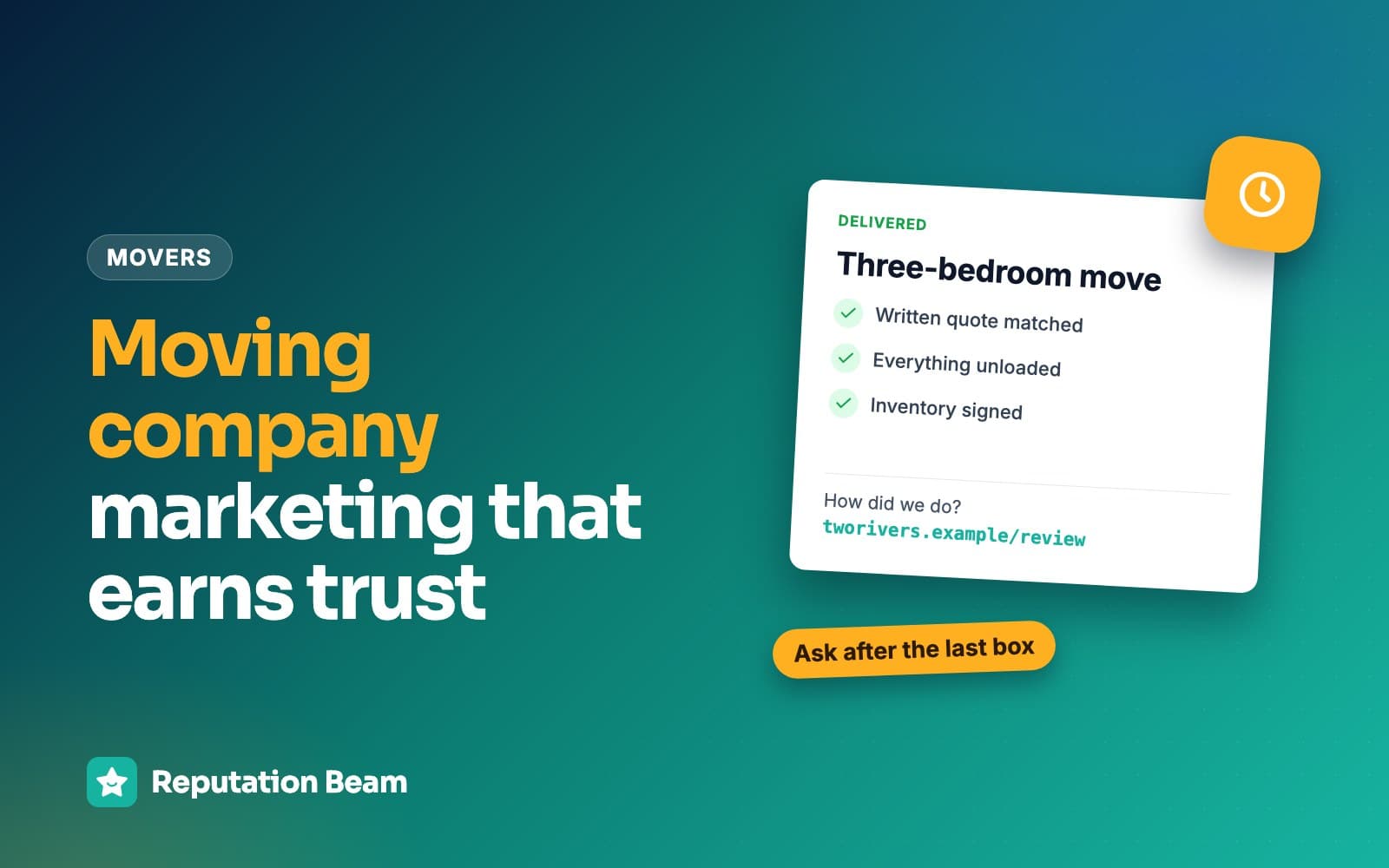
Ask moving customers after delivery, once the last item is inside and the paperwork is signed, and send the link that evening or the next morning. They're worn out on the day. On a long-distance move, the job ends at delivery, however friendly the crew was at pickup, so the request waits until then.
Set the rule by type of move, write it down and use it for everyone, including the customer who haggled over the stairs.
| Type of move | Spoken ask | Text with the link |
|---|---|---|
| Local apartment, same day | At the final walkthrough | That evening |
| Local house, one or two days | At the final walkthrough | Next morning |
| Long-distance | When the delivery crew finishes | Next morning, after delivery |
| Move with storage in between | At final delivery | Next morning, after final delivery |
| Packing only | When the packers finish | Same day |
| Load or unload help, no truck | When the job is done | Same day |
| Move arranged by a relative | To the person who booked | To the person who booked |
| Open damage claim | Skip the spoken ask | After the claim closes, same words |
| Estimate with no move | No ask | No text |
The claim row needs care. A customer with a broken dresser still gets asked, on the day the claim closes, in the same words as everyone else, whether they liked the result or not. The wait exists so a request doesn't land in the middle of an open dispute. Skipping them altogether would mean asking only people you expect to be happy, and the FTC's guide on soliciting reviews says "Don't ask for reviews only from customers you think will leave positive ones." Keep a note of each held request so none is forgotten.
- 1
Booking
Get permission to text on the estimate or booking form.
- 2
Delivery
Last item in, walkthrough done, crew lead says the one sentence.
- 3
Next morning
The office sends the text, with one reminder a few days later.
- 4
Claim open?
The text is held until the claim closes, then goes out unchanged.
What the crew lead says after the last box
The crew lead asks, in one sentence, after the walkthrough and the paperwork, and says a text is coming from the office. Keep it apart from the tip. A customer holding cash for the crew shouldn't feel that a review is part of that moment, so finish the paperwork, thank them and ask on your way to the door.
Google's policy lists "merchants requesting that staff solicit a certain number of reviews" and asking for "specific content" among things it prohibits, and says merchants "should not require or pressure users to leave ratings or write reviews while on the premises." So no crew bonus per review, no "mention Marco by name," and nobody standing in a customer's new kitchen holding out a phone. Here are made-up versions.
You
That's the last of it. Bed frames are together, and we've checked every room with you. Here's your copy.
Customer
I can't believe it's done. Thank you.
You
Thanks for having us. We ask every customer for an honest Google review. We're a small company and it helps people decide who to trust. The office will text you the link tomorrow, if you'd like to.
Customer
This corner of the desk wasn't like that when it left my house.
You
I'm sorry. Let's take a photo and write it on the paperwork now, so it's on record. Dana handles claims at the office, and here's her number. She'll call you tomorrow.
Moving company review templates: text and email
Send a text the morning after delivery with your company's name, a mention of the move and one link. Text only customers who agreed to it, and email the others. A card in the last box catches anyone left.
The FCC's rule (47 CFR 64.1200) requires prior express written consent for texts that include an advertisement or count as telemarketing, and it treats a "stop" reply as a reasonable way to revoke consent. This is general information, not legal advice. Add a line to your booking form or estimate, as the texting rules guide explains.
Consent line for a moving estimate or booking form
I agree that [Business name] may text me at the number above about this move and to ask for a review afterward. Message and data rates may apply. Reply STOP to opt out. Agreeing is not a condition of service.
Text: morning after a local move
Good morning [First name], it's [Business name]. Hope the first night in the new place went well. Would you take a minute to leave an honest Google review? [review link] Reply STOP to opt out.
Text: after long-distance delivery
Hi [First name], it's [Business name], who moved you to [city]. Now that your things have arrived, would you share an honest Google review? [review link] Reply STOP to opt out.
Text: after a claim closes
Hi [First name], it's [Business name]. Your claim is now closed. We ask every customer for an honest Google review, and we'd value yours, whatever you'd like to say: [review link] Reply STOP to opt out.
Card for the last box
You're in. Thanks for moving with [Business name]. If something's missing or damaged, call [Name] at [phone number] first. We'd rather hear from you.
If you have a minute, an honest Google review helps a small moving company like ours. Scan the code or visit [review link].
Email: after a move
- To
- [Customer email]
- Subject
- How did your move to [city] go?
Hi [First name],
Thanks for trusting [Business name] with your move. If anything's missing or damaged, call [Name] at [phone number] and we'll start on it.
If you have a few minutes, would you leave an honest review on Google? It helps other people in [town] decide who to hire.
Leave a review: [review link]
Thanks, [Your name]
[Business name], [street address, city, state, ZIP]. Don't want emails like this? [unsubscribe link]
Get your Google review link and print a Google review QR code on the card. Moving shoppers often read Yelp too, but Yelp's content guidelines say "Businesses should never ask customers to write reviews," so keep Yelp off the card and the texts.
Replying to moving reviews about price disputes and damage
Reply to moving reviews within a few days, in three or four sentences. Say you're sorry about the problem, explain your general practice and give a name and number. Don't post amounts, inventory lists or claim details, and don't argue over whether a scratch was already there. The next shopper reads your reply to judge how you'd treat them.
Here's a rule-of-thumb list of complaints a mover can expect.
| Complaint | What's usually behind it | What the reply does |
|---|---|---|
| "Final bill was way over the quote" | Extra items, stairs, hourly job ran long | Explains what can change a price, offers to go through it |
| "They broke my dresser" | Real damage, or a dispute about when | Apologizes, names the claims contact |
| "Claim has gone nowhere" | Slow paperwork, no updates | Gives the owner's direct line and a promise of a call |
| "My stuff arrived days late" | Long-distance delivery window | Explains delivery windows in general, offers a call |
| "Crew was rude" or "Crew asked for a tip" | Tired crew, poor handoff | Says it isn't your standard, asks for a call |
| "Scratched the walls and floors" | Tight stairwell, no floor protection | Apologizes, names the claims contact |
Here are two made-up replies.
Paul N. (example)
GoogleQuoted me one price on the phone and the final bill was almost double. They kept adding charges for stairs and boxes. Felt like a scam.
Reply from Two Bridges Moving (example)
Thank you for telling us. A final price can change when a move differs from what was quoted, and our crews should explain any change before doing the work. If that didn't happen, I want to know. Please call me at [phone number] and we'll go through the paperwork together. Aisha, owner
Renee C. (example)
GoogleThey scratched my dining table and it's been three weeks since I filed a claim with no answer.
Reply from Two Bridges Moving (example)
I'm sorry about the table and the wait. Three weeks without an update isn't how we want to treat anyone. I'm calling Dana about it today. Please call me directly at [phone number] so I can make sure you get an answer.
Handle each claim by your normal process, whatever the review says. Google prohibits "requests for revision or removal of a review or rating in exchange for an incentive," so never offer more on a claim if the review comes down, and don't write that into a settlement. The FTC says a business can't use an "unfounded or groundless legal threat" or intimidation to stop or remove a review (FTC questions and answers). How to respond to negative reviews goes further.
Your Google Business Profile as a mover
Set up your profile with your real company name, the area you actually serve, a moving company category and each service listed. If customers don't come to your yard or office, hide the address. If they do, for storage or for boxes, keep it visible. Fill in the hours someone really answers quote calls.
Google's guidelines say "you should hide your business address from customers" if you're a service-area business, and that your area "shouldn't extend farther than about 2 hours of driving time from where your business is based," though larger areas may suit some businesses. So list the region you work from, even if you take long-distance jobs, and describe those jobs on your website. Google also says "including unnecessary information in your business name isn't permitted, and could result in the suspension of your Business Profile."
Before
Two Bridges Cheap Local Long Distance Movers Near Me
After
Two Bridges Moving
Use the name on your truck and your paperwork. Keywords in the name risk suspension.
Before
A rented mailbox in the next city, to appear local there
After
One profile based where you really operate
Google says a virtual office isn't eligible unless it's staffed during business hours.
Google's services page explains Edit services. List what you really do: local moving, long-distance moving, packing, loading and unloading, storage, office moves, piano moving. Keep prices and phone numbers out of custom service names, as Google asks.
Earn trust before the quote: pages that answer the fear
Your website's first job is to answer the fear behind the quote request: will the price hold, whose crew shows up and what happens if something breaks? Write a page that explains how you price, then one page per service. A moving customer comparing three companies tends to trust the one that explains the most before anyone calls.
On the pricing page, say whether local moves are hourly or flat, what the minimum is, how travel time works, what you charge for stairs, long carries, heavy items and packing materials, and what happens if the customer has more than they told you. A low phone number with no explanation attracts the customers most likely to write the "almost double" review. Offer a walkthrough, in person or by video, before you quote a large home. A rule of thumb: the quote can only be as good as the inventory it's based on, so the walkthrough protects both sides.
- 1
Our own crews and our own trucks do every move. We don't sell your job to another company.
Who does the work
Only say this if it's true. If you're a broker or use partners, say so plainly.
- 2
We walk through your home, in person or by video, and send a written estimate listing what we saw.
How we quote
A written inventory settles later arguments.
- 3
Items not on the list, stairs we didn't know about, or a blocked truck. We tell you before we do the work.
What can change it
This heads off the most common complaint.
- 4
Call Dana at [phone number]. Here's how to file a claim and what coverage you have.
If something breaks
A worried shopper looks for this before anything goes wrong.
| Page | What that customer is worried about | What the page should say |
|---|---|---|
| Local moves | Hourly clock running up | Minimums, travel time, what speeds a job along |
| Long-distance | Where their things are, and when | Delivery windows, who drives, how you update them |
| Packing | Who's liable for a box they packed | What you pack, what you don't, how coverage differs |
| Apartment moves | Elevators, parking, building rules | Elevator bookings, certificates of insurance, stairs |
| Downsizing and senior moves | Pace, sorting, family involved | Time for decisions, who you coordinate with |
Interstate moves: read the federal rules yourself
If you move household goods across state lines, read the Federal Motor Carrier Safety Administration's Protect Your Move pages for yourself, starting with What if there are problems?. This guide doesn't restate those rules, so check the current version before you describe any of it in an ad or on your site.
Rules for moves within one state differ by state, so ask your state's regulator. This is general information, not legal advice. If you do hold a federal number or a state license, show it near your quote form, since a wary shopper looks for it.
How to get more moving customers: referrals and repeat work
Get more moving customers from the people who see moves coming: real estate agents, property managers, apartment leasing offices, senior living communities and storage facilities. Then keep your name in front of past customers, because they move again and hear about friends moving.
A real estate agent's reputation is on the line when a client asks "who should I hire?" So bring proof: your Google profile, your certificate of insurance and a promise to answer their client's call the same day. Do one move well for an agent and ask to be on their list. If you work with agents a lot, how realtors get reviews shows what they're dealing with on their side. Property management marketing describes who you'd be talking to on the rental side.
Slow months
Visit leasing offices and agents. Ask what went wrong with their last mover. Update your pages.
Before busy season
Hire and train crews. Print cards and box stickers. Tell past customers early dates fill up.
Busy season
Turn ads down or off when booked. Answer the phone and keep asking after every delivery.
End of month
Leases turn over, so expect a rush if you serve apartments. Keep dates honest and offer mid-month slots.
You may reward someone for a referral. You can't do it for a review: Google prohibits offering "payment, discounts, free goods and/or services" for one. Neighbors also ask each other who they used, so read how to get recommendations on Nextdoor.
Paid ads for a small moving company
Paid ads make sense for a moving company when you have open trucks and someone to answer the phone. Try Local Services Ads first, in the area around your yard, then search ads for specific moves. Turn them down in busy months.
Google's Local Services Ads page lists "Moving services" as a US category and says you pay "only when a customer gets in touch from your ad." Its screening page explains the checks by category, so read the entry for your category and allow time.
A rule of thumb: set a monthly test budget you could lose without missing payroll, and ask every caller how they found you. Count booked moves instead of calls, because a mover's phone rings with people who only want the lowest number. If bookings don't cover the spend after a full month, change the service or the area before adding more.
Common moving company marketing mistakes
Wasted moving company marketing usually skips the trust work or pays for leads you can't price honestly. These are the mistakes that cost the most.
- Asking at pickup on a long-distance job, before anything has arrived.
- Skipping customers who had a damage claim, instead of asking once it closes.
- Asking while the customer has cash for the crew in hand.
- Offering a better settlement if a review comes down.
- Replying to a price complaint with the customer's bill and inventory.
- A low phone quote on a whole house, with no walkthrough.
- Calling yourself a local company with a rented address, or hiding that another company does the move.
Moving company marketing setup
0 of 9 done
Where Reputation Beam fits
Reputation Beam sends review requests by text and email from one dashboard. If you run jobs in Housecall Pro or Jobber, visits can come in from there and a request follows each one unless you turn that off on the connection. Since a packing day or pickup can be its own visit, and this guide says to wait for delivery and for open claims, check how your moves are set up, or turn it off and send requests from the dashboard. Templates use placeholders for the customer's name, your business name and the review link, and follow-up reminders can go to people who haven't responded. Each request has its own link. Imported customers aren't texted until their permission is recorded. Google and Yelp reviews arrive in one feed, and you can reply to Google reviews from there.
Keep going
Google's review policy has the full rules on asking, and the best time to ask for a review covers timing for other businesses. For showing what customers wrote on your pricing page, see using customer reviews in marketing. Another trade that works in customers' homes has its own guide in plumbing marketing ideas.
Questions people ask
What is the best way to market a small moving company?
For a small moving company, start with Google reviews and a complete Business Profile, because customers worry about who they're handing their belongings to and they check first. Next, write a page explaining how you price a move and what can change the final bill. Then build relationships with real estate agents, property managers and apartment leasing offices. Add paid ads last, in the months when you have trucks and crews open.
When should a moving company ask for a review?
A moving company should ask after delivery, once the last item is in and the paperwork is done. Send the text that evening or the next morning, since a customer who just moved is tired. On a long-distance move, wait for delivery instead of pickup. If a damage claim is open, wait until it closes and send the same message. Ask every customer on the same schedule.
How do you reply to a review saying a mover charged more than the quote?
Thank the reviewer, explain in general what can change a price, such as extra items, stairs or a longer job than the walkthrough showed, and give a name and number to go through the paperwork. Don't post the amounts and don't call the customer dishonest. If your crew should have explained a change before the work and didn't, say you want to hear about it, and fix any billing error separately from the review.
How should a moving company handle a damage complaint in a review?
Say you're sorry about the damage, tell the reviewer how to reach the person who handles claims, and offer to look at it directly. Don't argue about whether the item was already scratched, and don't post claim details or amounts. Handle the claim by your normal process whether or not the review stays up. Google prohibits asking someone to change or remove a review in exchange for an incentive, so never link the two.
How can a moving company get more customers?
A small moving company can get more customers by earning steady reviews, publishing honest pricing explanations, answering quote requests quickly and building relationships with real estate agents, property managers and leasing offices. Past customers move again and tell friends who are moving, so leave a card in the last box and send a short note once a year. Lead sites and ads can fill gaps, but count booked moves before paying for more.
Was this guide helpful?
Get the free review request checklist and new guides
Twenty checks to run before you ask customers for reviews, as a one-page PDF. After that, a short email when new guides go up, at most once a week.