Key takeaways
- Start with reviews. Ask after the job is actually finished: the final follow-up on a bed bug or rodent job, the second visit on a quarterly plan, and always with a date so customers who cancel are asked too.
- Keep the pest out of every text, email and public reply. A customer with bed bugs or roaches doesn't want the word on a lock screen or under their name on Google.
- Then fix your Google Business Profile as a service-area business, build one page per pest, and turn one-off jobs into plans with honest renewal terms.
- Be careful with "safe," "green" and "government approved." EPA says agencies don't endorse service companies, and the FTC expects evidence for safety claims.
In this guide
- Pest control marketing: what to do first
- When to ask for a pest control review
- Who says what: the tech at the door and the office
- Discretion: bed bugs, roaches and the lock screen
- Pest control review templates: text and email
- How to answer pest control complaints in reviews
- Your Google Business Profile as a pest control company
- Pest control service pages: one page per pest
- Seasonal demand: plan around your pests
- Referrals and repeat customers: plans, property managers and agents
- Paid ads for a small pest control company
- Common pest control marketing mistakes
- Where Reputation Beam fits
- Keep going
A homeowner who finds something crawling in the kitchen tends to search on a phone, read what the neighbors wrote and call that day. This guide to pest control marketing is for the owner of one small local company. It starts with reviews, because they do the most work: when to ask, which words the tech uses at the door, texts that don't announce bed bugs on a lock screen, and replies to "they came back."
After that comes a realistic plan for the rest: your Google Business Profile, a page per pest, plans and referrals, and paid ads where they fit. For the same review method in other businesses, see how to ask customers for reviews.
Pest control marketing: what to do first
Start with reviews, then your Google Business Profile, then one web page per pest, then plans and referrals, and paid ads last. A pest control company's customers usually search during a problem, so a recent, believable set of reviews and a complete profile do more than a logo or a social media calendar.
Google says reviews affect how you show in local search: "More reviews and positive ratings can help your business's local ranking" (Google Business Profile Help). Long lists of pest control marketing ideas rarely say what comes first, so here is a rule-of-thumb order for a small company.
Week 1
Set the review rule by job type and write one text. Fix your Google profile as a service-area business.
Weeks 2 to 4
Send the request after every finished job. Reply to every review. Add a consent line to your service agreement.
Month 2
Write pages for your three most-called pests.
Month 3
Offer plans to one-off customers. Introduce yourself to two property managers and two real estate agents.
Before your busy season
Try paid ads for one service in the towns where you can arrive quickly.
When to ask for a pest control review
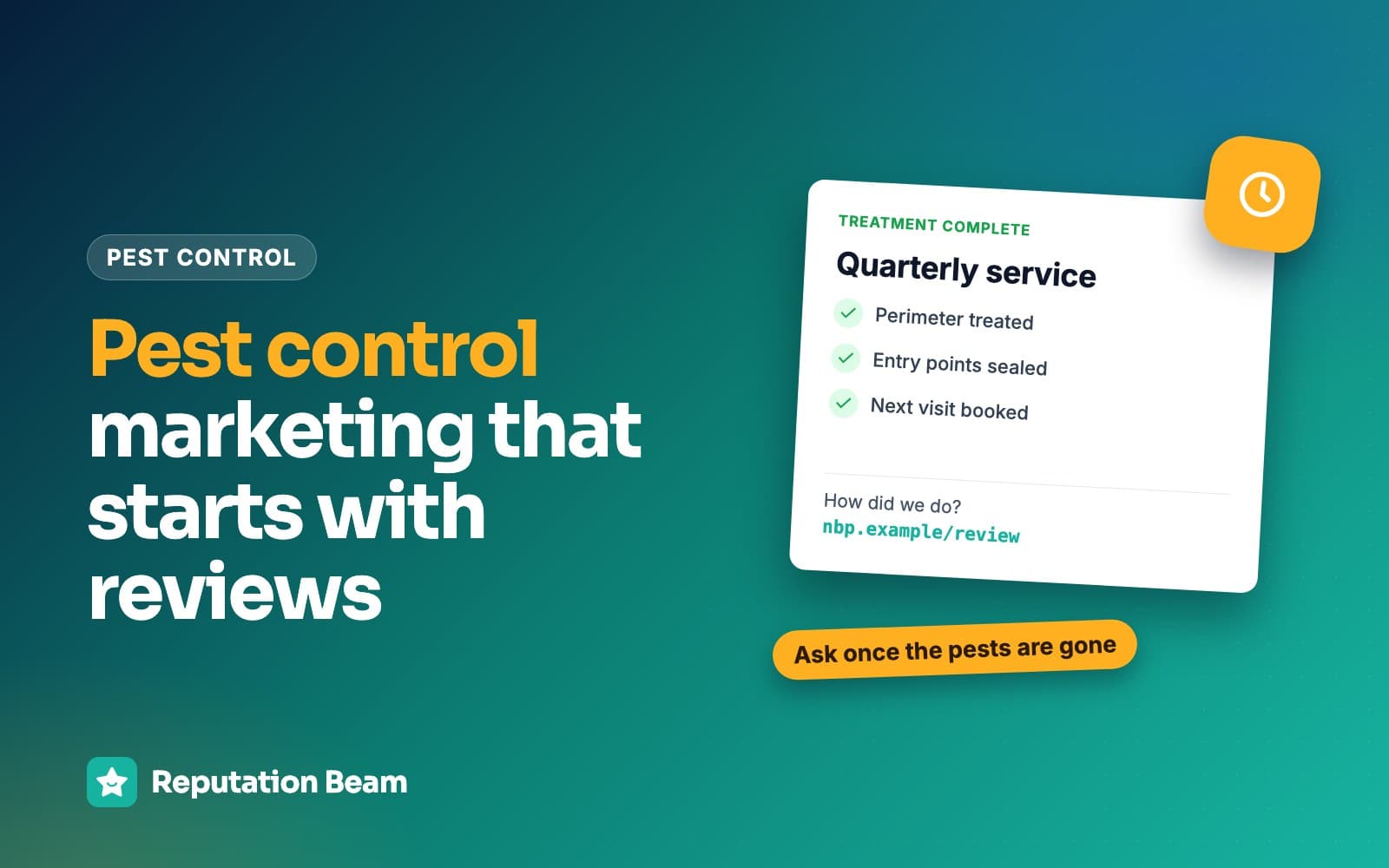
Ask when the customer can tell the treatment worked. That's rarely the end of the first visit. A wasp nest removal can be asked about the same day, but bed bugs, rodents and roaches usually need a follow-up, and a request sent before it invites a review of an unfinished job.
EPA says that treating bed bugs "is complex and can take weeks to months" and warns that "retreatment may be needed" (EPA). So a text on treatment day asks about something nobody can judge yet. Here is a rule of thumb by job type. Adjust it to your treatments, write it down, and apply it to every customer.
| Job | When to ask | Why |
|---|---|---|
| Wasp or hornet nest | Same day | The result is visible |
| One-time ant or spider treatment | About a week later | Activity needs time to drop |
| Roaches | After the follow-up visit | Usually more than one visit |
| Bed bugs | After the final inspection | Ask when you've signed it off |
| Rodents | After exclusion and the last trap check | Traps and sealing take visits |
| Termite treatment | After the work and paperwork are finished | Results take years, so review the service |
| Quarterly plan | After the second service, then once a year at most | The first visit is mostly the start-up |
| Mosquito season program | After the second treatment | One spray tells them little |
Why the rule needs a date
Follow-up rules have a catch. A customer who cancels before the second visit, often because they're unhappy, never reaches the follow-up. If only the customers who stayed get asked, you're choosing the happy ones without meaning to, and Google's policy says merchants may not "selectively solicit positive reviews from customers."
Add a date: "after the final visit, or four weeks after the first visit, whichever comes first." Four weeks is an example, so set a date that suits your treatments. A cancellation gets the same request on that date.
Plans and property managers
Don't ask quarterly customers after every service. Pick the second service and limit it to once a year. For apartments and rentals, the review request goes to whoever hired you. A tenant in unit 4B didn't choose you and may not want a text about pests, so the property manager gets the request, once a year at most.
Who says what: the tech at the door and the office
The tech who finished the job asks in one sentence and says a text is coming. The office sends the text the same day. Use the same words at every house, including the one where the customer grumbled, and keep your voice down at an apartment door. These exchanges are made up.
You
That's the last check. All your traps are empty and the gaps by the garage are sealed. Call us if you hear anything in the walls.
Customer
Will do. It's been quiet for two weeks.
You
Good to hear. We ask every customer for an honest Google review. The office will text you the link today, if you'd like to leave one.
Bed bug and roach customers need a quieter version. Stay inside, say less, and let the text do the rest.
You
We're finished for today, and that was the final inspection. You'll get a text from the office in a bit. It only says thanks for having us out, and it has a link for a review if you ever want to leave one.
Customer
Does it say what you were here for? I really don't want anyone knowing.
You
It doesn't. And if you write a review, you don't have to mention it either. It's completely up to you.
Discretion: bed bugs, roaches and the lock screen
Treat every customer as if they don't want the pest named, because you can't tell who does. Say "your service" in every text and email, leave the pest out of public replies, and don't photograph a house with its number showing. Many customers feel embarrassed about bed bugs or roaches, whatever caused them.
Discretion also belongs in the booking call. Ask whether they'd like the tech to park down the street or come in an unmarked vehicle, if you can offer that.
Before
Thanks for choosing us for your bed bug treatment! Leave us a review.
After
Thanks for having us out. Would you leave an honest review on Google? [review link]
A lock screen shows the first line to anyone nearby.
Before
We just treated your neighbor at number 12 for roaches. Want an inspection?
After
We're working in your neighborhood this week. Here's our card if you ever need us.
It gives away a customer's problem. EPA also warns homeowners about companies that show up unexpectedly citing a neighbor's insects.
Before
Glad we could get rid of those bed bugs for you, Dana!
After
Thank you for taking the time to write this. We'll pass it along to the team.
A public reply under someone's name. Don't add a detail they left out.
Pest control review templates: text and email
Send a short text the day the job is finished, with your business name, thanks for having you out, an honest-review ask and one link. Leave the pest out, and text only customers who agreed to it. The service agreement they already sign is the natural place to get that agreement.
The FCC's rule (47 CFR 64.1200) requires prior express written consent for texts that include an advertisement or count as telemarketing, and it treats a reply of "stop" as a reasonable way to revoke consent. Texting customers for reviews covers what that means for review texts. This is general information, not legal advice.
Consent line for a pest control service agreement
I agree that [Business name] may text me at the number above about my service visits and to ask for a review afterward. Message and data rates may apply. Reply STOP to opt out. Agreeing is not a condition of service.
Text: any finished job, with no pest named
Hi [First name], it's [Business name]. Thanks for having us out. Would you take a minute to leave an honest review on Google? [review link] Reply STOP to opt out.
Text: after the final follow-up visit
Hi [First name], [Business name] here. That wraps up your service. Thanks for your patience through the follow-up visits. Would you share an honest review on Google? [review link] Reply STOP to opt out.
Text: quarterly plan customer, once a year
Hi [First name], it's [Business name]. Thanks for having us on your plan this year. If you have a minute, we'd be grateful for an honest Google review: [review link] Reply STOP to opt out.
Text: one reminder, a few days later
Hi [First name], [Business name] again. If you still have a minute for a Google review, here's the link: [review link] Either way, thanks. Reply STOP to opt out.
Email: termite job, or a customer who prefers email
- To
- [Customer email]
- Subject
- Would you review [Business name] on Google?
Hi [First name],
Thank you for choosing [Business name]. Your paperwork is attached for your records, and you can call us at [phone number] with any questions.
If you have a minute, would you leave an honest review on Google? It helps other homeowners in [town] decide who to call.
Leave a review: [review link]
Thanks, [Your name]
[Business name], [street address, city, state, ZIP]. Don't want emails like this? [unsubscribe link]
Yelp is different. Its content guidelines say: "Businesses should never ask customers to write reviews." So keep Yelp links out of your requests. Review request email templates covers the email rules, and a review QR code can go on your leave-behind service ticket.
How to answer pest control complaints in reviews
Thank the reviewer, state your re-service policy in general terms, and give a name and number. Keep the pest and the address out of it unless the reviewer named them, and don't debate chemistry in public. Then fix what you can, with no connection to the review: Google prohibits offering anything for changing or removing one.
| Complaint | What's usually behind it | What the reply does |
|---|---|---|
| "They came back" | Life cycle, entry points, or a real miss | States the re-service policy and offers a visit |
| "Still seeing bugs after the spray" | Expectations about timing | Explains in general what to expect, invites a call |
| "Couldn't cancel my plan" | A renewal term they didn't notice | Names who handles cancellations today |
| "Tech missed my window" | Routing on a busy day | Apologizes and asks them to call |
| "Sprayed near my pet or garden" | A worry about safety | Takes it seriously, offers the product information, makes no safety claim |
| "Pushy salesman at my door" | Door-to-door sales | Says plainly what you'll do about it |
Here are three made-up examples.
Marcus T. (example)
GooglePaid for treatment and a month later we're seeing them in the kitchen again. Waste of money.
Reply from Ridgeline Pest Control (example)
Thank you for letting us know. If something comes back within the period your service covers, we come back at no extra charge, and some problems do take more than one visit. Please call Ana at [phone number] so we can look at your account and set up a time.
Lena R. (example)
GoogleTried to cancel my quarterly plan and got the runaround. They kept saying I signed a contract and charged me again.
Reply from Ridgeline Pest Control (example)
I'm sorry about that. Canceling should be simple, and it sounds like it wasn't. I'd like to look into this myself. Please call me at [phone number] and I'll go through your agreement and the charge with you today. Tom, owner
Priya S. (example)
GoogleThe tech sprayed near where my dog sleeps and didn't warn me. I'm worried.
Reply from Ridgeline Pest Control (example)
Thank you for telling us, and I understand the worry. Our techs should go over where they're treating and what to do before pets come back in. Please call me at [phone number]. I'll go through what was used and share the product information with you. Tom, owner
Don't threaten a reviewer: the FTC says a business can't use an "unfounded or groundless legal threat" or intimidation to stop or remove a review (FTC questions and answers). How to respond to negative reviews has more.
Your Google Business Profile as a pest control company
Set your profile up as a service-area business: hide your address if customers don't come to it, list the towns you actually reach, pick pest control as your category, and add each service. Most small pest control companies run from a home or a small shop, and Google's rules for that setup are specific.
Google's guidelines say "you should hide your business address from customers" if you're a service-area business. They also say your service area "shouldn't extend farther than about 2 hours of driving time from where your business is based," though larger areas may suit some businesses. A rented mailbox doesn't work as a shortcut: a virtual office "isn't eligible for a Business Profile" unless it's staffed during business hours.
Do
- Use your real business name on the profile
- Add each treatment through Edit services: termites, bed bugs, rodents, mosquitoes
- Post photos of your trucks, your team and sealed entry points
- Keep your hours current through the season
- Answer new reviews within a few days
Avoid
- Adding 'Best Cheap Termite Exterminator' to your business name
- Claiming a virtual office in the next town to look local
- Posting photos that show a customer's house number or an infested room
- Listing towns your trucks never reach
- Letting spring pass with the profile unchanged since last year
Google says "including unnecessary information in your business name isn't permitted, and could result in the suspension of your Business Profile." Its services page explains Edit services, and it asks you to keep prices and phone numbers out of custom service names.
Pest control service pages: one page per pest
Build one page for each pest you treat. Each page answers what the frightened homeowner wants to know: what am I looking at, how many visits will it take, what do I have to do, how long until it stops, and what happens if it comes back. A single "our services" page can't do that.
- 1
We treat bed bugs in homes and apartments in [towns]. Most jobs take more than one visit.
Plain opening
Sets the expectation that prevents the 'still seeing them' review.
- 2
An inspection, a prep list, the treatment, and a follow-up inspection.
What happens
EPA says bed bug treatment can take weeks to months, so say so.
- 3
Your prep list, in plain steps, printable.
What you do
A lot of failed jobs start with a confused customer.
- 4
Say whether you'll park discreetly or use an unmarked vehicle, if you can.
Discretion
Bed bug customers often want to know this before they call.
- 5
Your re-service policy in one short paragraph.
If they come back
Answers the question they're afraid to ask.
- 6
Your state license number and your insurance.
Credentials
EPA tells homeowners to check licenses, so show yours.
| Page | What that customer most needs to read |
|---|---|
| Termites | Inspection, how long your guarantee runs, letters for home sales |
| Bed bugs | Number of visits, prep list, discretion |
| Rodents | Sealing entry points, trap checks, how you handle droppings |
| Roaches | Why it can take more than one visit, what helps between visits |
| Mosquitoes | Season length, how often you treat, what it covers |
| Wasps and hornets | How fast you can come, what to do until you arrive |
EPA says "it is customary for termite control work to be guaranteed from one to five years" and adds that a guarantee "is only as reliable as the company that offers it" (EPA's tips for selecting a pest control service). So state your terms on the termite page in plain words. That page also says each company "must have at least one certified, licensed commercial pesticide applicator in the proper service category," and that homeowners can check licenses with state agriculture departments, so print your number where they can find it.
Before
Completely safe for kids and pets. Green, EPA-approved pest control.
After
We'll tell you what we use and where, give you the product information, and tell you when kids and pets can go back in.
The second version is checkable, and it's what a worried parent wants to know anyway.
Seasonal demand: plan around your pests
Demand in pest control moves with the weather and the bug, and it varies by region. Write your own calendar from last year's jobs: a month-by-month count of calls per pest shows exactly when each page, email and ad should go out.
A made-up calendar for a company in a four-season climate might look like this. Yours will differ.
Before the rush
Late winter
Update your termite and ant pages, tidy the profile, and email past customers about spring plans.
Termites, ants
Spring
The busy stretch for many companies. Answer the phone, and ask for a review on every finished job.
Mosquitoes, wasps
Summer
Run same-day wasp ads only if you can really come the same day. Keep review requests going through the rush.
Rodents
Fall
Email about sealing up before the cold. Offer plans to customers who only called once this year.
Keep asking through the busy weeks. A company that stops asking in July has a thin stretch of reviews when the rush ends, which is just when the next customer is reading them.
Referrals and repeat customers: plans, property managers and agents
The steadiest work for a small pest control company tends to come from customers who stay on a plan and from people who refer many homes. Offer a plan to every one-off customer once, plainly and with easy cancellation. Then build a short list of property managers, real estate agents and home inspectors who need a reliable name.
Plan cancellation complaints are among the reviews you least want, so write renewal terms a customer can repeat back to you. EPA warns homeowners about companies that "try to pressure you into immediately signing a contract" or "sell services door-to-door or target the elderly or infirm persons who live alone," so door-to-door sales can cost a small company more trust than the signups are worth. Leave a door hanger with your license number instead, and never mention a neighbor's problem.
Worth your time
- Property managers: a few buildings can mean steady, repeat work
- Real estate agents and home inspectors: termite inspections around home sales
- Restaurants and small landlords, with a plain recurring agreement
- Other trades you already know, such as lawn care companies and roofers
Be careful with
- Door-to-door sales crews
- Lead sites where the same job goes to several companies
- Long plan terms that bring cancellation complaints
- Group coupon deals that attract one-time customers
Written consent is the safe basis for marketing texts, so use email for offers. Here's one to adapt.
Email: offering a plan to a one-time customer before their season
- To
- [Customer email]
- Subject
- [Season] is coming: would a plan make sense for you?
Hi [First name],
We came out to your home last [month]. This is the time of year we get the most calls about it in [town].
If you'd like us to keep an eye on it, our [quarterly] plan covers [what it covers] and you can cancel at any time by calling or replying to this email. If you'd rather call only when you need us, that's fine as well.
[Your name], [Business name], [phone number]
[Business name], [street address, city, state, ZIP]. Don't want emails like this? [unsubscribe link]
You can reward a referral with a credit on the next service. Keep it completely separate from reviews: Google prohibits offering "payment, discounts, free goods and/or services" for one. Nextdoor can also bring neighbor recommendations, as how to get recommendations on Nextdoor explains. For reusing what customers wrote, see using customer reviews in marketing, and ask before you quote a bed bug customer by name.
Paid ads for a small pest control company
Paid ads suit a pest control company with open slots, a phone that gets answered and a job you can profit on from one visit. Start with Google's Local Services Ads for one service area, or search ads for one pest in your closest towns. Pause when your schedule is full, and skip anything you can't measure in booked jobs.
Google's Local Services Ads page lists "Pest control services" as a US category and says you "only pay when a customer gets in touch from your ad." Its screening page lists background checks, license and insurance requirements for pest control, some of them "only required for select users," so check your own account.
A rule of thumb for a small company: set a test budget you could lose without worrying, run it for a full month in your season, and count booked jobs with a "how did you hear about us?" question on each call. Budgets vary too much by town for a general figure to be useful.
Common pest control marketing mistakes
- Asking for a review on the first bed bug visit, then getting a one-star review the next week.
- Naming the pest in a text, or thanking someone by name for removing their roaches.
- Writing "guaranteed" without saying what it covers and for how long.
- Advertising "completely safe" or "EPA approved."
- Writing a renewal term nobody can explain.
Pest control marketing setup
0 of 10 done
Where Reputation Beam fits
Reputation Beam sends review requests by text and email from one dashboard. If you run your jobs in Housecall Pro or Jobber, visits can come in from there and a request can follow each one, with follow-up reminders for people who haven't responded. Templates use placeholders for the customer's name, your business name and the review link, which makes it easy to leave the pest out of the message. Each request has its own link. Each customer's permission to be texted is recorded, and imported customers aren't texted until it is. Google and Yelp reviews arrive in one feed, and you can reply to Google reviews from there.
Keep going
The best time to ask for a review covers timing for more kinds of business. Google's review policy has the full rules, and how many Google reviews you need helps you set a sensible aim. The same plan adapts to neighboring trades in plumbing marketing ideas, landscaping marketing ideas and cleaning business marketing.
Questions people ask
What is the best marketing for a small pest control company?
For a small pest control company, start with Google reviews and a complete Google Business Profile, because homeowners with a pest problem often search and call the same day. Next, build one web page per pest you treat, then turn one-off jobs into recurring plans and ask property managers and real estate agents for referrals. Add paid ads only for the services and towns where you have open slots.
When should a pest control company ask for a review?
A pest control company should ask once the customer can judge the result. That means the final follow-up visit on a bed bug or rodent job, a week or so after a one-time treatment, and the second service on a quarterly plan. Set a date as a backstop, so a customer who cancels before the follow-up gets the same request. This is a rule of thumb, so adjust it to your treatments.
How do I ask for a review from a customer who had bed bugs?
Ask the same way you ask everyone, and leave the pest out of it. Text "thanks for having us out" with your review link, never "thanks for choosing us for your bed bug treatment," because texts show on lock screens. Don't ask in a hallway where neighbors can hear. What the customer writes is up to them, and many will keep it general. Never suggest wording.
How should a pest control company reply to a review saying the bugs came back?
Reply in three or four sentences: thank the reviewer, say what your re-service policy is in general terms, and give a name and number to call. Don't argue about the treatment in public, don't repeat the pest if the reviewer was discreet, and don't offer a free visit in exchange for changing the review, which Google prohibits. Then send someone out if the policy covers it, whether or not they change a word.
Can I advertise pest control as safe for kids and pets?
Be careful. EPA's rule for pesticide labels lists "safe," "harmless" and "nontoxic to humans and pets" as examples of false or misleading statements, and the FTC says health and safety claims generally need competent and reliable scientific evidence. Those rules don't settle every service company's wording, and state rules differ. Safer wording describes what you do: what you use, where you apply it and what you ask the family to do. Ask a lawyer about your ads.
Are Google Local Services Ads worth it for pest control?
They can suit a small pest control company with open slots and someone to answer the phone, because Google lists pest control services as a category and you pay for leads instead of clicks. Lead prices vary, and business screening may apply, with Google saying some checks are required only for select users. Try one service area in your busy season, track booked jobs and pause when your schedule is full.
Was this guide helpful?
Get the free review request checklist and new guides
Twenty checks to run before you ask customers for reviews, as a one-page PDF. After that, a short email when new guides go up, at most once a week.