Key takeaways
- Google says local results are mainly based on relevance, distance and prominence, and that more reviews and positive ratings can help your local ranking. That is the whole official answer.
- Google says replying to reviews shows you value feedback and helps you stand out. It has never called replies, or keywords in reviews, a ranking factor.
- Asking customers to mention a keyword, your town or a staff member breaks Google's rule against requesting specific content in a review.
- The plan that fits the rules: ask every customer the same way after every job, reply with something specific, and keep your Business Profile complete and accurate.
In this guide
- Do Google reviews help SEO? The short answer
- How Google ranks local businesses: relevance, distance and prominence
- What Google says, what experts estimate and what vendors claim
- Do reviews help Google ranking? Each review signal, one at a time
- Does responding to Google reviews help SEO?
- Do keywords in Google reviews help? Why you shouldn't ask for them
- Map pack vs regular search results: where reviews count
- Distance and service-area businesses
- A review plan that follows Google's rules
- Common mistakes and myths about reviews and SEO
- Where Reputation Beam fits
- Keep going
Do Google reviews help SEO? Google answers that itself, in one sentence on its help page about local ranking. Most of what you'll read beyond that sentence is an educated guess, and some of it is advice that breaks Google's own review policy.
This guide separates what Google says, with links, from what local search consultants estimate. Then it takes the questions owners ask one at a time (review count, star rating, replies, keywords, distance) and ends with a plan you can run every week without putting your Business Profile at risk.
If you haven't started asking yet, how to ask customers for reviews has the scripts and templates.
Do Google reviews help SEO? The short answer
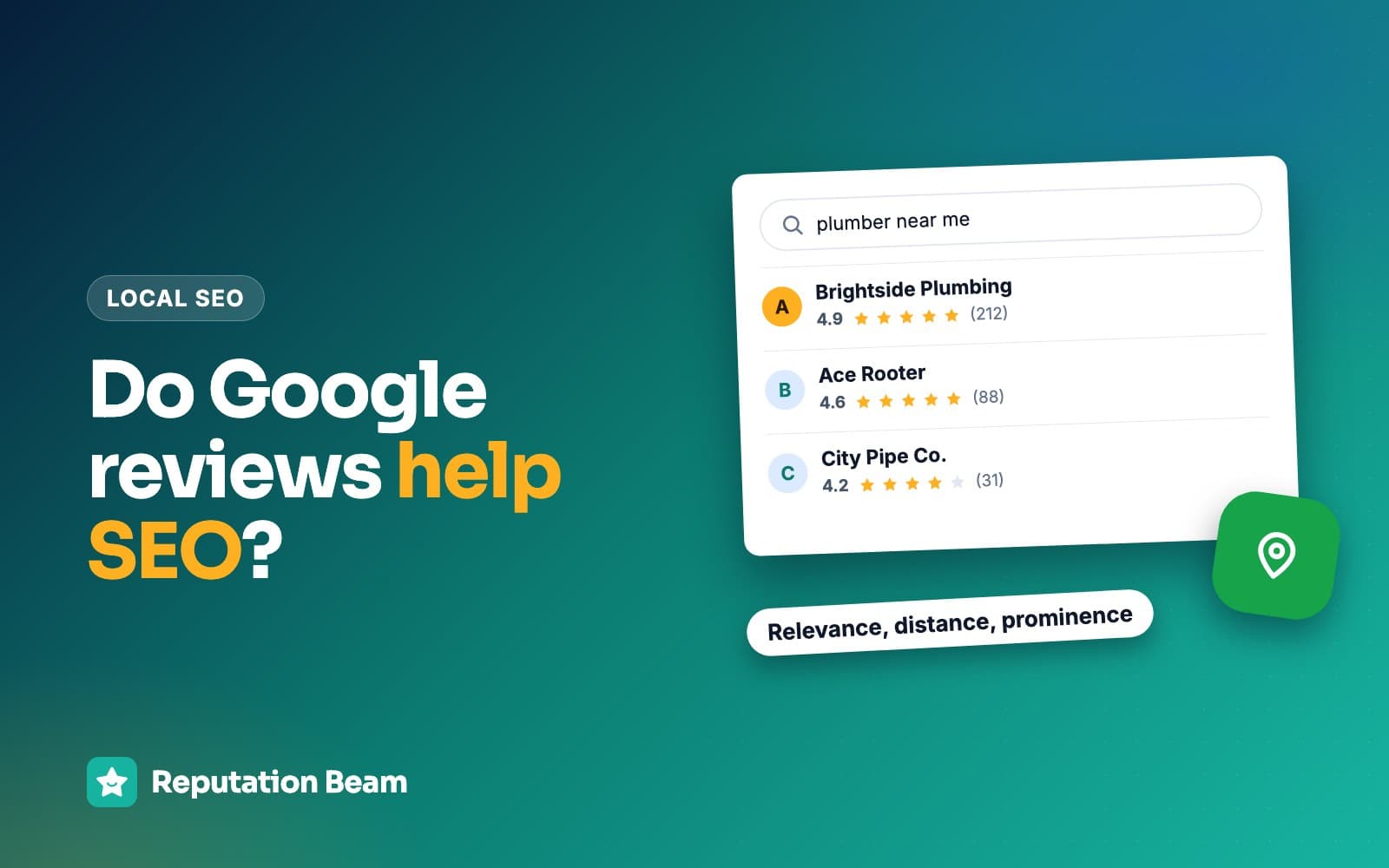
Yes, for the map results. Google's help page says local results are mainly based on relevance, distance and prominence, and that "more reviews and positive ratings can help your business's local ranking." Google does not say reviews move your website up the regular web results, and it does not call replies or keywords in reviews a ranking factor.
That sentence comes from Google's page Tips to improve your local ranking on Google. It's the most direct thing Google says about reviews and ranking, and it's carefully worded: reviews "can help." The same page says "There's no way to request or pay for a better local ranking on Google," and that Google keeps the details of its ranking system confidential "to make the ranking system as fair as possible for everyone."
3
Things Google names for local ranking: relevance, distance and prominence
No way
To pay or ask Google for a better local ranking, in Google's words
2 weeks
How long Google says a new review can take to show in your review score
So when a page tells you exactly how much reviews weigh in Google's formula, it's guessing. Some guesses come from people who test this for a living, and they're covered below.
How Google ranks local businesses: relevance, distance and prominence
Google's page explains three things. Its summary sentence says local results are "mainly based on relevance, distance, and popularity," then explains the third one under the heading Prominence. Same idea, two names.
Your profile
Relevance
"How well a Business Profile matches what someone is searching for." Google's advice: provide complete, detailed business information. Reviews aren't mentioned under this heading.
Out of your hands
Distance
"How far each business is from the customer who's searching." If the searcher doesn't share a location, Google uses what it knows about it. Reviews can't change this.
Where reviews count
Prominence
"How well-known a business is," based partly on how many websites link to you and "how many reviews you have." This is where Google puts reviews.
Picture someone searching "emergency plumber" at 10 p.m. (an example). Relevance narrows the field to plumbing businesses. Distance favors the ones near the searcher. Among those, prominence helps decide the order, and reviews are part of prominence.
So reviews help you compete with businesses you're already close to and relevant for. They won't make a plumber in one suburb show up first for someone across the metro, or make a bakery show up for "wedding cakes" if nothing on its profile mentions wedding cakes.
What Google says, what experts estimate and what vendors claim
Pages about reviews and SEO mix three kinds of source without saying which is which.
| Source | What it is | How far to trust it |
|---|---|---|
| Google's help pages | Google describing its own system | The only official word, kept general on purpose |
| Expert ranking reports | Consultants scoring factors from their experience and tests | Informed opinion, not Google's formula |
| Vendor blog posts | Companies selling review or SEO tools | Check every number for a linked source |
Google reviews ranking factors, as experts rank them
The best-known expert report is Whitespark's Local Search Ranking Factors. For the 2026 edition, 47 local search consultants completed a survey scoring 187 factors. The report is upfront about its limits: "None of the experts have special access to the internal workings of Google's local search algorithm." Read the ranks as informed opinion.
| Review factor (the report's wording) | Rank for map results | Rank for local web results |
|---|---|---|
| High numerical Google ratings (4 to 5) | 6 of 187 | 81 |
| Quantity of native Google reviews with text | 9 | 104 |
| Recency of reviews | 11 | 105 |
| Sustained influx of reviews over time (rather than bursts) | 14 | 111 |
| Keywords in native Google reviews | 36 | 107 |
| Presence of owner responses to most reviews | 122 | 156 |
| Keywords in owner responses to reviews | 182 | 185 |
The top two factors on the map list are your primary Business Profile category and the distance between searcher and business. The report also says that for 2026, "the biggest changes we're seeing are an increased importance of review signals and behavioural signals."
In short, the experts score star rating, review count and a steady flow of reviews highly for map results, much lower for regular web results, and put owner responses near the bottom.
What vendor posts claim
Review software companies write many of the pages that rank for this question, including this one. Some common claims have no source behind them: that Google hides businesses under four stars, or that you must reply to a set share of reviews to rank. Google's ranking page and its page on how review scores are calculated mention no rating cutoff and no reply quota. One well-ranked page even suggests offering rewards for reviews, which Google's policy prohibits. If a number comes with no link to its source, don't plan around it.
Do reviews help Google ranking? Each review signal, one at a time
For each signal: what Google says, what the experts think and what to do.
Review count
Google says prominence is based partly on "how many reviews you have." The experts put the number of Google reviews with text ninth for map results. Along with rating, it's one of only two review signals Google names outright.
Google doesn't publish a target number, because it depends on your competition: a dentist in a busy town faces more of it than a roofer in a rural county. How many Google reviews you need shows how to size it up. Either way, the count only grows when you ask.
Star rating
Google says "positive ratings can help." Its page on review scores says the score is "the average of all ratings published on Google for that place or business," and that after a new review "it may take up to 2 weeks to get an updated review score." The experts put high ratings sixth for map results.
Because the score is a plain average, the more reviews you have, the less any one rating moves it. Here is the arithmetic with made-up numbers:
- A cafe with 10 reviews averaging 4.8 gets a 1-star review. Its average drops to about 4.5.
- A cafe with 40 reviews averaging 4.8 gets the same 1-star review. Its average drops to about 4.7.
Don't chase a perfect score. Google's tips for getting more reviews say "A mix of positive and negative feedback often feels more trustworthy."
Recency and a steady pace
Google's ranking page doesn't mention how recent your reviews are. The experts rank it highly: recency of reviews 11th for map results, and a "sustained influx of reviews over time (rather than bursts)" 14th.
Google's review policy does say something about patterns. Its Maps user contributed content policy lists "Content exhibiting unusual volumes or patterns of review contributions that are indicative of efforts to manipulate a place's rating" as rating manipulation that gets removed. Asking every customer after every job produces the opposite: a steady trickle of real reviews.
Review text
The experts put keywords in review text 36th for map results. Google hasn't said whether the words in reviews affect ranking, and the next section explains why you shouldn't ask for keywords either way.
Review text can still describe your work without anyone asking. Google's page on reviews for service businesses says customers "may be asked to identify what tasks your business performed," and "That information will be used in the review." Those tasks come from your service list, your website or a standard list for your type of business, so keep the services list on your Business Profile complete.
Does responding to Google reviews help SEO?
Google hasn't said it does. "Respond to reviews" appears among the tips on its local ranking page, but the reason it gives is about customers: replying "shows that you value their feedback," and "Positive reviews and helpful replies can help your business stand out." Google doesn't call replies a ranking factor.
The experts rank replies low too. Whitespark's report puts "presence of owner responses to most reviews" 122nd of 187 for map results, and "keywords in owner responses" 182nd. Anyone who says replies will lift your ranking is claiming more than Google or the experts do.
Reply anyway, for the readers. Google's page on managing customer reviews says the reviewer "is notified when you reply" and can "still change their review after reading your reply," and everyone comparing you with the next business sees it too.
Google's tips say what a good reply looks like: "Instead of sending the same 'thank you' to everyone, focus on reviews where you can share a helpful update or answer a question," and "Be conversational, not promotional." That rules out the keyword-stuffed reply.
Before
Thanks for choosing Desert Peak, the best AC repair in Mesa! For AC repair Mesa, HVAC service Mesa and emergency AC repair Mesa, call Desert Peak Heating and Air today!
After
Thank you, Marisol. A dead AC in that heat is miserable, and we're glad we got it running the same day. If it gives you any trouble this summer, call the office and we'll come back out.
Two replies to the same 5-star review of a same-day AC repair (example). The first is written for a search engine and reads like an ad. Google's tips ask for short, conversational replies.
Here is Google's "answer a question" tip in practice.
Jo R.
GoogleLove my color. It took longer than I expected, though. Do you have evening appointments?
Reply from Fern and Fox Salon (example)
Thank you, Jo. Color does run long, and we should have told you that when you booked. We're open until 8 on Thursdays.
For more on what to write, how to reply to Google reviews covers the basics, how to respond to positive reviews has replies for the good ones, and how to respond to negative reviews has worked examples for the ones that sting.
Do keywords in Google reviews help? Why you shouldn't ask for them
The experts think keywords in reviews may help a little. Google hasn't said. Either way, asking customers to put specific words in a review breaks Google's policy, so whether it helps doesn't change what you should do.
Google's Maps user contributed content policy says: "When soliciting reviews, merchants should not require or pressure users to leave ratings or write reviews while on the premises, nor should they request that specific content be included." Among its examples is "Merchants requesting that staff solicit reviews that include specific content, including content that identifies a staff member." What Google does allow is asking for reviews of a genuine experience "without offering incentives to do so or attempting to influence the rating or the contents of the review."
Requests that ask for specific content
- Mention our town in your review
- Use the words 'emergency plumber'
- Say which stylist you saw
- Tell people we're licensed and insured
- Mention our prices
- Copy this sample review
- Say we're the best in [town]
Each of these has a clean rewrite. The businesses are made up.
Before
If you leave us a review, could you mention 'AC repair in Mesa'? It really helps our SEO.
After
Thanks for having us out today. Would you take a minute to leave an honest review on Google? [review link]
An HVAC company. Asking for a phrase is requesting specific content, whatever the reason.
Before
Please mention Dr. Alvarez by name in your review!
After
Thank you for visiting [Practice name]. If you have a moment, we'd appreciate an honest review on Google: [review link]
A dental office. Google's policy names content that identifies a staff member as specific content.
Before
Here's a sample review you can paste: 'Fast, friendly roofers, fair price, highly recommend!'
After
Would you share how the roof replacement went, in your own words? [review link]
A roofer. Prewritten text is specific content, and a pasted review may not reflect the customer's own experience.
When a customer asks what to write, the answer is theirs to decide.
Customer
Sure, I'll leave a review. Want me to say you're in Riverside and that you did the brakes?
You
Write whatever you'd tell a friend about the visit. An honest review is all we're after.
Customer
Easy enough. Text me the link?
You
It'll come from our shop number in a few minutes. Thanks for bringing the car in.
Map pack vs regular search results: where reviews count
Google's ranking page is about "local results on Google Maps and Search": the map with a short list of businesses that appears for searches like "dentist near me", and the results inside Google Maps. It says nothing about reviews affecting the regular list of websites below the map, and the experts rank review factors far lower there.
| Where people see you | What Google says about reviews |
|---|---|
| Map results in Search and Google Maps | "More reviews and positive ratings can help your business's local ranking" |
| Your Business Profile | Reviews "show next to your Business Profile in Maps and Search" |
| Your website in regular web results | Nothing on its local ranking page |
| Star ratings under your website's own listing | Not available for a business's reviews of itself |
The last row needs explaining. Google's review snippet guidelines say that when a business controls the reviews about itself, its pages using LocalBusiness or Organization structured data are not eligible for the star review feature, including reviews shown "through an embedded third-party widget (for example, Google Business reviews or Facebook reviews widget)."
So a reviews widget on your homepage won't put stars under your website in search results. It can still help a visitor decide whether to call you, and Google's tips page says reviews "can help your business stand out and give potential customers helpful info." How to add Google reviews to your website and using customer reviews in marketing cover that side.
Distance and service-area businesses
Distance is the factor reviews can't touch. Google defines it as "how far each business is from the customer who's searching," and says that if a customer doesn't share where they are, "Google uses what it knows about their location." The experts put distance between searcher and business second of 187 for map results.
That matters most for businesses that go to the customer, such as plumbers, house cleaners, mobile groomers and mobile mechanics. Google's page on service areas sets the rules:
- If you don't serve customers at your business address, remove the address from your Business Profile.
- You can set up to 20 service areas, by city, postal code or another type of area, and you can't set a radius.
- Google says the boundaries of your overall area "shouldn't be more than about 2 hours of driving time from where your business is based."
- "Service-area businesses can only have one profile for the whole area that they serve."
A long list of towns tells customers where you work. It doesn't move your business closer to them, and reviews don't either.
A review plan that follows Google's rules
This plan uses only what Google says helps and what its policy allows. It works for a dentist, a salon or a roofer.
- 1
Ask every customer
The same words, after every job, so reviews arrive at a steady pace.
- 2
Reply with something specific
Answer what the reviewer said. Skip the copy-paste thank-you and the keywords.
- 3
Keep the profile complete
Verified, accurate hours, the right category, a full services list, current photos.
- 4
Check once a month
Read what customers mention, fix what keeps coming up, update the profile.
Ask every customer the same way
Google's policy says merchants may not "selectively solicit positive reviews from customers" or offer incentives "in exchange for posting any review." So the ask goes to everyone, in the same words, with nothing in return. A standard request after every invoice or checkout takes the choice out of anyone's hands.
Ask for Google reviews only. Yelp's content guidelines say "Businesses should never ask customers to write reviews." Let people know you're on Yelp without asking them to review you there.
The request itself can be two sentences. This text works for almost any business, and review request email templates has the email versions.
Text: review request with no keywords, any business
Hi [First name], it's [Your name] from [Business name]. Thanks for coming in today. Would you take a minute to leave an honest review on Google? [review link] Reply STOP to opt out.
Text only customers who agreed to receive texts from you; the rules for texting customers explain consent and opt-outs. To get the direct link that opens your review form, see how to find your Google review link. For timing by type of business, read the best time to ask for a review, and for the rest of the method, how to get more Google reviews.
Reply on a schedule
Pick a day or two each week to read new reviews and reply. Here is one request from start to finish at a dog groomer (example).
At pickup
Ask in person whether they'd leave an honest review on Google, and say a link is coming by text.
Same day
Send the text with your direct review link. Same words as every other customer.
When the review posts
Reply within a few days, with a detail from their visit. Leave out anything private.
Up to 2 weeks later
Google says an updated review score can take up to 2 weeks to appear after a new review.
Keep your Business Profile complete
Google's ranking page lists what it wants: verify your business, keep information up to date, and include your full address if customers visit you, your hours (including special hours), your category, details such as parking or Wi-Fi, and photos and videos. Most of this feeds relevance, the factor you control most.
Reviews and SEO: quick reference
0 of 8 done
Common mistakes and myths about reviews and SEO
Most mistakes come from chasing a ranking signal and forgetting the rules.
Do
- Ask every customer, after every job, in the same words
- Send one direct link to your Google review form
- Reply with a detail from the visit
- Keep your services list and hours accurate
- Let customers write whatever they want
Avoid
- Ask customers to mention keywords, your town or a staff member
- Offer a discount, a freebie or a prize entry for reviews
- Ask only the customers who seemed happy
- Stuff keywords into your business name or your replies
- Buy reviews or trade them with other business owners
Reviews from staff or family are removed as a conflict of interest, which Google's policy says "may include current or former employment" and familial relationships (can employees leave Google reviews has the details). Trading reviews with an owner who was never your customer is content "not based on a real experience," which Google removes as fake engagement. Incentives are out for any review, positive or negative, as can you offer incentives for Google reviews explains, and the FTC's fake review rule covers fake and bought reviews. The full list is in the Google review policy guide.
One more myth: that paying Google or a vendor improves your map ranking. Google says there's no way to pay for a better local ranking. Software can save you time, and the reviews still have to come from customers.
Where Reputation Beam fits
Reputation Beam doesn't change how Google ranks you, and no tool can promise that. It makes the plan above easier to keep up. You send requests by text or email from the dashboard, using templates with placeholders for the customer's name, your business name and the review link, so every customer gets the same ask. Each request carries its own link that expires after 72 hours. Customers can be added one at a time or imported from a CSV file, each customer's permission to be texted is recorded, and the default text ends with "Reply STOP to opt out." If you book through Square, a request can go out after an appointment. Your Google and Yelp reviews arrive in one feed, and you can reply to Google reviews from there.
Keep going
If you're starting from zero, how to get Google reviews for a new business covers the first few weeks. When a review doesn't appear after a customer says they posted it, Google reviews not showing up lists the usual reasons. And for the words to use when you ask, in person, by text or by email, go back to how to ask customers for reviews. Beyond Google, business listing sites that matter for a local business covers which other listings to claim and keep consistent.
Questions people ask
Does responding to Google reviews help SEO?
Google lists replying among the tips on its local ranking page, and the reason it gives is that replies show customers you value their feedback and can help your business stand out. It doesn't call replies a ranking factor, and in Whitespark's 2026 expert report owner responses rank far below review count, rating and recency. Reply for the people reading.
Do keywords in Google reviews help ranking?
Google hasn't said. The consultants in Whitespark's 2026 report rank keywords in review text well below review count, rating and recency. Either way, don't ask for them: Google's policy says businesses should not request that specific content be included in a review, which covers a service, your town or a staff member's name.
How many Google reviews do I need to rank higher?
Google doesn't publish a number. It says more reviews and positive ratings can help your local ranking, alongside relevance and distance, so enough depends on the nearby businesses competing for the same searches. Search for your service from your area, note the review counts that show up, and aim for a steady flow from real customers.
Do Google reviews help my website rank in regular search results?
Google ties reviews to local results in Maps and Search, the map with a short list of businesses. It says nothing about reviews moving your website up the regular web results. Embedding your Google reviews on your site won't earn star ratings in search either: Google's rules make a business's reviews of itself ineligible for review stars.
Does one bad review hurt my Google ranking?
Google hasn't said that a single review moves your ranking. Your review score is the average of all ratings published on Google, so one low rating pulls it down a little, and less when you have more reviews. Google's tips say a mix of positive and negative feedback often feels more trustworthy.
Can I pay Google to rank higher on Google Maps?
No. Google's help page says there's no way to request or pay for a better local ranking on Google. Ads, such as Local Services ads, are a separate paid placement Google offers to some kinds of business. The unpaid map results depend on relevance, distance and prominence, and reviews are part of prominence.
Do Yelp or Facebook reviews help my Google ranking?
Google doesn't say. Its help pages say a Business Profile may show reviews from other local review sites, gathered automatically from the web, and Whitespark's expert report counts third-party reviews among review signals. Put your effort into Google reviews: Yelp's guidelines say businesses should never ask customers to write reviews.
Was this guide helpful?
Get the free review request checklist and new guides
Twenty checks to run before you ask customers for reviews, as a one-page PDF. After that, a short email when new guides go up, at most once a week.